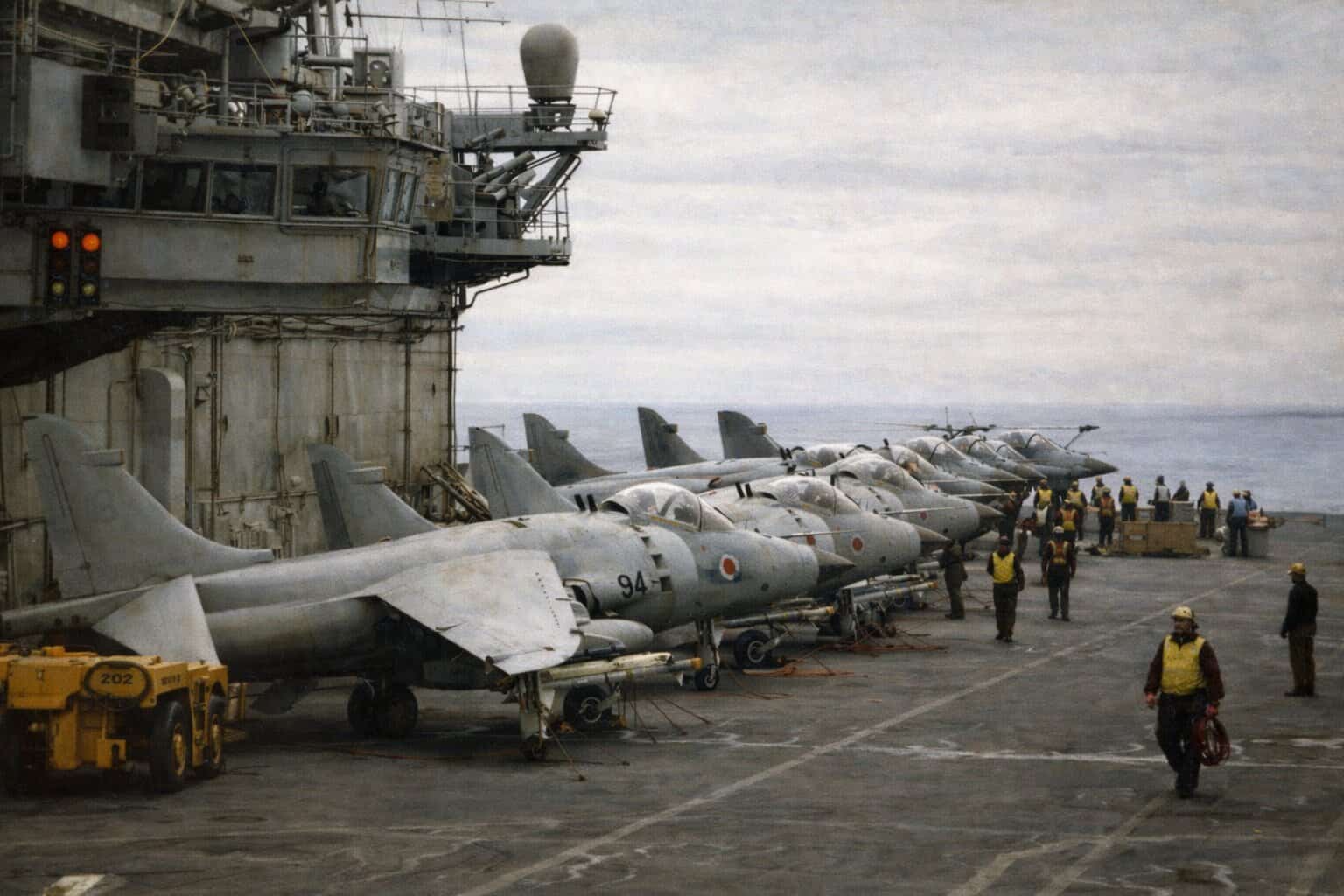
On 28 April 1982, Buenos Aires was warned that Britain was about to establish a no-fly area around the Falkland Islands. This was an important step in the unfolding South Atlantic campaign of Operation Corporate. Before the major clashes of the war had fully developed, the political and military boundaries of the conflict were being defined, and the declaration of an exclusion regime formed part of that process. For the RAF and the wider British armed forces, it signalled that the campaign was moving from mobilisation and transit towards active operational enforcement.
Drawing a line in the South Atlantic
An exclusion zone is not simply a technical notice. It is a strategic declaration. By announcing that aircraft entering a defined area would be liable to attack, Britain was asserting control, shaping expectations, and signalling resolve to both Argentina and the international community. In practical terms, it was intended to constrain Argentine activity over and around the islands. In political terms, it made clear that the United Kingdom was prepared to back its position with force.
For air power, such a warning matters because control of the sky is rarely achieved by combat alone. It also depends on law, signalling, deterrence and the clear communication of intent. The British government was not merely describing a possible future battlefield. It was declaring the conditions under which that battlefield would now operate. RAF planners and crews preparing to support the campaign had to understand that wider framework, because operational action would be judged against it.
The RAF dimension
Although naval and joint operations dominate popular memory of the Falklands War, the RAF was deeply involved from the outset in the enormous task of projecting British power across vast distances. The warning issued on 28 April belongs to the RAF story, even before individual strikes are considered. It sat within a campaign shaped by long-range planning and tanker support stretching across the Atlantic. The declaration of an exclusion zone was therefore a political measure with obvious operational consequences: it established the framework within which British air and naval action would be taken.
Significance
The warning to Buenos Aires on 28 April matters because it clarified the character of the coming conflict before some of its best-known actions had yet occurred. Britain was signalling that the airspace around the Falklands would no longer be neutral or undefined. That, in turn, affected planning, expectations, and the risks faced by any Argentine aircraft operating in the area.
For RAF history, the date belongs to the early architecture of the Falklands campaign. It shows that the air war was shaped by declarations, rules and strategic signalling as well as by bombing and interception. The exclusion zone helped define the operational environment in which later RAF actions, including the Black Buck raids, would be understood and undertaken.