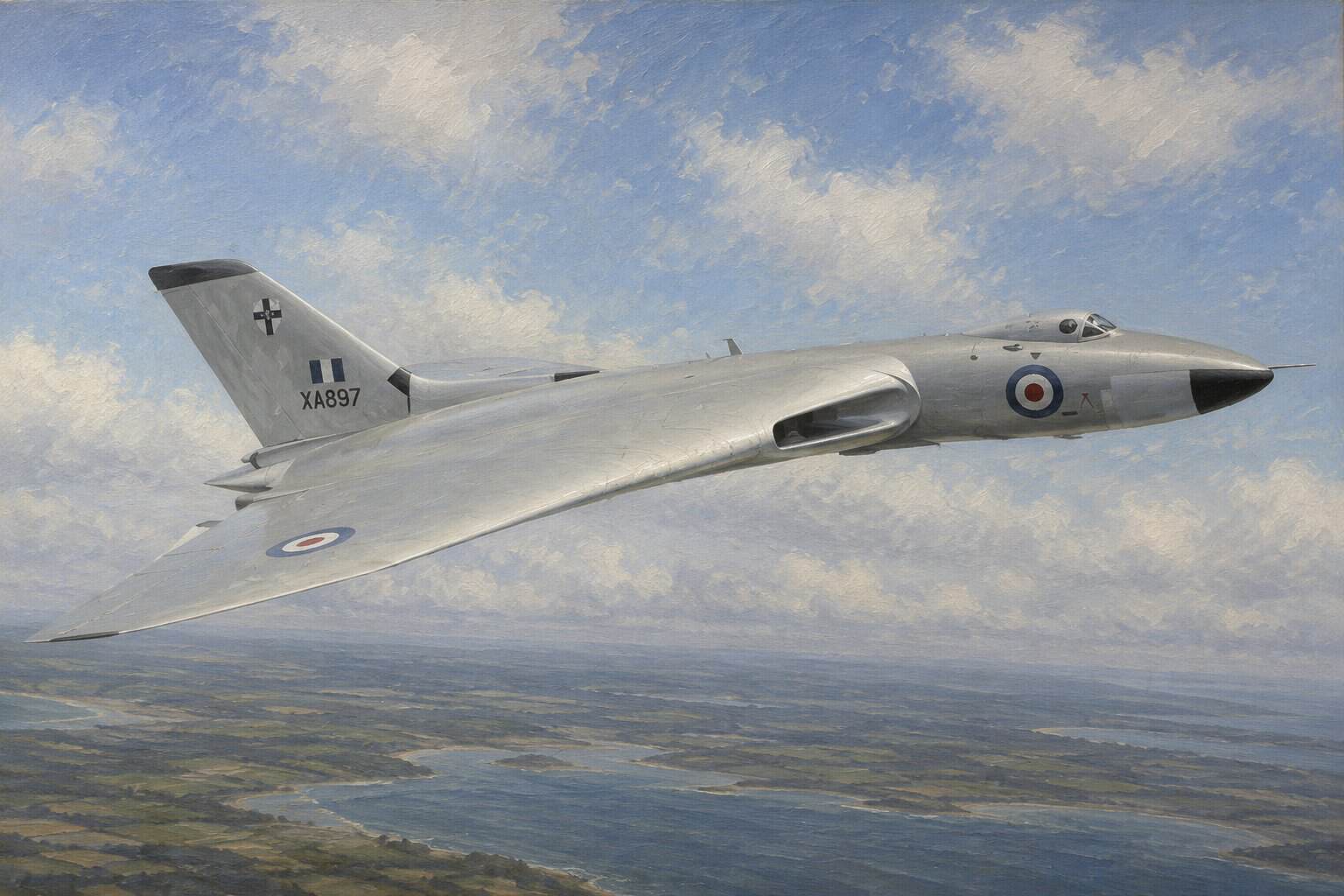
On 9 September 1956, Avro Vulcan XA897 departed for Australia on a long-range demonstration tour intended to display both the aircraft's performance and the broader credibility of British strategic air power. Such flights were never merely technical outings. In the mid-1950s, when the RAF’s V-bombers stood at the centre of Britain’s nuclear posture, a voyage of this kind was also a political signal. It showed that the Service’s newest strategic aircraft could project presence over great distance and represent British air power well beyond Europe.
The Vulcan in the V-bomber age
The departure of XA897 came at a time when the RAF was consolidating the V-bomber force as the visible core of Britain’s strategic deterrent. The Vulcan, with its striking delta planform and advanced performance, quickly became one of the best-known symbols of that force. Yet deterrent credibility depended on more than design promise. It also required public demonstrations of reach, reliability and operational seriousness.
That is why overseas tours mattered. They placed RAF aircraft before allied governments, military observers and wider audiences in a way that domestic testing could not. A long-distance demonstration allowed the RAF to show not only what the aircraft could do in theory, but how it could be handled as part of a larger strategic system.
More than a performance flight
Flights to Australia had significance because they combined aviation prestige with Commonwealth and alliance politics. Britain remained anxious to show that its strategic air arm was modern, mobile and globally relevant. A V-bomber operating across such distance suggested that the RAF could act far beyond the immediate European theatre and that its aircraft belonged in the front rank of contemporary military aviation.
The journey therefore had a dual purpose. On one level, it celebrated engineering, speed and endurance. On the other hand, it reinforced the image of Britain as a power capable of supporting far-reaching strategic commitments. The aircraft itself became a form of diplomatic and military communication.
RAF image and Cold War credibility
The timing is important. In 1956, Britain was still trying to define its place within the nuclear age, balancing alliance dependence, national policy and technological prestige. The V-bombers helped express an answer to that problem. They offered a means by which the RAF could present itself as a sophisticated strategic force whose value rested on performance as well as symbolism.
Vulcan XA897’s departure for Australia belongs within that setting. It was not an isolated feat but part of a wider effort to prove that the RAF’s new bomber force could be understood as serious, modern and internationally visible. Demonstration tours made that message concrete.
Significance
The departure of Vulcan XA897 on 9 September 1956 matters because it captures the RAF using one of its most advanced aircraft as both an operational asset and a strategic statement. The tour demonstrated range and professionalism, but it also served a broader political purpose in the Cold War world. In RAF history, the event stands as a reminder that V-bomber credibility was built not only on weapons and doctrine but also on visible proof of what British strategic aircraft could achieve over long distances.