On This Day, 1956: On 11 October 1956, a Valiant of No. 49 Squadron dropped a live Blue Danube atomic bomb at…
Read the entry →Protector RG1
General Atomics Aeronautical Systems
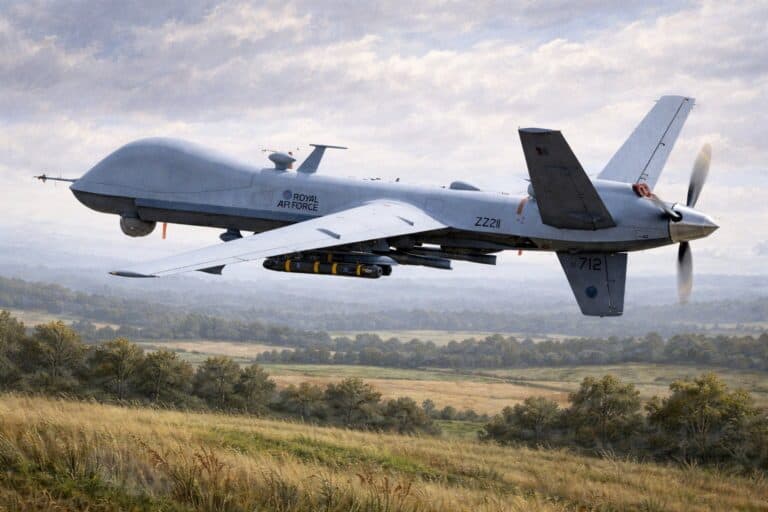
Protector RG1 will replace Reaper in RAF service, combining long endurance, broad surveillance capability and a more adaptable remotely piloted operating model.
Introduction
The General Atomics Protector RG Mk1 is the Royal Air Force’s version of the MQ-9B SkyGuardian, a medium-altitude, long-endurance remotely piloted aircraft designed for intelligence, surveillance, reconnaissance and precision strike. Developed to succeed the RAF’s MQ-9A Reaper, Protector combines long endurance with an airworthiness and operating framework intended to permit wider access to regulated airspace. It is based at RAF Waddington and represents a major change in how the RAF plans, trains for and sustains remotely piloted operations.
Development and the Reaper Legacy
RAF Reapers demonstrated the operational value of persistent surveillance and precision attack during campaigns in Afghanistan, Iraq and Syria. Crews operating from ground control stations could monitor areas for extended periods, follow developments and, when authorised, employ weapons. Those operations also established a substantial RAF body of expertise in remote piloting, intelligence analysis and the coordination of air and ground forces.
In October 2015 the UK announced its intention to acquire a new generation of remotely piloted aircraft under the Protector programme. The selected MQ-9B family was developed by General Atomics Aeronautical Systems. Although it shares a lineage with the MQ-9A Reaper, Protector is a significantly revised aircraft with longer wings, greater fuel capacity, different airworthiness provisions and systems designed to support operation in a broader range of airspace. The intended RAF fleet comprises sixteen aircraft.
The first UK Protector flew in September 2020. The programme involved aircraft development, certification, ground infrastructure, training systems and weapons integration, rather than simply purchasing a replacement airframe. The first aircraft arrived at RAF Waddington in September 2023, an important step towards establishing the type in Britain.
Design and Performance
Protector is powered by a Honeywell TPE331-10T turboprop rated at approximately 900 shaft horsepower. It has a wingspan of 24.07 metres, a length of 11.43 metres and a height of 3.78 metres. The RAF lists a maximum speed of about 250 knots and a published maximum operating altitude of 50,000 feet. Its long wings and efficient powerplant allow missions lasting well beyond those normally practical for crewed tactical aircraft.
Published endurance figures require care. RAF operational descriptions commonly refer to more than 30 hours, while broader aircraft performance material quotes endurance exceeding 40 hours under particular conditions. Neither figure should be read as a guaranteed duration for every armed or sensor-equipped mission: payload, route, altitude, weather and fuel reserves affect practical endurance.
There is no pilot aboard the aircraft. A remotely located crew includes a pilot, sensor operator and mission intelligence coordinator, supported by a wider team handling intelligence, communications and maintenance. Remote operation does not mean autonomous decisions about the use of force. Crews remain responsible for controlling the aircraft and its mission in accordance with the applicable command and authorisation arrangements.
Sensors, Communications and Weapons
Protector is designed to collect and distribute intelligence over extended periods. Its mission systems include electro-optical and infrared imaging, radar capabilities such as synthetic-aperture mapping and ground moving-target indication, and communications links connecting the aircraft with its operators and supported forces. These capabilities allow crews to observe an area, build a picture of activity and pass information to other assets.
The RAF has planned the integration of Brimstone 3A missiles and Paveway IV precision-guided bombs, providing options for engaging authorised targets as well as conducting surveillance. The aircraft’s actual weapons fit and available clearances depend on the stage of testing, certification and operational introduction. Its importance therefore rests on a combination of sensing, communications and potential precision effects, rather than on a single payload.
Airworthiness and Shared Airspace
One of Protector’s defining differences from Reaper is the emphasis placed on certification and routine operation within regulated airspace. Its design incorporates provisions for meeting demanding airworthiness standards, including detect-and-avoid technology intended to help crews maintain separation from other aircraft. That matters for flights between RAF bases, training areas and overseas locations without relying on the same restrictive arrangements often associated with earlier remotely piloted systems.
On 29 April 2025 Protector received its Military Type Certificate, a significant milestone in the process of demonstrating the aircraft’s airworthiness. Type certification is distinct from declaring an entire RAF force operationally capable. Personnel training, infrastructure, mission systems, tactics and readiness must also be brought together before a particular operational milestone can be achieved.
RAF Units and Training
RAF Waddington in Lincolnshire is Protector’s principal operating base. No. 31 Squadron was established as the first frontline Protector unit, carrying the RAF’s remotely piloted experience into a new aircraft generation. No. XIII Squadron has also been associated with the developing Protector force. No. 54 Squadron contributes training expertise, while No. 56 Squadron supports test and evaluation work. Their respective responsibilities form part of the wider system needed to introduce and sustain a new aircraft type.
The Protector Training Centre at Waddington opened in July 2025, providing a dedicated environment for preparing crews and supporting the aircraft’s entry into service. Ground control stations, technical support, mission planning and intelligence exploitation are as essential to this capability as the aircraft themselves. Protector is best understood as an integrated operational system rather than an isolated remotely piloted airframe.
Entry into Service and Operational Milestones
Protector formally entered RAF service in June 2025, following the arrival of aircraft in the UK and progress with certification and training. Entry into service did not mean that every element of the planned force had reached full operational maturity. In January 2026 the Ministry of Defence confirmed that the programme’s Initial Operating Capability milestone remained outstanding, even though Protector had already deployed on operations and provided intelligence, surveillance and reconnaissance support. These distinctions are important: service entry, operational use and a formal capability declaration are separate events.
In June 2026 a Protector flew from RAF Waddington to RAF Akrotiri via European civilian airspace. The flight demonstrated the practical value of an aircraft designed for wider airspace integration and highlighted a difference from the RAF’s earlier Reaper operating model. As the force develops, its capabilities will depend on the readiness of trained crews, support infrastructure, approved sensors and weapons, and the operating permissions available for each mission.
Historical Significance
Protector marks the RAF’s transition from a remotely piloted capability shaped primarily by overseas campaigns towards one intended to be an enduring element of the force structure. Its long endurance allows persistent observation and supports the careful development of intelligence over time. The prospect of operating through shared airspace also gives commanders more flexibility in moving aircraft between home bases and overseas locations.
It does not replace every task performed by crewed aircraft. High-speed response, air combat and missions requiring other combinations of payload, mobility or survivability still demand different platforms. Protector’s value lies in persistent surveillance, networked intelligence and the ability to remain on station for extended periods while retaining the option of precision attack when authorised.
The aircraft’s history is still developing. Its first flights, certification, squadron formation, service entry and early deployments are already important milestones, but they should not be confused with the completion of every planned capability. Protector’s lasting significance will be measured by how effectively the RAF integrates it into operations, training and the wider air-power system.
| Dimensions | |
| Wingspan | 79 ft 0 in (24.0 m) |
| Length | 38 ft 3 in (11.7 m) |
| Height | 12 ft 6 in (3.8 m) |
| Wing area | 388 sq ft (36.0 m²) |
| Weights | |
| Empty weight | 6,800 lb (3,084 kg) |
| Max takeoff weight | 12,500 lb (5,670 kg) |
| Max bomb load | 4,750 lb (2,155 kg) external payload |
| Performance | |
| Maximum speed | 240 mph (386 km/h) |
| Cruise speed | 200 mph (322 km/h) |
| Service ceiling | 40,000 ft (12,192 m) |
| Range | 3,730 miles (6,000 km) |
| Powerplant | |
| Engines | 1 × Honeywell TPE331-10 turboprop |
| Power | 900 shp (671 kW) |
| Armament | |
| Guns | Provision for precision-guided weapons including Brimstone, Paveway IV and AGM-114 Hellfire, alongside surveillance sensor payloads |
| Bombs / weapons | 4,750 lb (2,155 kg) external payload |
RAF UAV Operations and the Rise of StormShroud Systems
How RAF uncrewed air systems evolved from early experiments to operational use, with StormShroud marking a…
27 April 2026 · 5 minJaguar GR1As Depart for the Gulf in Operation Granby
On 11 August 1990, RAF Jaguar GR1As left the UK for Thumrait as Britain built the…
11 August 2026 · 3 minNo. 29 Squadron Phantoms Take Ascension Island QRA in 1982
On 24 May 1982, No. 29 Squadron’s Phantom fighters took over Quick Reaction Alert on Ascension…
24 May 2026 · 3 min