The Royal Air Force entered the Cold War with responsibilities that were broader than those of the immediate post-war years and more complex than the single-task wartime commands from which it had grown. Between 1945 and 1991, RAF planning was shaped by the defence of the United Kingdom, the requirements of NATO, the maintenance of Britain’s nuclear deterrent for part of the period, and the continuing need to support overseas commitments. Cold War RAF operations and strategy rested not on a single aircraft type or command alone, but on an interlocking structure of strike, interception, reconnaissance, maritime patrol, transport, and support.
The central feature of that structure was readiness. Unlike the major campaigns of the Second World War, the Cold War produced long periods of tension without general war in Europe. RAF forces had to remain credible over decades rather than for a single campaign season. Aircraft, bases, radar stations, command networks and overseas deployments all had to be organised around the possibility that a crisis might pass quickly into nuclear or conventional conflict.
Strategic Setting
British air strategy in the early Cold War developed under the pressure of economic constraint, alliance politics and the emergence of nuclear weapons as the decisive element in great-power planning. The wartime alliance with the Soviet Union collapsed rapidly, and by the late 1940s Britain had to consider the possibility of direct attack by long-range bomber forces and, later, ballistic missiles. The Royal Air Force became central to both deterrence planning and the immediate defence of British airspace.
This setting gave the RAF two major strategic responsibilities. The first was the provision, for a substantial part of the period, of Britain’s airborne nuclear deterrent. The second was the maintenance of a layered air-defence system capable of detecting, tracking, and, if necessary, intercepting hostile aircraft approaching the United Kingdom. Around those tasks sat a wider set of supporting functions, including reconnaissance, maritime patrol, transport, air-to-air refuelling and liaison with allied commands.
The V-Force and the Nuclear Role
For much of the 1950s and 1960s, the most visible expression of Cold War RAF strategy was the V-Force. The Vickers Valiant, Avro Vulcan and Handley Page Victor provided Britain with a strategic bomber force intended to deliver nuclear retaliation in the event of Soviet attack. Their importance lay not simply in their technical performance, but in the strategic doctrine they embodied. RAF strike planning depended on the continued credibility of a retaliatory capability that could survive long enough to impose unacceptable cost on an aggressor.
This required more than the possession of aircraft. Bomber stations, dispersal procedures, maintenance routines and crew readiness all formed part of the deterrent posture. Aircraft had to be capable of rapid launch, and crews had to sustain a demanding pattern of training and alert duties. In practical terms, Cold War RAF operations treated the bomber force as an operational system rather than a collection of individual squadrons.
The V-bombers were originally designed for high-altitude penetration, but improvements in Soviet radar, interceptor performance and surface-to-air missile systems made that approach increasingly vulnerable. RAF tactics shifted towards low-level penetration, with crews trained to use terrain masking and precise navigation over long distances. That change illustrates a wider feature of Cold War RAF strategy: doctrine had to adapt continuously to technological change, even where the strategic objective remained the same.
From the late 1960s, Britain’s principal nuclear deterrent passed to the submarine force. Even so, the RAF’s earlier nuclear role had already shaped force structure, aircrew training, base organisation and the wider culture of constant readiness that marked much of the period.
Air Defence and Fighter Readiness
Alongside the nuclear role, the defence of British airspace remained a permanent operational commitment. The threat of Soviet bomber attacks required a radar and control network that could provide early warning and efficiently direct interceptor aircraft. Post-war air defence depended on the integration of radar sites, operations rooms, communications systems, and fighter stations rather than on aircraft alone.
Programmes such as ROTOR modernised the radar infrastructure inherited from the Second World War. At the same time, later developments in the UK Air Defence Ground Environment improved the speed and reliability of tracking and control. Fighter units maintained quick-reaction arrangements at key stations, and interceptions of Soviet aircraft near NATO airspace became a routine part of Cold War service. These sorties did not represent combat in the wartime sense, but they sustained operational standards and demonstrated the continuing seriousness of the air-defence mission.
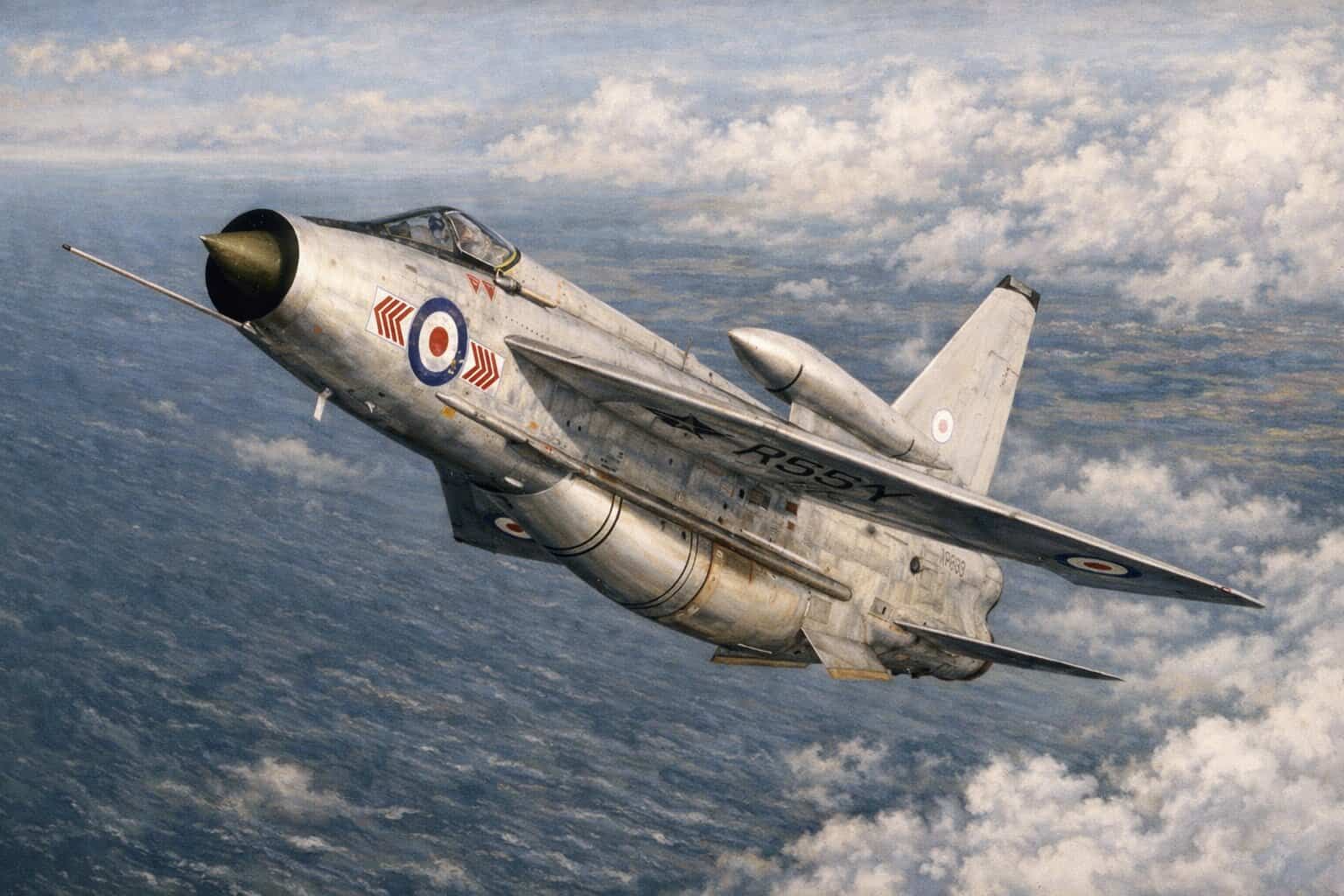
Aircraft used in this role changed as the threat evolved. Types such as the Hawker Hunter formed part of the RAF’s early jet-era defensive capability, while the English Electric Lightning became one of the most recognisable interceptor aircraft of the Cold War. The operational point, however, remained constant: fighter aircraft had to be linked to an effective warning and control system if they were to contribute meaningfully to national defence.
Reconnaissance, Maritime Patrol and Support
Cold War RAF strategy also depended on information, endurance and reach. Reconnaissance, in its various forms, contributed to the assessment of Soviet and Warsaw Pact capabilities, while electronic intelligence helped build a clearer picture of radar systems, air-defence networks and broader military activity. Much of this work remained less visible than the bomber or interceptor force, but it was essential to informed planning.
Maritime patrol formed another major element of the RAF contribution, especially in relation to NATO’s North Atlantic responsibilities. The monitoring of sea lanes, anti-submarine warfare, and surveillance of maritime approaches all had direct strategic relevance in a conflict where Soviet naval and submarine activity could threaten reinforcement routes and the wider alliance position.
Support capabilities gave coherence to the whole structure. Air transport sustained deployments and reinforcement, while air-to-air refuelling extended the endurance and range of front-line aircraft. Rescue, communications and specialist support units further underline that Cold War RAF operations cannot be understood through strike aircraft and fighters alone. The Service functioned as an integrated operational system, with support elements carrying strategic weight of their own.
Strategy, Risk and Institutional Change
A further feature of the Cold War RAF was the relationship between readiness and risk. Low-level flying, quick-reaction procedures, dispersed basing and sustained alert states imposed heavy operational demands even in peacetime. Accident risk remained a serious matter, particularly as aircraft performance increased and training demands intensified.
At the same time, the RAF had to reconcile national responsibilities with alliance commitments. NATO integration affected planning, basing, exercises and command relationships, while Britain’s changing defence posture repeatedly altered the balance between home defence, overseas roles and the nuclear mission. The result was not a static Cold War force, but one that evolved repeatedly in response to strategic, technological and financial pressures.
Conclusion
Cold War RAF operations and strategy were defined by sustained preparedness rather than by a single campaign. The Service’s responsibilities ranged from nuclear strike and air defence to reconnaissance, maritime patrol, transport and support, all within a structure increasingly tied to NATO planning and technological adaptation.
What distinguished the RAF’s Cold War posture was the need to preserve credible capability over decades of tension. Aircraft such as the Vickers Valiant, Avro Vulcan, Handley Page Victor, Hawker Hunter and English Electric Lightning formed visible parts of that posture, but the wider significance lay in the integrated system of command, warning, readiness and support within which they operated. That system shaped the RAF’s role throughout the second half of the twentieth century and remains central to understanding how Britain organised air power in the nuclear age.