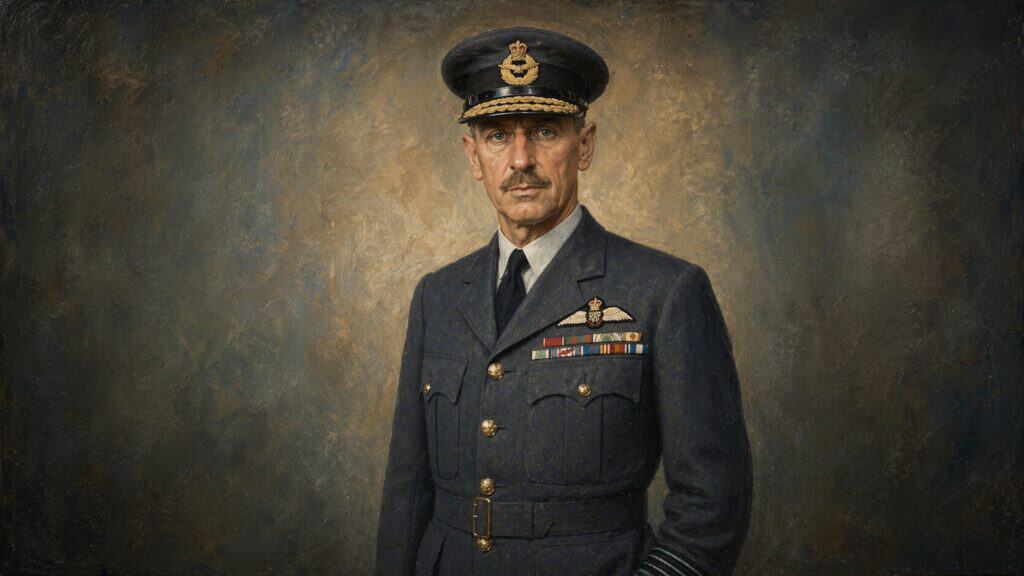
RAF Fighter Command was created on 14 July 1936 as the Royal Air Force command responsible for the air defence of the United Kingdom. Established in response to the growing importance of air attack in European war planning, it became the organisation through which Britain developed an integrated system of warning, control and fighter interception before the Second World War. Under Air Chief Marshal Hugh Dowding, Fighter Command combined radar, the Royal Observer Corps, operations rooms and front-line squadrons into a single operational structure capable of responding quickly to large-scale air attack.
The command is most closely associated with the Battle of Britain, but its wartime history extended beyond the campaign of 1940. Between 1940 and 1945, Fighter Command moved from home defence into offensive sweeps over occupied Europe, night defence during the Blitz, support for the invasion of north-west Europe, and the interception of German V-weapons. Its structure, doctrine and equipment evolved repeatedly in response to changing strategic demands.
Formation and Structure
Fighter Command was organised from headquarters at RAF Bentley Priory, which housed the central filter and operations functions through which incoming reports were assessed and passed down the command chain. The system worked through a hierarchy of command. At the highest level, Fighter Command Headquarters directed national air defence and the allocation of forces. Below this stood the geographically defined Groups, notably 10, 11, 12 and 13 Groups in 1940, each responsible for a broad regional area. Each Group was divided into Sectors, built around key airfields whose control rooms directed local squadrons and their associated satellite stations.
This arrangement gave Fighter Command both central control and local flexibility. A squadron remained the basic fighting unit, but the command system ensured that squadrons could be scrambled, reinforced, rested or redeployed according to the wider operational picture. The structure was supported by radar reporting from Chain Home and Chain Home Low stations, visual reporting from the Royal Observer Corps, filtering procedures to remove duplication and error, and a communications network that linked the whole system from detection to interception.
The significance of this arrangement lay in economy of force. Fighter aircraft did not have to be wasted in standing patrols at random. Controllers could hold squadrons on the ground until a raid’s size, direction and approximate height were understood, then commit them where they were most needed. That principle became one of the decisive strengths of Fighter Command in 1940.
The Battle of Britain and Defensive Operations
The Battle of Britain placed Fighter Command under sustained pressure between July and October 1940. During the earlier fighting connected with the Battle of France and the evacuation from Dunkirk, it had already faced the problem of balancing support for operations across the Channel against the preservation of home defence. Once the Luftwaffe turned its main effort towards Britain, Fighter Command became the central instrument through which the RAF contested German attempts to achieve air superiority.
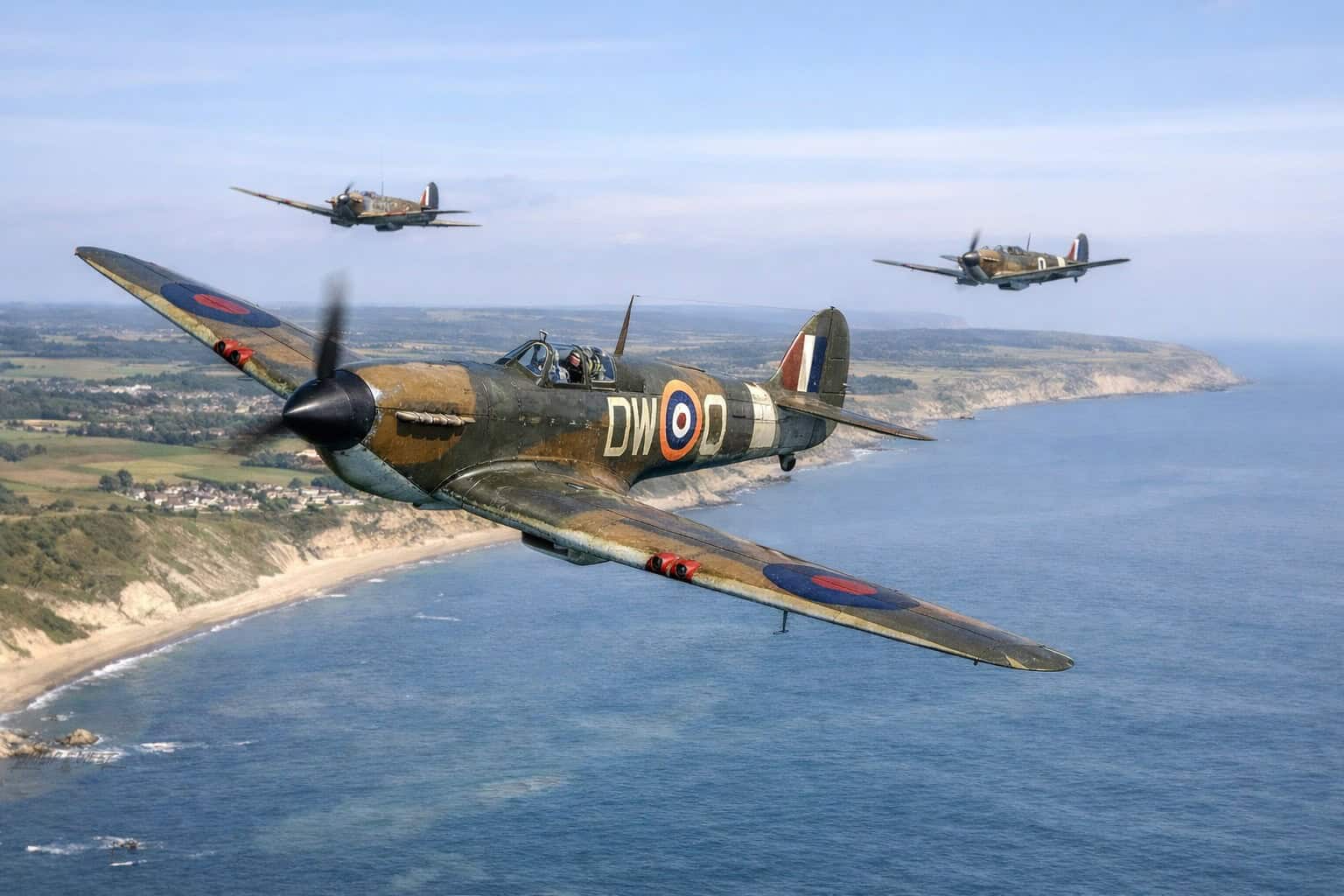
Its front-line strength in 1940 rested primarily on the Hawker Hurricane and the Supermarine Spitfire. The Hurricane, more numerous in squadron service, accounted for a substantial proportion of German losses during the campaign, especially among bomber formations. The Spitfire offered higher performance and was often used against German fighters. What mattered operationally, however, was not the individual reputation of either aircraft but the command system’s ability to place them in the right position at the right time.
The Luftwaffe campaign shifted through several phases, including attacks on convoys and coastal traffic, operations against fighter airfields and supporting infrastructure, and later attacks on London and other urban centres. Fighter Command suffered heavy losses in pilots, aircraft, and serviceable machines, especially within 11 Group under Air Vice-Marshal Keith Park, but the command system remained intact. By imposing continuing losses on the Luftwaffe while preserving enough of its own force to remain operational, Fighter Command denied Germany the air superiority required for invasion.
Night Fighting and the Blitz
The shift from daylight attack to sustained night bombing during the Blitz created a different operational problem. The methods that had worked against daylight raids were not directly transferable to darkness, and Fighter Command initially lacked a fully effective night-fighting system. Early responses relied on improvised methods, searchlights, and adapted aircraft, but these yielded limited results.
Improvement came through the development of airborne interception radar, better ground-controlled interception procedures and the gradual creation of a more coherent night-fighting network. As these systems matured, Fighter Command became more effective in directing aircraft onto hostile bombers after dark. This phase of the war illustrates that the command’s importance did not end with the Battle of Britain. It continued to adapt its structure and methods in response to evolving forms of air attack.
Offensive Sweeps and the Air War Over Europe
After 1940, Fighter Command increasingly took part in offensive operations over occupied Europe. Under new command leadership, policy shifted towards carrying fighter pressure across the Channel through operations intended to engage German fighters, protect limited bomber attacks, and maintain offensive activity.
These operations took several forms. Fighter sweeps and bomber-escort missions sought to draw German opposition into combat and to impose attrition on the Luftwaffe. In practice, results were mixed. Early Spitfire marks suffered from limited range, and German radar and control systems often allowed defending fighters to meet RAF formations with an advantage. Losses could be heavy for results that were not always proportionate.
Even so, these operations contributed to tactical development and to the wider air war. Fighter Command gained experience in escort, sweep, and offensive control tasks that differed from those of the defensive battle of 1940. The command’s wartime history cannot be reduced to a single home-defence role. It became part of the broader RAF and Allied effort to contest airspace over Western Europe.
Reorganisation, ADGB and Later War Service
By 1943 and 1944, organisational changes reflected the wider Allied offensive. Much of the command’s day-fighter strength was transferred to the Second Tactical Air Force, which was designed to support the invasion of Europe and subsequent ground operations. The home-defence element became the Air Defence of Great Britain, reflecting its continuing responsibility for protecting British airspace while offensive fighter strength was redirected elsewhere.
This reorganisation did not remove the command from active wartime responsibilities. During 1944, it faced renewed German attacks, including the V-1 flying bomb campaign. The interception of V-1s required high performance, rapid reaction and careful control. Aircraft such as the Hawker Tempest, later marks of the Spitfire and the first operational Gloster Meteor all took part in anti-Diver operations. Fighter Command, restored in title later in 1944, thus remained central to the defence of the United Kingdom even in the final phase of the war.
At the same time, RAF fighter forces were contributing to escort and tactical support roles over the Continent as Allied armies advanced. The command structure of 1940 had evolved substantially by this stage, but the underlying need for effective warning, control, coordination and rapid reaction remained constant.
Evolution in Doctrine and Technology
The wartime history of Fighter Command was also a history of adaptation. In 1936, it had been created primarily as an air-defence command. By 1945, it had experience not only in interception and home defence, but also in night fighting, offensive sweeps, escort duties and the defence of Britain against pilotless weapons.
This evolution was shaped by both doctrine and technology. Radar, centralised plotting, radio control and operations-room procedure gave the command its initial distinctive strength. Aircraft development, from early-war Hurricane and Spitfire variants to later high-performance fighters and the introduction of jet aircraft, altered the means by which that system could be applied. Organisational changes, including the relationship between Fighter Command, Air Defence of Great Britain and the Second Tactical Air Force, reflected strategic priorities as the war moved from survival to offensive pressure and then to invasion support.
Conclusion
RAF Fighter Command was one of the most important operational commands created by the Royal Air Force before the Second World War. Its integrated warning and control structure gave Britain a viable system of air defence in 1940, and its ability to preserve that system under pressure was central to the outcome of the Battle of Britain.
Its wartime role, however, extended beyond that single campaign. Fighter Command adapted to night defence during the Blitz, took part in offensive operations over occupied Europe, contributed to the reorganisation of fighter forces for the invasion of north-west Europe, and remained responsible for the air defence of Britain against later threats such as the V-1. Its history combines structure, battle and institutional change in a way that makes it central to any serious understanding of RAF air power in the Second World War.