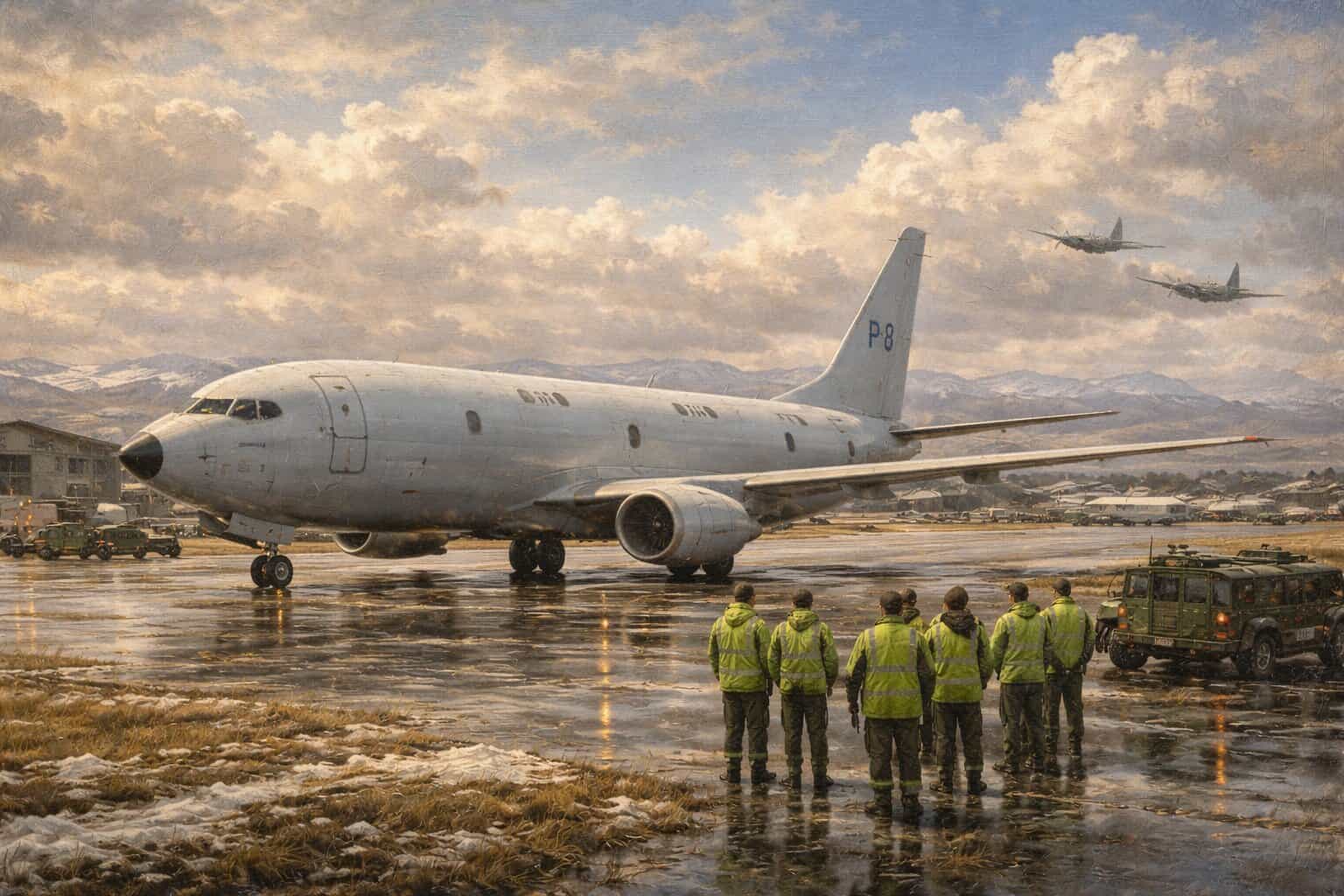
On 4 February 2020, the Royal Air Force marked a significant moment in the restoration of its maritime patrol capability when the first Poseidon MRA1 aircraft arrived in the United Kingdom. The aircraft landed at RAF Kinloss in Scotland, where it was received by personnel preparing for the re-establishment of the RAF’s long-range maritime patrol force. The arrival represented the beginning of a new chapter in British maritime aviation after nearly a decade without a dedicated fixed-wing maritime patrol aircraft.
The Poseidon programme formed part of a wider effort to rebuild the United Kingdom’s ability to monitor and defend the seas surrounding the British Isles. Maritime patrol aircraft perform a variety of tasks, including anti-submarine warfare, maritime surveillance, search-and-rescue support, and intelligence gathering, roles that have long been core responsibilities of the RAF.
The Return of Maritime Patrol Capability
For many years, the RAF had relied on aircraft such as the Avro Shackleton and later the BAE Nimrod to conduct maritime patrol operations. These aircraft monitored the North Atlantic, tracked submarines, and supported naval operations during the Cold War and beyond.
However, the retirement of the Nimrod force in 2010 left the United Kingdom without a dedicated maritime patrol aircraft capability. In the years that followed, maritime surveillance tasks were carried out through cooperation with allied nations, the use of naval assets, and other forms of intelligence gathering. The absence of a specialised aircraft nonetheless created an acknowledged gap in the nation’s defence posture.
The decision to acquire the Poseidon MRA1, derived from the Boeing P-8 maritime patrol aircraft, was taken as part of efforts to restore this capability. The aircraft was designed specifically for long-range maritime surveillance and anti-submarine warfare, equipped with advanced sensors, radar systems, and the ability to deploy a range of specialist equipment.
Arrival at RAF Kinloss
The first Poseidon MRA1 arrived in the United Kingdom on 4 February 2020, landing at RAF Kinloss, which had been prepared to support the introduction of the new aircraft. The arrival marked an important milestone in the programme, demonstrating that the RAF was moving closer to returning a fully operational maritime patrol force to service.
Although Kinloss had historically been associated with maritime patrol aviation during the Nimrod era, the Poseidon force was ultimately intended to operate from RAF Lossiemouth in Moray, where extensive infrastructure upgrades were underway to accommodate the new aircraft and its associated support systems.
Personnel from the RAF and supporting organisations were already engaged in training and preparation for the aircraft’s introduction. Crews had begun learning the specialised techniques required for maritime patrol operations, including anti-submarine search procedures and coordination with naval forces.
Capabilities of the Poseidon MRA1
The Poseidon MRA1 represents a modern generation of maritime patrol aircraft designed to operate over large ocean areas for extended periods. Equipped with advanced radar and sensor systems, the aircraft can detect and track vessels and submarines across vast maritime regions.
One of its principal roles is anti-submarine warfare, a task that involves locating submarines using sophisticated sensors and coordinating with naval forces to monitor or engage potential threats. The aircraft also supports broader maritime security operations, including surveillance of shipping routes and assistance during search-and-rescue missions.
The ability to rapidly deploy aircraft to areas of strategic interest enables the RAF to contribute to both national defence and broader NATO maritime operations. In the North Atlantic, where submarine activity has long been an important strategic consideration, the restoration of a maritime patrol capability was widely regarded as a significant step.
Strategic Importance
The arrival of the Poseidon MRA1 in February 2020 marked the beginning of the RAF’s return to a role that had been central to British air power for decades. Maritime patrol aircraft play a critical part in maintaining awareness of activity in surrounding waters, protecting naval forces, and safeguarding vital sea lanes.
For the United Kingdom, an island nation heavily dependent on maritime trade, the ability to monitor the seas around the British Isles is strategically important. Maritime patrol aircraft provide a flexible and responsive platform capable of addressing a wide range of threats and emergencies.
The Poseidon fleet also strengthened cooperation between the RAF, the Royal Navy, and allied forces. Maritime patrol operations often involve close coordination between aircraft, surface vessels, and submarines, allowing information gathered by one platform to be shared across the wider defence network.
A New Era in RAF Maritime Aviation
The events of 4 February 2020 marked more than the arrival of a new aircraft type. They symbolised the restoration of a vital capability that had been absent for nearly a decade and signalled the beginning of a new era in RAF maritime aviation.
As further aircraft entered service and infrastructure at RAF Lossiemouth was completed, the Poseidon force would go on to play an increasingly important role in monitoring the North Atlantic and supporting NATO operations.
In the wider context of RAF history, the arrival of the first Poseidon MRA1 demonstrated how maritime patrol aviation continues to evolve while remaining central to the defence of the United Kingdom and its surrounding seas.