On This Day, 1939: On 21 October 1939, 46 Squadron Hurricanes intercepted Heinkel He 115 floatplanes over the North Sea in the…
Read the entry →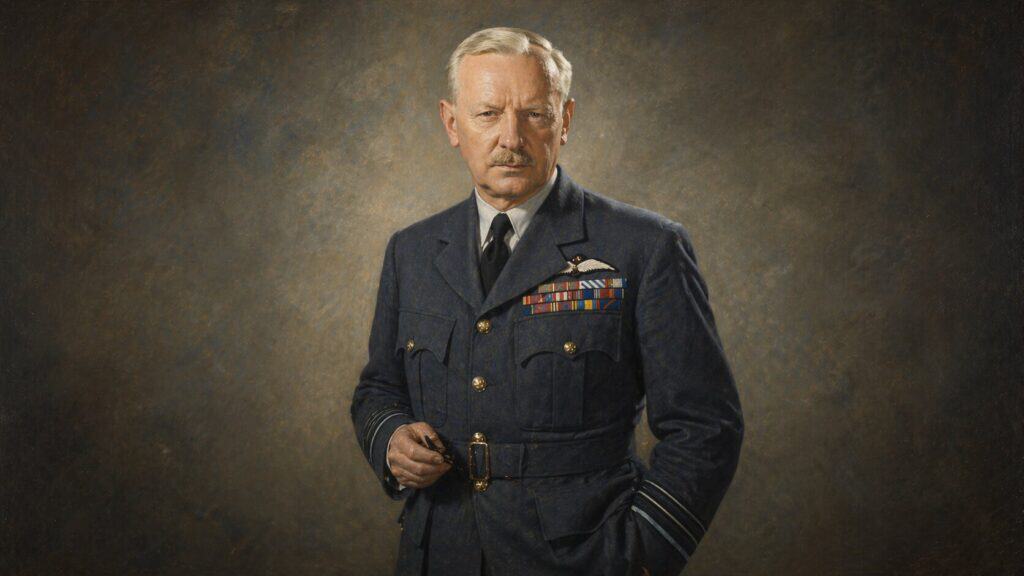
Marshal of the Royal Air Force
Arthur Harris
Arthur Harris led RAF Bomber Command through the main strategic bombing offensive against Germany, leaving one of the war’s most debated legacies.
Early Life
Arthur Travers Harris was born on 13 April 1892 in Cheltenham, Gloucestershire. His early years belonged to a generation shaped by the late Victorian and Edwardian British Empire, before aviation had demonstrated any clear military utility. As with many future senior officers of his era, his route to prominence was not predetermined by aviation alone; it would be formed by wartime opportunity, institutional expansion, and the rapid professionalisation of air power.
Entry into Service
Harris entered military service during the First World War and became an officer in the Royal Flying Corps, the wartime predecessor of the Royal Air Force. The RFC was an organisation learning at speed: aircraft were fragile, navigation crude, and operational method still developing. Service in the RFC demanded technical competence and resilience as much as personal courage, because losses arose from accident and mechanical failure as well as enemy action. Harris’s wartime experience placed him inside a service that, by 1918, would be reorganised into the world’s first independent air force.
With the formation of the Royal Air Force in April 1918, Harris continued his career within the new institution, joining the cadre of officers who would carry wartime aviation experience into an inter-war service tasked with defining the RAF’s purpose and doctrines.
Operational Career
Between the wars, the RAF operated under financial constraint while also maintaining global commitments. Officers advanced through postings that combined flying, administration, and command responsibilities, often far from Britain. Harris’s career progressed through the institutional patterns typical of senior RAF officers: a mixture of overseas appointments, command experience, and staff work.
By the outbreak of the Second World War, the RAF’s strategic arguments about bombing and air power had become central to planning. Britain’s inability to strike Germany decisively on land in the early years of the war increased the political and military weight placed upon the air offensive. Harris emerged as a senior commander in a force that was expanding rapidly, converting from a pre-war service into a mass wartime organisation.
Major Actions or Commands
Harris’s defining appointment was as Air Officer Commanding-in-Chief of RAF Bomber Command, a role he held during the key years of the strategic bombing campaign against Germany. Under his leadership, Bomber Command pursued large-scale operations intended to damage German industrial capacity and undermine morale. The campaign was shaped by constraints as well as intent: technological limitations, heavy losses, and the difficulties of precision bombing at night all influenced how operations were conducted.
Harris became strongly identified with the persistence and scale of the night offensive. The conduct of area attacks and the destruction of German cities became defining features of the campaign, and therefore of his reputation. The heavy casualty rates borne by Bomber Command aircrew also formed a central part of the wartime record and the later historical debate, because the offensive demanded sustained effort against increasingly effective defences.
The controversy that surrounds Harris rests on the collision between strategic aims and human consequences. The RAF Museum has noted that his legacy remains contentious, reflecting the enduring argument over the costs and effects of the bombing campaign. Harris’s wartime leadership is therefore studied in two dimensions: as the direction of a vast operational enterprise, and as a focal point in the wider moral and strategic evaluation of air power in total war.
Later Life and Death
Harris remained in the Royal Air Force until 1946. Post-war, he lived through a period in which the memory of Bomber Command was shaped by national reconstruction, evolving historical interpretation, and changing public attitudes. Commemoration and criticism both followed him, reflecting the broader difficulty of representing a campaign that involved both extreme danger to aircrew and large-scale destruction on the ground.
He died on 5 April 1984 at Goring-on-Thames, Oxfordshire.
Historical Significance
Arthur Harris is historically significant as the wartime commander most closely associated with the RAF’s strategic bombing of Germany at its height. His leadership illustrates how air power was employed as a principal instrument of British strategy when direct land engagement was limited and when the demands of alliance warfare shaped operational choices.
His legacy remains debated because the campaign’s effectiveness cannot be separated from its costs. The sustained losses among Bomber Command crews and the devastation inflicted on German cities have ensured that Harris is remembered as a commander whose decisions sit at the centre of one of the Second World War’s most contested subjects in British air history.
| Dates | Role | Unit | Aircraft |
|---|---|---|---|
| 1914-1918 | Officer; wartime flying and operational appointments | Royal Flying Corps | N/A |
| 1918-1939 | RAF officer; overseas, staff and command appointments | Royal Air Force | N/A |
| 1942-1945 | Air Officer Commanding-in-Chief | RAF Bomber Command | N/A |
| 1945-1946 | Senior RAF officer; transition to retirement | Royal Air Force | N/A |
Operation Torch
How the RAF supported Operation Torch through airfield seizure, tactical air power and the wider struggle for air superiority in North Africa.
Operation Gomorrah
How RAF Bomber Command carried out Operation Gomorrah against Hamburg using concentrated area bombing and the new Window countermeasure.
Sir Arthur Travers Harris remains inseparable from the intensification of RAF Bomber Command’s strategic offensive against Germany during the Second World War. As Air Officer Commanding-in-Chief, he led the force through the years in which large-scale night area attacks became central to Britain’s air strategy, and he is closely associated with the direction and persistence of that campaign.
His reputation has long been contested because Bomber Command’s campaign involved heavy RAF losses and caused extensive destruction in German cities. The debate has centred on effectiveness, proportionality, and the moral dimension of area bombing, ensuring that Harris is remembered not only as a wartime commander but also as a figure through whom broader arguments about air power and strategy are frequently expressed.
Commemoration has reflected those tensions. Harris’s post-war public standing differed from that of some other senior commanders, yet his role as Bomber Command’s wartime leader has remained prominent in institutional memory, scholarship, and public monuments, where the focus is often on the scale of the campaign and the cost paid by Bomber Command aircrew.
RAF Pathfinders: How Bomber Command Evolved Target Marking
How RAF Pathfinders improved Bomber Command’s night offensive through specialist crews, navigation aids and disciplined target-marking.
22 April 2026 · 5 minRAF Bombing Strategy: From Daylight Raids to the Night War
How RAF bombing strategy evolved from costly daylight raids to a sustained night offensive shaped by…
27 April 2026 · 14 minRAF Bomber Command Begins the Dresden Raids
On 13 February 1945, RAF Bomber Command began the Dresden raids with a major night attack…
13 February 2026 · 4 min