On This Day, 1939: On 21 October 1939, 46 Squadron Hurricanes intercepted Heinkel He 115 floatplanes over the North Sea in the…
Read the entry →Avro Shackleton
A. V. Roe and Company
Discover the Avro Shackleton, the RAF patrol aircraft that combined maritime surveillance, anti-submarine and early warning roles across the Cold War.
The Avro Shackleton was the Royal Air Force’s principal long-range maritime patrol aircraft for much of the Cold War and, in its final two decades, an airborne early warning platform. Developed from the family of Avro aircraft that included the Manchester, Lancaster and Lincoln, it combined a bomber-derived wing and four powerful piston engines with a purpose-built maritime patrol fuselage. Its endurance, sensor capacity and adaptability kept the type in RAF service until 1991.
The Shackleton’s long career encompassed anti-submarine patrols, Soviet naval surveillance, search and rescue, overseas deployments and airborne radar coverage. It was an aircraft of striking contrasts: a loud, vibration-prone piston-engined machine carrying sophisticated Cold War sensors, and a maritime reconnaissance design that eventually guarded British airspace after its original role had passed to the Nimrod.
Development from the Lincoln and Tudor
Avro developed the Shackleton to meet a post-war requirement for an aircraft capable of sustained patrol over the Atlantic and other distant waters. The design drew on the wing and general structural heritage of the Lincoln, while its Griffon engine installations reflected work associated with the Avro Tudor. The fuselage was redesigned to accommodate a large crew, radar, navigation equipment, weapons and the facilities needed for long flights. The Shackleton was therefore a new maritime aircraft built around proven elements, not merely a converted Lancaster or Lincoln.
The prototype first flew on 9 March 1949. The Shackleton entered RAF Coastal Command service in 1951, with No. 120 Squadron among the first operational units. Early aircraft revealed maintenance and serviceability challenges. Crews also experienced prolonged noise and vibration, leading to trials and modifications intended to improve working conditions on patrols that could last around fifteen hours. Approximately 185 aircraft were built for the RAF, with further examples produced for South Africa; production figures depend on the variants and national orders included.
Engines, Crew and Technical Characteristics
Four Rolls-Royce Griffon engines drove distinctive contra-rotating propellers. Each engine turned two propellers in opposite directions, helping absorb the engine’s power and reducing some handling effects, but creating a characteristic and exceptionally loud sound. Long flights demanded close attention to engine management, fuel consumption and crew fatigue.
Dimensions and performance varied by mark. The Shackleton’s wingspan was approximately 120 feet and its length around 87 feet on early maritime versions, with changes in the MR.3. Maximum speeds were roughly 300 mph, while patrol endurance could reach approximately fifteen hours depending on fuel, equipment, weather and operational task. A typical maritime crew included pilots, flight engineers, navigators, radar operators and air signallers, with the number and distribution of crew positions varying across versions and missions.
Radar, navigation equipment and acoustic submarine-detection systems occupied substantial internal space. Weapons carried in the bomb bay could include depth charges, bombs and torpedoes according to the aircraft’s configuration and operational requirement. A searchlight and visual observation positions supported maritime searches. Figures for range, load and crew complement should not be treated as identical across all Shackleton marks.
The MR.1, MR.2 and MR.3 Variants
The Shackleton MR.1 established the basic maritime patrol capability, with radar and other equipment fitted for long-range sea operations. Early service highlighted the need for improved crew accommodation, visibility and equipment arrangements. The MR.1A incorporated engine-related improvements, while subsequent developments altered the aircraft more substantially.
The MR.2 introduced a revised nose and radar arrangement, with the main search radar housed beneath the fuselage rather than in the earlier forward installation. Its improvements made it an important version for RAF maritime squadrons and, eventually, the basis of the airborne early warning conversions.
The MR.3 was a more extensive redesign, recognisable by its tricycle undercarriage instead of the earlier tailwheel arrangement. It offered improved crew accommodation and other changes intended to make long patrols more tolerable. Later Phase 3 aircraft received auxiliary Armstrong Siddeley Viper jet engines to assist take-off and climb. These additions improved performance in particular circumstances but increased structural stresses and contributed to fatigue concerns. The MR.3 should not be confused with the AEW.2, which was based on converted MR.2 aircraft.
Anti-Submarine Warfare and NATO Maritime Patrol
The Shackleton’s primary purpose was to locate, track and, if required, attack submarines. Crews combined radar searches for surfaced vessels or submarine masts with visual observation and acoustic information from sonobuoys. Contacts had to be evaluated and followed, often over long periods in difficult weather. An aircraft might spend many hours searching vast areas of sea without finding a submarine, yet its presence was valuable for surveillance and deterrence.
As the Soviet Navy expanded, RAF maritime patrol became an important element of NATO’s wider monitoring of submarine and surface-ship movements. Shackleton crews watched approaches to the British Isles and operated over the North Atlantic, helping build a picture of naval activity. Their work relied on intelligence, communications and cooperation with ships and other aircraft. It was not simply a matter of flying out with a bomb load: detection, identification, reporting and sustained tracking were central tasks.
No. 42 Squadron provides an example of the aircraft’s changing service. Re-formed at RAF St Eval in June 1952, it operated Shackletons on maritime reconnaissance and search-and-rescue commitments. During the early 1960s its aircraft monitored Soviet naval activity, including a July 1962 detachment associated with tracking ships north of Britain. The squadron eventually converted to the Hawker Siddeley Nimrod, making its final Shackleton flight in September 1971.
Search and Rescue over the Atlantic
Search and rescue was an important secondary role. A Shackleton could remain over a search area for hours, scanning for lifeboats, wreckage or survivors and directing ships towards a sighting. Crews could drop rescue stores and use radio communications to coordinate with maritime authorities. The aircraft’s endurance made it particularly valuable when an incident occurred far offshore or when bad weather delayed surface vessels.
These sorties could be as demanding as anti-submarine patrols. Low-level searches required careful flying and sustained concentration, often in poor visibility and turbulent conditions. A successful mission might end with the aircraft returning after directing a ship to survivors rather than landing or recovering anyone itself.
The Double Loss off Fastnet Rock, January 1955
On 11 January 1955, two No. 42 Squadron Shackleton MR.2 aircraft, WG531 and WL743, failed to return from separate patrols off Fastnet Rock, southwest of Ireland. Both had departed RAF St Eval in poor weather. During their final reported communications the aircraft were approximately 85 miles apart. An extensive three-day search failed to locate either aircraft or their crews.
All eighteen men aboard the two aircraft died, nine in each Shackleton. Eleven years later, a trawler recovered an engine associated with one of the missing aircraft. The precise cause of the double loss was never established. A mid-air collision has been suggested, but the available evidence does not justify presenting that theory as a proven explanation. The disaster remains one of the gravest peacetime losses in the Shackleton’s history.
Overseas Deployments and Other Duties
The Shackleton’s endurance and carrying capacity made it useful beyond maritime patrol. RAF aircraft undertook personnel and freight movements, reconnaissance, supply-dropping and support duties during overseas commitments. Trials in 1955 explored the carriage of passengers, while operations connected with Cyprus and deployments around Aden demonstrated the flexibility of the aircraft’s large fuselage and long range.
Some Shackletons supported security operations and regional contingency planning, including photographic reconnaissance and leaflet-dropping tasks. Accounts also describe aircraft carrying relief supplies and personnel after severe weather in British Honduras, now Belize. Such missions belong in the Shackleton story, but they should be distinguished from its principal anti-submarine and surveillance role rather than presented as evidence of a separate, sustained transport career.
The aircraft also carried out less conventional tasks, such as delivering supplies or mail to vessels at sea and assisting with long-distance maritime searches. These operations illustrate the practical value of a patrol aircraft that could cover great distances and remain on station for extended periods.
The South African Air Force
The South African Air Force was the only foreign military operator of the Shackleton. No. 35 Squadron received eight MR.3 aircraft in 1957 and used them for long-range maritime patrol and surveillance around southern Africa. Their service extended into 1984, demonstrating the type’s continued usefulness where endurance and sea-search capability remained priorities.
South African operations took place under different political and strategic circumstances from those of the RAF. The aircraft’s longevity there should be understood within the country’s own maritime requirements and the practical difficulties of maintaining a small, ageing fleet of complex piston-engined aircraft.
From Maritime Patrol to Airborne Early Warning
The Shackleton’s most remarkable transformation came after the Nimrod began replacing it in maritime reconnaissance. Twelve MR.2 airframes were converted to Shackleton AEW.2 aircraft, fitted with the large AN/APS-20 radar in a ventral radome. The radar had originally been developed in an earlier generation of airborne early warning equipment, but it could still provide useful coverage when integrated into an aircraft with the Shackleton’s endurance.
No. 8 Squadron re-formed in the airborne early warning role at RAF Kinloss on 1 January 1972 and moved to RAF Lossiemouth in August 1973. Its Shackletons monitored aircraft movements and helped provide warning of approaches towards British airspace, supporting the wider air-defence system. This mission differed fundamentally from hunting submarines: the aircraft now carried radar operators concerned with airborne contacts, identification and reporting rather than maritime search and weapons delivery.
The AEW.2 fleet continued for almost two decades. Planned replacement arrangements changed and suffered delays, leaving the RAF dependent on elderly piston-engined aircraft long after comparable air forces had adopted jet-powered early warning platforms. The proposed Nimrod AEW.3 programme was cancelled after development difficulties, and the Boeing E-3D Sentry was selected instead. The Shackletons remained operational until 1991, when No. 8 Squadron converted to the Sentry and moved to RAF Waddington.
The AEW.2’s continued service was a striking example of adaptation, but it also reflected a capability gap. A robust old airframe had been made useful in a new role, while the age of its engines, equipment and structure imposed growing maintenance demands.
Withdrawal and Preservation
The Nimrod progressively replaced the Shackleton in maritime patrol duties around the turn of the 1970s. This did not mark the aircraft’s final RAF retirement, because the AEW.2 remained with No. 8 Squadron until 1991. Distinguishing these dates is essential: the Shackleton’s maritime and airborne early warning careers overlapped but ended almost twenty years apart.
Several Shackletons survive in museums and collections, including examples of the maritime patrol and AEW versions. Preserved aircraft convey the scale of the design, its extensive crew accommodation and the large radar installation of the AEW.2. Their condition and public accessibility vary, and preservation should not be confused with continuing RAF operational service.
The Shackleton’s Place in RAF History
The Avro Shackleton connected wartime heavy-bomber engineering with the specialised demands of Cold War maritime reconnaissance and air defence. Its crews searched for submarines, monitored naval movements, supported rescues and carried out difficult overseas duties. In its AEW.2 form, the same basic aircraft type continued protecting approaches to Britain until 1991.
The Shackleton’s importance rests on this unusually long and varied service. It combined exceptional endurance and adaptability with considerable noise, fatigue and maintenance challenges. From Coastal Command patrols to airborne early warning, it showed how far a sound aircraft design could be developed, and how much the RAF sometimes depended on that adaptability while newer technology was still being brought into service.
| Dimensions | |
| Wingspan | 120 ft 0 in (36.58 m) |
| Length | 87 ft 4 in (26.62 m) |
| Height | 17 ft 6 in (5.33 m) |
| Wing area | 1,300 sq ft (120.8 m²) |
| Weights | |
| Empty weight | 62,000 lb (28,123 kg) |
| Max takeoff weight | 98,000 lb (44,452 kg) |
| Max bomb load | 10,000 lb (4,536 kg) |
| Performance | |
| Maximum speed | 300 mph (483 km/h) |
| Cruise speed | 230 mph (370 km/h) |
| Service ceiling | 30,000 ft (9,144 m) |
| Range | 3,000 mi (4,828 km) |
| Powerplant | |
| Engines | 4 × Rolls-Royce Griffon 57A liquid-cooled V-12 |
| Power | 2,455 hp (1,831 kW) each |
| Armament | |
| Guns | 2 × 20 mm Hispano cannon (nose turret) & 2 × 20 mm Hispano cannon (dorsal turret) |
| Bombs / weapons | 10,000 lb (4,536 kg) |

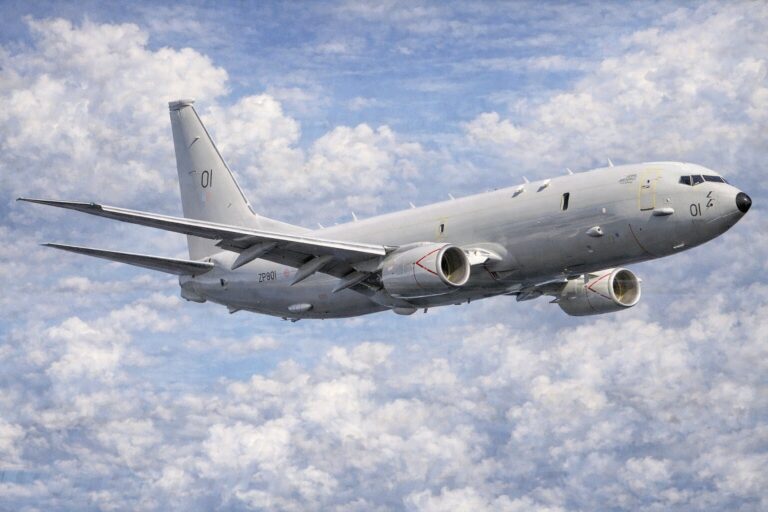
Arrival of the RAF’s First Poseidon MRA1
On 4 February 2020, the first RAF Poseidon MRA1 arrived in the United Kingdom, restoring a…
4 February 2026 · 5 minTri-National Tornado Training Begins at RAF Cottesmore
On 5 January 1981, the first tri-national training course for Panavia Tornado crews commenced at RAF…
5 January 2026 · 4 minReserve Flying Units End in a Turning Point for RAF
On 10 March 1957, Royal Auxiliary Air Force and Royal Naval Volunteer Reserve flying squadrons were…
10 March 2026 · 3 min