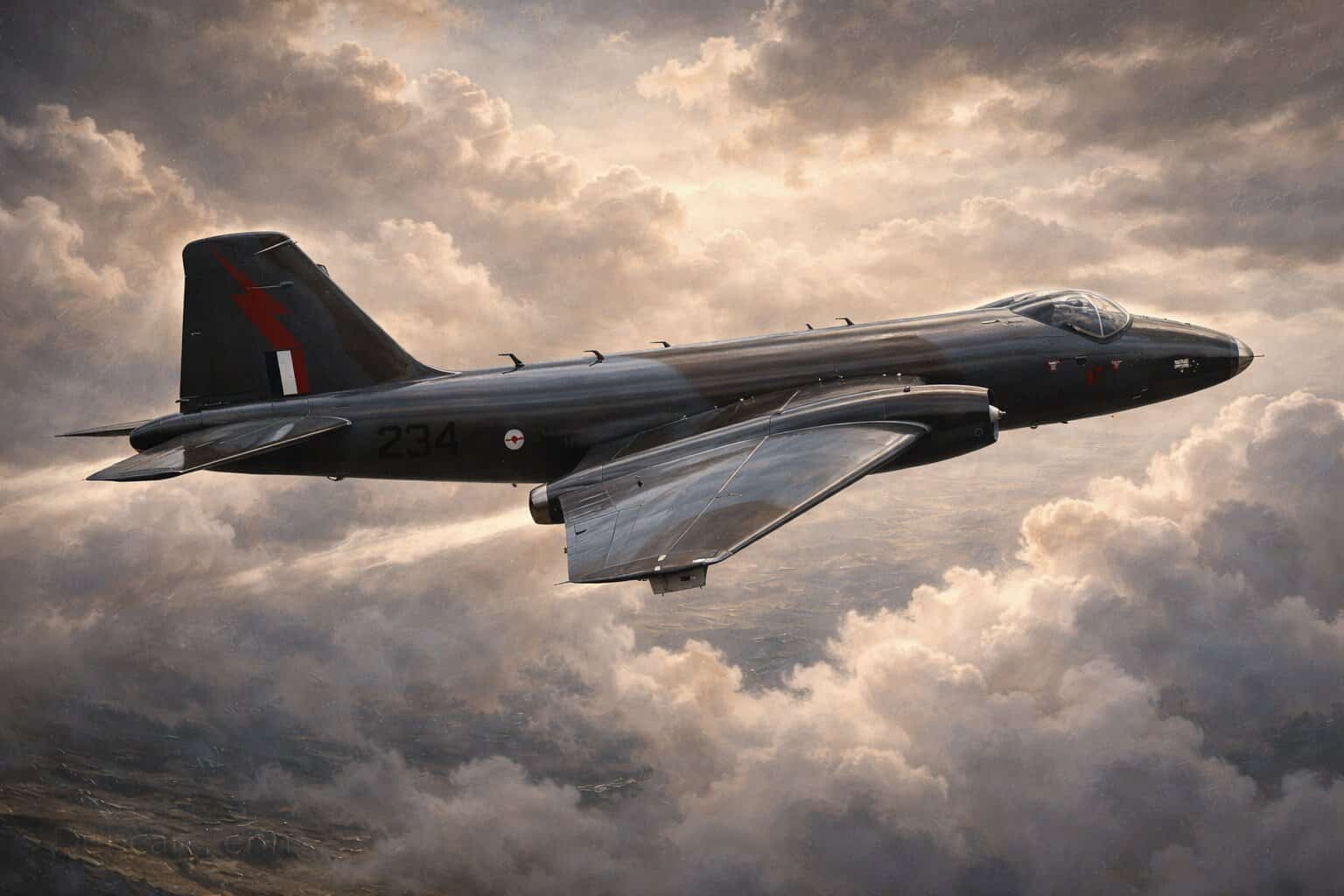
On 9 April 1958, two crew members escaped safely from an English Electric Canberra aircraft at 56,000 feet over Derbyshire. Even in an era of rapid aviation progress, that was an extraordinary occurrence. High-altitude flying imposed severe physical and technical demands, and the successful ejection of both men at such a height speaks to both individual composure and the growing sophistication of post-war escape systems.
The Canberra occupied an important place in RAF history. It was one of the service’s most successful jet aircraft, valued for its performance and adaptability. Yet its very capabilities took crews into environments where small failures could become critical in a matter of moments. At great height, temperature, pressure and speed all combine to make emergency procedures exceptionally unforgiving. A crew forced to abandon an aircraft there entered conditions hostile to life even before descent and landing were considered.
The challenge of ejection at height
The most striking detail is the altitude: 56,000 feet. That figure alone explains why the incident stands out. At such heights, the body is dependent upon equipment and procedure in a way that is less apparent closer to the ground. Oxygen, pressure protection and the sequence of escape all become matters of survival. To eject is not merely to leave the aircraft; it is to trust a chain of engineering and training under the worst possible circumstances.
By the late 1950s, military aviation had pushed far beyond the operating envelope of the Second World War. The RAF was flying faster and higher, and it needed corresponding advances in cockpit design, life support and emergency systems. Incidents like this one showed why those developments mattered. A successful escape was never routine. It was the result of doctrine, technology and aircrew discipline functioning together under acute stress.
A Cold War aviation story away from combat
Because this incident did not take place in combat, but that does not lessen its importance. Cold War flying placed aircrews under new forms of technical and physiological strain, and survival in an emergency at such altitude was itself remarkable. It showed how the RAF’s post-war world depended not only on aircraft performance but on the reliability of escape systems and the professionalism of trained crews.
Significance
The Canberra escape is therefore remembered as more than an isolated survival story. It belongs to the broader history of the RAF’s transition to high-altitude jet operations, in which emergencies became inseparable from questions of engineering, life support, and crew endurance. A successful escape at 56,000 feet demonstrated that those systems could work in conditions that earlier generations of airmen had scarcely imagined.
For RAF history, the episode is a reminder that progress in military aviation always carried new forms of danger alongside new capabilities. The Canberra symbolised modernity and reach, but incidents such as this showed that the margin between routine flight and catastrophe remained narrow even in the jet age.