On This Day, 1939: On 21 October 1939, 46 Squadron Hurricanes intercepted Heinkel He 115 floatplanes over the North Sea in the…
Read the entry →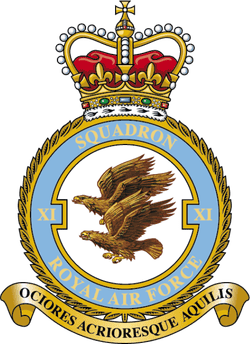
11 Squadron
Ociores acrioresque aquilis — Swifter and keener than eagles
Explore 11 Squadron RAF from the Gunbus in 1915 and Burma operations to Lightnings, Tornado F.3s and today's Typhoons.
Multi-role combat and air-defence fighter squadron with a long continuity from early fighter service to the modern Typhoon force.
11 Squadron occupies a distinctive place in Royal Air Force history because it combines very early fighter service with unusually long continuity into the present day. Formed in 1915, it became one of the first dedicated fighter squadrons of the Royal Flying Corps and later carried that identity through imperial policing, the campaigns of the Second World War, the Cold War air-defence era and the modern Typhoon force. Few RAF units show the changing character of British military aviation across so many different periods.
Its significance lies not in a single famous episode, but in repeated adaptation. 11 Squadron moved from pusher fighters over the Western Front to army co-operation on the North-West Frontier, from Blenheim operations in the Middle East and Burma to post-war night fighters, Lightnings, Tornado F.3s, and today's Eurofighter Typhoons. In doing so, it provides a useful thread through the wider history of RAF air defence and expeditionary air power.
First World War origins
11 Squadron formed at Netheravon on 14 February 1915 from a nucleus provided by 7 Squadron. Equipped with the Vickers F.B.5 Gunbus, it soon moved to France and entered operations as a fighter squadron in July 1915. This gave it an early and important place in the history of fighter aviation, at a time when air combat was still developing in method, technology and purpose.
The squadron's early work was hazardous and transitional. Its original Gunbuses were soon outclassed, but the unit continued in action, later receiving Royal Aircraft Factory F.E.2b fighters and then Bristol Fighters. During the war, it took part in the sustained air fighting over the Western Front and remained in service until after the Armistice, joining the Army of Occupation before disbanding at the end of 1919. Among its notable wartime figures was George Stanley Merrick Insall, whose Victoria Cross gave the squadron one of its earliest and most enduring gallantry associations.
Inter-war service and the road to global war
The squadron re-formed in January 1923 and, after a brief communications role, returned to more conventional flying with the Airco DH.9A. Fairey Fawns and Hawker Horsleys followed before a major change in 1928, when 11 Squadron moved to India. There it became part of the RAF's army co-operation system on the North-West Frontier, flying Westland Wapitis and later Hawker Harts.
This inter-war phase mattered because it moved the squadron away from purely European fighter history and into imperial policing and frontier warfare that shaped much of the RAF experience between the wars. Those duties demanded endurance, reconnaissance, communications work and ground support rather than the classic air-defence role for which the squadron had first become known.
Middle East and Burma in the Second World War
By 1939, the squadron had re-equipped with Bristol Blenheims and moved towards the Far East, but the opening course of the war carried it west again. From Egypt and Aden, it took part in operations against the Italians in East Africa before serving in Greece in 1941. It then moved through Palestine, Syria and Iraq, taking part in the campaign against Vichy French forces in Syria and the subsequent occupation of Iran.
In 1942, the squadron went to Ceylon and then into Burma, where it continued on Blenheims before converting to Hawker Hurricanes. In that theatre, it undertook close-support work for the Fourteenth Army, linking the squadron to one of the most demanding and often under-appreciated campaigns fought by British and Commonwealth forces. Late in the war, it re-equipped with Spitfires for the planned return to Malaya, but the Japanese surrender changed the shape of that final phase. The squadron instead moved to Malaya and then to Japan with the occupation forces before disbanding in 1948.
Post-war jets and Cold War air defence
11 Squadron re-entered the order of battle later in 1948 in Germany as a Mosquito unit, then moved rapidly into the jet age with de Havilland Vampires. In 1952, it became the first squadron to receive the de Havilland Venom, continuing its recurring association with new fighter equipment. After another disbandment, it returned in 1959 as a Meteor night-fighter squadron and soon converted to the Gloster Javelin.
A further major transition came in 1967 when the squadron re-formed on the English Electric Lightning. That phase restored 11 Squadron to the heart of Britain's home air-defence system. From Leuchars and later Binbrook, it formed part of the Quick Reaction Alert structure of the Cold War, standing ready against Soviet air intrusions. Re-equipment with the Panavia Tornado F.3 in 1988 marked the squadron's entry into the final phase of that mission, with service from RAF Leeming until its disbandment in 2005.
Typhoon service and modern significance
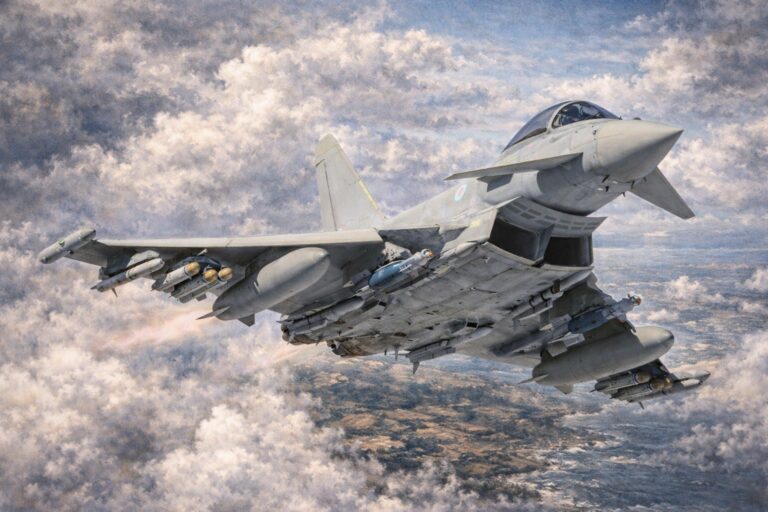
The squadron re-formed again at RAF Coningsby in March 2007 as a Typhoon unit. In this role, it became part of the RAF's modern multi-role combat force, combining the long-standing air-defence mission with expeditionary and coalition operations. Its participation in Operation Ellamy over Libya in 2011 showed how a unit rooted in Britain's fighter past could still serve on contemporary operations.
11 Squadron therefore matters not simply because it is old, but because it shows continuity across radically different eras of air warfare. From the Gunbus to the Typhoon, it has repeatedly stood near points of transition in RAF history. Its record links the beginnings of organised fighter operations, imperial policing, global war, Cold War interception, and the modern combat-air force in a single-squadron narrative.
Western Front, 1915–1918
Loos
Somme, 1916
Arras
Cambrai, 1917
Somme, 1918
Amiens
Hindenburg Line
North West Frontier, 1930–1931
North West Frontier, 1935–1939
East Africa, 1940
Egypt & Libya, 1940–1942
Greece, 1941
Syria, 1941
Ceylon, April 1942
Arakan, 1943–1944
North Burma, 1943–1944
Manipur, 1944
Burma, 1944–1945
Libya, 2011
Western Front
North West Frontier
East Africa Campaign
Greek Campaign
Syria-Lebanon Campaign
Anglo-Soviet invasion of Iran
Burma Campaign
Battle of Britain
Operation Ellamy
Second Lieutenant George Stanley Merrick Insall won the Victoria Cross for his actions of 7 November 1915 while serving with 11 Squadron, giving the unit one of its earliest and most distinguished gallantry associations.
| Period | Station | Notes |
|---|---|---|
| 1915 | Netheravon | Formed from a nucleus provided by 7 Squadron. |
| 1915–1919 | France and the Western Front, including Saint-Omer | Fighter operations and later Army of Occupation service. |
| 1923–1928 | Andover and Bircham Newton | Re-formed, communications work, then DH.9A, Fawn and Horsley service. |
| 1929–1939 | Risalpur | Army co-operation and frontier duties with Wapitis and Harts. |
| 1939–1942 | Singapore, Egypt, Aden, Greece, Palestine, Syria and Iraq | Blenheim operations across several theatres. |
| 1942–1946 | Ceylon, Burma, India and Malaya | Burma operations and post-war move to Malaya. |
| 1946–1948 | Japan | Occupation service before disbandment. |
| 1948–1957 | RAF Wahn | Mosquito, Vampire and Venom era. |
| 1959–1966 | RAF Geilenkirchen | Meteor and Javelin night-fighter service. |
| 1967–1972 | RAF Leuchars | Lightning air-defence role. |
| 1972–1988 | RAF Binbrook | Continued Lightning service. |
| 1988–2005 | RAF Leeming | Tornado F.3 air-defence era. |
| 2007 onwards | RAF Coningsby | Typhoon multi-role combat service. |
| Name | Dates | Notes |
|---|---|---|
| U. J. D. Bourke | 1915 | First commanding officer on formation. |
| Cuthbert T. Maclean | 1917 | Led the squadron in the First World War fighter period. |
| Edward A. B. Rice | 1923 | Commanded at the squadron’s inter-war re-formation. |
| Robert O. Jones | 1936 | Associated with the pre-war period before the Second World War. |
| Richard Kellett | 1941 | Commanded during the Middle East wartime phase. |
| David G. Evans | 1956 | Associated with the post-war jet period. |
| Peter S. Collins | 1967 | Commanded in the opening Lightning phase. |
| Michael J. Graydon | 1977 | Associated with the later Cold War air-defence era. |
| Gavin D. A. Parker | 2007 | Commanded at the squadron’s Typhoon re-formation. |


Churchill Signals the Coming Battle of Britain in Commons
Churchill told Parliament that the Battle of France was over and the Battle of Britain was…
18 June 2026 · 3 minThe V1 Campaign and the RAF’s Air Defence Response
How the RAF met the V1 offensive through Operation Diver, fighter interception and an adapted air-defence…
23 June 2026 · 4 minRAF Fighter Power Beyond 1940: From Spitfire to Deterrence
How RAF fighter power evolved from wartime Spitfire defence into overseas presence, air control and Cold…
18 August 2026 · 3 min