On This Day, 1944: On 27 November 1944, the RAF Fauld explosion devastated an underground bomb store and nearby workplaces, killing about…
Read the entry →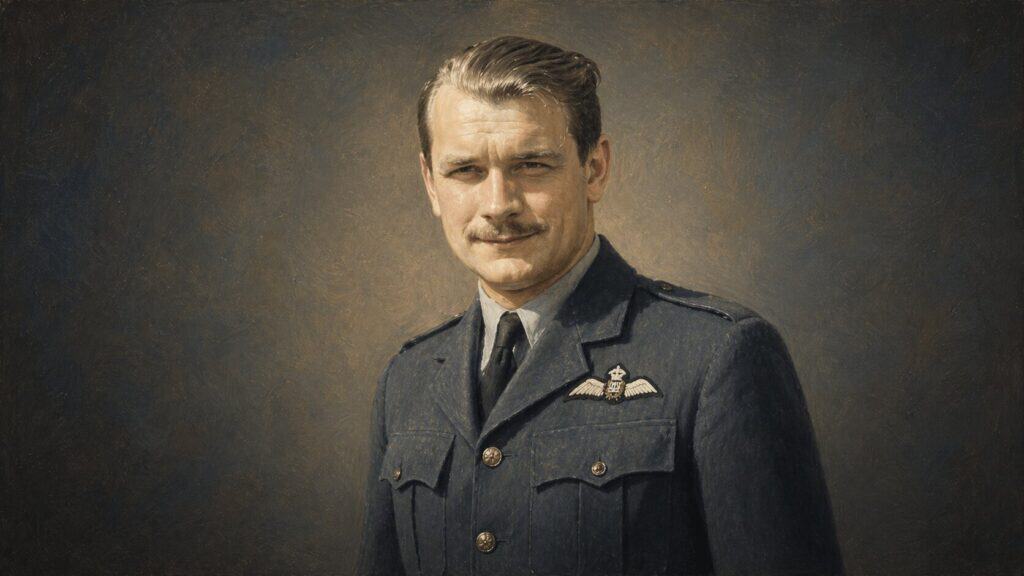
Group Captain
John Hemingway
John Hemingway served with 85 Squadron in France and the Battle of Britain, later commanded 43 Squadron, and became the last surviving pilot of The Few.
Group Captain John Allman ‘Paddy’ Hemingway DFC (17 July 1919 to 17 March 2025) served as an RAF fighter pilot in the Battle of France and the Battle of Britain, and later held operational and command appointments across the service. At his death aged 105, he was the last known surviving pilot of the Battle of Britain.
Who was John Hemingway?
John Allman “Paddy” Hemingway was an Irish-born RAF fighter pilot, born in Dublin on 17 July 1919, who flew Hurricanes with No. 85 Squadron in the Battle of France and the Battle of Britain and was shot down four times during the war. When he died in Dublin on 17 March 2025, aged 105, he was the last surviving pilot of the Battle of Britain (Royal Air Force).
John Allman Hemingway was born in Dublin on 17 July 1919 and grew up in an Irish Protestant family at a time when military service in the British armed forces still formed part of many Irish careers and traditions. He was educated at St Patrick’s Cathedral Choir School and later at St Andrew’s College in Dublin. Known in later life as Paddy Hemingway, he had a long and unusually varied Royal Air Force career that began before the Second World War and continued until the late 1960s.
When did John Hemingway join the RAF?
Hemingway joined the RAF on a short-service commission on 7 March 1938 and was flying Hawker Hurricanes with No. 85 Squadron by the start of the war. He was one of the generation of young pilots who went straight from training into the battles of 1940.
Hemingway entered the Royal Air Force on a short-service commission on 7 March 1938, joining while Europe was moving towards war. He trained in Britain and was confirmed as a pilot officer the following year. By the opening phase of the war, he was flying Hawker Hurricanes, the fighter that would become central to his early operational service.
His arrival in the RAF was part of a generation that had little time to mature gradually in peacetime conditions. Young pilots who joined in the late 1930s were quickly drawn into active operations, first over France and the Low Countries and then in the air battles over Britain itself. Hemingway’s career followed that pattern closely.
What did John Hemingway do in the Battle of Britain?
Hemingway flew Hurricanes with 85 Squadron through the Battle of Britain, baling out into the sea off Clacton on 18 August 1940 and again over the Pitsea marshes on 26 August. Before that, in the Battle of France, he had been credited with a Heinkel He 111 and a Dornier Do 17 on 10 and 11 May 1940.
With 85 Squadron, Hemingway went to France in 1940 during the German offensive in the west. On 10 May 1940, he was credited with a Heinkel He 111, followed by a Dornier Do 17 on 11 May. During the fighting he was forced to land near Maastricht after his Hurricane was damaged, and had to make his way back to his unit. He also flew during the fighting associated with Dunkirk and the retreat from France.
He served for a period with No. 253 Squadron before returning to No. 85 Squadron on 15 June 1940, in time for the Battle of Britain. Flying Hurricanes, he was among the younger fighter pilots committed to the defence of southern England at the height of the Luftwaffe assault. His own experience reflected the attritional nature of the battle. On 18 August, he bailed out into the sea off Clacton and was rescued after approximately two hours. On 26 August, his Hurricane P3966 was damaged and he bailed out over the Pitsea marshes. Both incidents underline the risks faced by No. 85 Squadron’s pilots. Even so, he returned to operations and remained part of the battle that later defined the public memory of Fighter Command.
When did John Hemingway win the DFC?
Hemingway was awarded the Distinguished Flying Cross on 1 July 1941, after 85 Squadron had converted to night fighting on Douglas Havocs, and was mentioned in despatches that September. In May 1941 he survived baling out at about 600 feet in bad weather.
In 1941, after No. 85 Squadron converted to night fighting, Hemingway flew Douglas Havoc aircraft in a very different form of combat. In May that year, instrument failure in bad weather forced him to bail out at approximately 600 feet. His parachute caught in a tree, and he survived with a broken hand. Separately, he was awarded the Distinguished Flying Cross on 1 July 1941 and was mentioned in despatches that September.
Following this exhausting early war service, Hemingway spent time on lighter duties before joining 1452 Flight at West Malling. As the war moved into a new phase, his work broadened beyond the day-fighter fighting with which his name is most closely associated.
What did John Hemingway do later in the war?
Hemingway commanded No. 43 Squadron’s Spitfires in Italy from September 1944, and in April 1945 was shot down by flak near Ravenna and helped back to Allied lines by Italian partisans. He stayed in the RAF after the war, commanding RAF Leconfield and retiring as a Group Captain in 1969.
He served as an air traffic control officer during the invasion of Normandy, an essential but less publicly celebrated role in the conduct of large-scale air operations. From September 1944 to December 1945, he commanded No. 43 Squadron, flying Supermarine Spitfires in the Mediterranean theatre, including operations in Italy. In April 1945, anti-aircraft fire brought down his Spitfire near Ravenna behind enemy lines. Italian partisans helped him return to Allied territory. During the war, he was shot down four times in total, a stark measure of how often he returned to danger.
After 1945, he remained in the RAF, including command of No. 32 Squadron in Egypt, service with NATO and appointments at the Air Ministry. In 1966, he became Officer Commanding RAF Leconfield. Promotion eventually carried him to the rank of group captain, and he retired in 1969 after more than three decades of service. That long post-war career places him among the officers who helped carry the RAF from the emergency conditions of the Second World War into the Cold War service that followed.
When did John Hemingway die?
Hemingway died in Dublin on 17 March 2025, aged 105, the last surviving pilot of “the Few” (The Irish Times). He had married Helen “Bridget” Prowse in 1948, and they had three children.
In 1948, Hemingway married Helen ‘Bridget’ Prowse; they had three children. She died in 1998. In later life, Hemingway lived for periods outside Ireland before returning to Dublin. As the years passed and the number of surviving Battle of Britain veterans declined, he came to occupy a particular place in public memory as one of the last living members of what Churchill had called The Few. After the death of other surviving pilots, he became the last known Battle of Britain pilot still alive.
That position brought renewed public attention, especially in Britain and Ireland, though by most accounts, he remained measured about his fame. In 2023, he returned to his old school in Dublin for public events connected to his wartime generation, and in 2024, his 105th birthday was marked there. Hemingway died there on 17 March 2025 at the age of 105.
Why is John Hemingway important in RAF history?
Hemingway fought through the Battle of France, the Battle of Britain, night fighting and the Italian campaign, then served the RAF into the Cold War. As the last of the Few, he became a living link to one of the defining campaigns in RAF history.
John Hemingway is historically significant partly because of what he did and partly because of what he came to represent. Operationally, he belonged to the front-line fighter force that experienced the Battle of France, Dunkirk, the Battle of Britain, night fighting, Mediterranean operations and the wider wartime evolution of the RAF. His DFC and mention in despatches reflected sustained active service rather than a single simplified legend.
In public memory, however, he became most widely known as the last surviving Battle of Britain pilot. That status gave his later life symbolic weight beyond the details of his own logbook. It linked living memory directly to one of the defining campaigns in RAF history. His career also stands on its own: he had shared the dangers, changes and continuities of RAF service across war and peace.
| Dates | Role | Unit | Aircraft |
|---|---|---|---|
| 1938–1940 | Pilot Officer / Flying Officer, fighter pilot | 85 Squadron | Hawker Hurricane |
| 1940 | Flying Officer, fighter pilot | 253 Squadron | Hawker Hurricane |
| 1940–1941 | Flying Officer / Flight Lieutenant, fighter and night-fighter pilot | 85 Squadron | Hawker Hurricane; Douglas Havoc |
| 1941 | Flight Lieutenant, night-fighter duties | 1452 Flight | Douglas Havoc |
| 1944–1945 | Squadron Leader, Commanding Officer | 43 Squadron | Supermarine Spitfire |
| 1945–1969 | Post-war staff and command appointments | RAF Leconfield, NATO, Air Ministry |
Battle of Britain
How the Battle of Britain saw RAF Fighter Command defeat the Luftwaffe’s attempt to gain the air superiority needed for invasion in 1940.
Battle of France
An RAF-centred history of the Battle of France, from the opening German offensive to Dunkirk, losses in the air, and the lessons of 1940.
John Hemingway is remembered above all as the last surviving Battle of Britain pilot, a status that gave his later life a symbolic importance beyond the formal details of rank and appointment. That public role linked a living witness directly to one of the RAF's defining campaigns, and made him a figure of remembrance in both Britain and Ireland.
Yet his legacy rests on more than longevity. He served in France, the Battle of Britain, night fighting, Mediterranean operations and the post-war RAF, and his decorations reflected repeated exposure to operational danger rather than a single celebrated episode. His place in RAF history therefore sits at the meeting point of lived experience, institutional memory and the fading direct memory of 1940.
John Paddy Hemingway, Last Battle of Britain Pilot
On 17 March 2025, John “Paddy” Hemingway died at 105, marking the passing of the last…
17 March 2026 · 3 minMosquito Enters Bomber Command Service with No. 105 Squadron
On 1 June 1942, No. 105 Squadron flew the Mosquito’s first operational bombing mission for Bomber…
1 June 2026 · 3 minFrom Dunkirk to Air Mobility: RAF Transport Under Pressure
Why the RAF could not fly an army out of Dunkirk in 1940, what little air…
26 May 2026 · 5 min