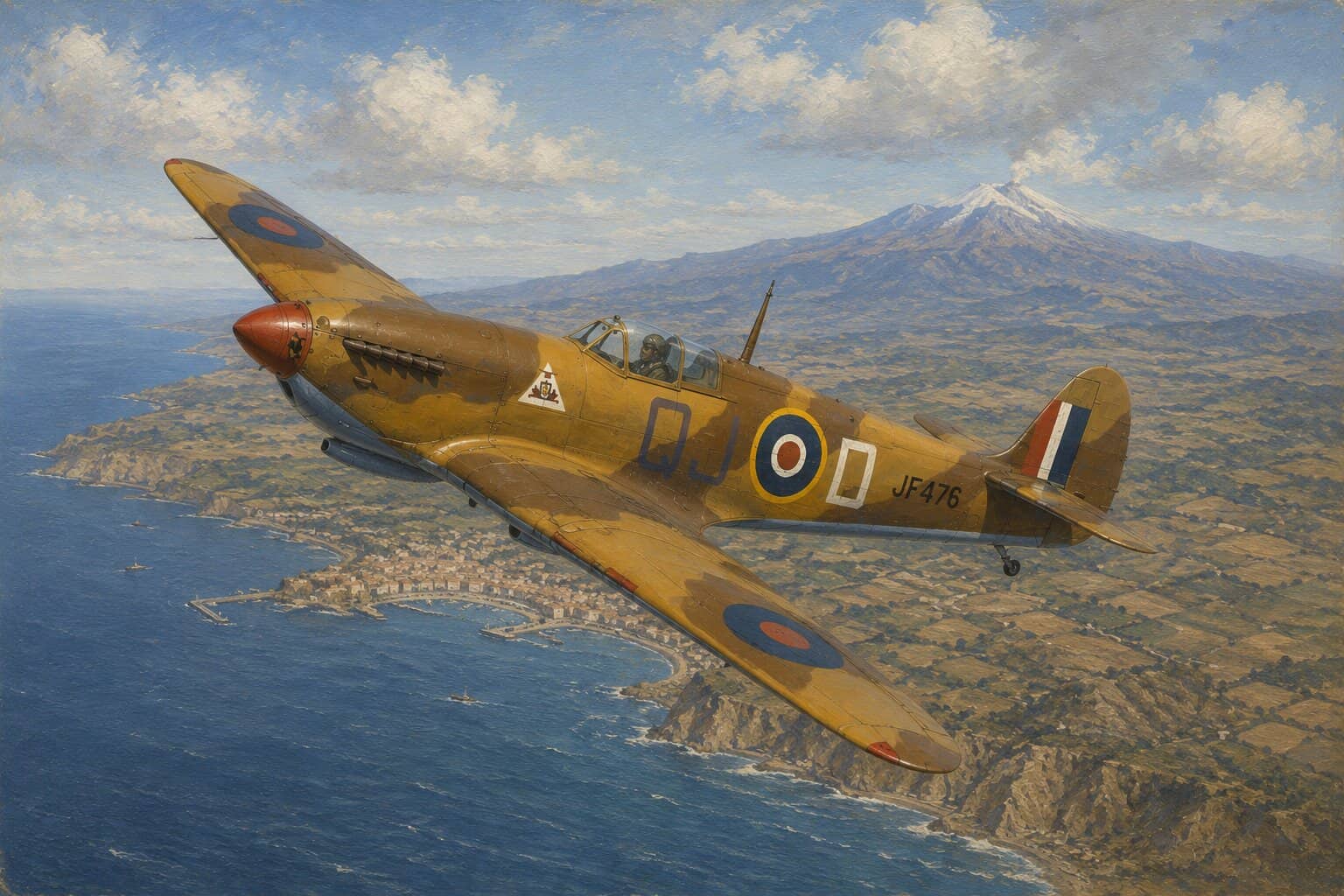
The Sicily air campaign of 1943 marked the point at which Allied air power in the Mediterranean moved from hard-won survival to sustained offensive dominance. For the RAF, the campaign was not simply a supporting episode to Operation Husky, but a demonstration of how air superiority, interdiction and close cooperation with naval and land forces could shape an invasion before troops went ashore and continue to influence events once the fighting began.
Background
The invasion of Sicily followed the defeat of Axis forces in North Africa and the consolidation of Allied air strength around the Mediterranean. From bases in Tunisia, Malta and North Africa, Allied air forces were now positioned to strike Sicilian airfields, ports, shipping routes and communications with far greater weight than had been possible earlier in the war. That changed the character of the campaign before the first landings took place.
For the RAF, the Sicilian operation formed part of a wider shift in the Mediterranean air war. Earlier fighting had often been shaped by shortage, dispersal and the need to protect vulnerable positions such as Malta. By mid-1943, air power could instead be concentrated for offensive purposes. Under the broader Allied command structure associated with figures such as Arthur Tedder and Arthur Coningham, air forces were expected to isolate the battlefield, reduce enemy freedom of movement and support the invasion as an integrated operation rather than as a separate effort.
The Air Plan
Air operations against Sicily were designed to do more than destroy individual targets. The larger intention was to weaken the Axis air response, disrupt reinforcement and make the island harder to defend as a coherent battlefield. Airfields were attacked to reduce the scale and tempo of enemy flying activity. Ports and coastal shipping were hit, complicating supply. Rail and road communications were pressured so that men, fuel and equipment could not move freely to threatened sectors.
This approach reflected growing Allied confidence in interdiction. Rather than treating the battle as decided only at the beachhead, planners used air power to attack the conditions that enabled organised resistance. The effect was cumulative. Even where individual strikes did not produce decisive destruction in isolation, repeated attacks forced delay, dispersal and uncertainty across the defence system.
The campaign also drew upon the increasingly mature cooperation between tactical and strategic air elements in the theatre. Fighters, fighter-bombers, medium bombers and heavier aircraft all had roles, whether in direct support, offensive counter-air work or attacks on transport and infrastructure. The RAF's contribution sat within the wider Allied air effort, but it remained central to the operational method developed through the desert war and adapted for amphibious assault.
Opening The Invasion
When the landings began, the value of earlier air preparation became clearer. The invasion convoys and beaches benefited from the weakening of the Axis air threat, while Allied ground forces were aided by ongoing attacks on routes, strongpoints, and local concentrations. Air power could not remove every difficulty from the assault, and the Sicilian campaign still involved hard fighting, confusion, and determined resistance, but it reduced the defenders' ability to respond with freedom and speed.
The battle for Sicily also showed the importance of air power in managing momentum after the initial assault. Once forces were ashore, the problem was no longer only about gaining a foothold, but about sustaining the advance and preventing the enemy from restoring the balance. Continued pressure from the air limited the room available for organised counter-action and helped maintain the operational tempo on which the invasion depended.
Results And Consequences
The campaign contributed materially to the Allied capture of Sicily and helped open the next stage of the war against Italy. Air superiority, once established, allowed the Allies to combine sea movement, land manoeuvre and logistical build-up with far less interference than would otherwise have been possible. The campaign did not end Axis resistance in the theatre, nor did air power alone decide events, but it made the invasion markedly more manageable and the defence markedly harder.
For the RAF, Sicily confirmed lessons that had been emerging since the later North African fighting. Control of the air was valuable not as an abstract measure of strength, but because it shaped what could be done on land and at sea. Interdiction, battlefield isolation and sustained support to a combined operation had become practical instruments of campaign design rather than secondary or improvised tasks.
Wider Context
Sicily stood between the North African victory and the invasion of mainland Italy, and its air campaign reflected that transitional position. It drew upon the experience of the desert war, the defence and reinforcement of Malta, and the expanding Allied command machinery in the Mediterranean. It also pointed forward to later operations in which air superiority and transport disruption were treated as preconditions for success rather than welcome advantages if they could be achieved.
In RAF terms, the Sicilian campaign was therefore important not simply because it supported a major invasion, but because it illustrated a more mature use of air power in coalition warfare. Aircraft were employed not only to fight other aircraft or strike targets of opportunity, but to organise the wider battle by constraining movement, weakening response and helping determine the pace of the campaign.