On This Day, 1944: On 27 November 1944, the RAF Fauld explosion devastated an underground bomb store and nearby workplaces, killing about…
Read the entry →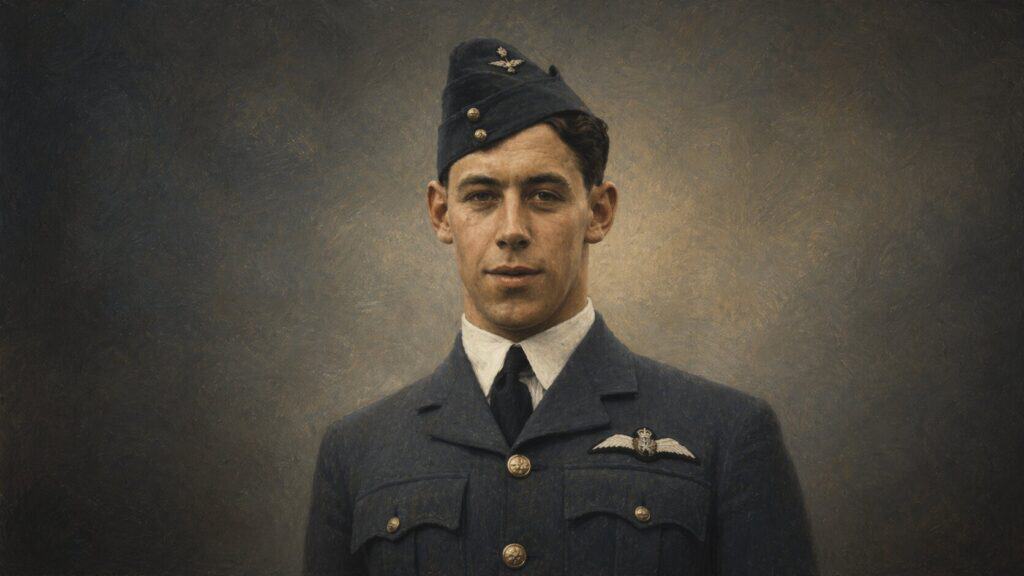
Flying Officer
Edgar Kain
Edgar Kain of 73 Squadron became the RAF's first ace of the Second World War during the fighting in France before his death in 1940.
Who was Edgar Kain?
Edgar James “Cobber” Kain was a New Zealand fighter pilot, born at Hastings on 27 June 1918, who flew Hurricanes with No. 73 Squadron in France and became the RAF’s first ace of the Second World War. He was killed in a flying accident on 7 June 1940, aged 21 (Te Ara: The Encyclopedia of New Zealand).
Edgar James Kain was born at Hastings, New Zealand, on 27 June 1918 and grew up largely in Wellington after his family moved there in his childhood. He developed an early fascination with flying and, while still young, sought practical instruction through the Wellington Aero Club. Academic performance was not his strongest feature in school, but aviation gave him a clearer sense of direction. Determined to become a service pilot, he obtained the qualifications needed to apply for entry to the Royal Air Force and travelled to Britain in 1936 to pursue that ambition.
Kain belonged to a generation of young Commonwealth airmen who entered the RAF before the war and reached operational service just as Europe moved towards conflict. By the time war began, he was a trained fighter pilot who had already passed through the regular pre-war system.
When did Edgar Kain join the RAF?
Kain travelled to Britain and was accepted into the RAF in December 1936, gained his wings in June 1937 and joined No. 73 Squadron at RAF Digby that November. He flew Gloster Gladiators with the squadron before it converted to the Hawker Hurricane in 1938.
Kain was accepted into the RAF in December 1936 and undertook elementary flying training at Brough in Yorkshire. He was appointed acting pilot officer on 21 December 1936, subsequently completing ground training at RAF Uxbridge and beginning advanced flying training in March 1937. He gained his wings in June and joined No. 73 Squadron at RAF Digby in November 1937.
His early operational service was flown first on the Gloster Gladiator, the last of the RAF’s biplane fighters, before the squadron converted to the Hawker Hurricane. That transition placed him within one of the key fighter units that would go to France at the opening of the war. By 1939, he had matured into an aggressive and confident pilot whose temperament suited fighter combat, even if that same quality sometimes contributed to a risk-taking appetite.
Why was Edgar Kain the RAF’s first ace of the war?
Kain shot down a Dornier Do 17 on 8 November 1939, 73 Squadron’s first victory of the war, and by the end of March 1940 had reached five victories, making him the first RAF pilot of the Second World War to become an ace. He was awarded the DFC and became one of the best-known RAF airmen in Britain and New Zealand during the Phoney War.
In September 1939, No. 73 Squadron deployed to France alongside No. 1 Squadron, providing Hurricane fighter protection for the RAF’s Advanced Air Striking Force. Initially stationed at Le Havre-Octeville, the squadron subsequently moved eastwards to Rouvres. During the Phoney War, there were long periods of limited contact with the enemy, but Kain gradually established a reputation within the squadron. On 8 November 1939, Kain destroyed a Dornier Do 17. It was his first aerial victory and the first credited to No. 73 Squadron during the Second World War.
Further successes followed only gradually during the winter and early spring, reflecting the intermittent nature of air fighting in that phase of the campaign. By March 1940, Kain had reached the five victories traditionally associated with fighter-ace status. That made him the RAF’s first flying ace of the war. He was also awarded the Distinguished Flying Cross, becoming an especially visible figure at a time when the RAF had few fighter personalities yet was known to the wider public. Reports in Britain and New Zealand helped turn “Cobber” Kain into a recognisable name.
What did Edgar Kain do in the Battle of France?
After the German offensive of 10 May 1940, Kain flew repeated sorties with 73 Squadron over France and added rapidly to his score against bombers and reconnaissance aircraft. Published totals for his victories range from 14 to 17, reflecting the difficulty of assessing combat claims in that campaign.
Kain’s greatest operational importance came in the fighting that followed the German offensive of 10 May 1940. With 73 Squadron committed to the air battle over France, he added rapidly to his score while flying repeated sorties in support of Allied forces and in defence against German bomber and reconnaissance aircraft. He claimed victories over Dornier bombers, Henschel reconnaissance aircraft and other Luftwaffe types during the opening weeks of the Battle of France, often under intense pressure as the military situation on the ground deteriorated.
These combats made him one of the RAF’s most publicised fighter pilots of the campaign. Kain’s final victory total varies between historical accounts. Figures of 14, 16 and 17 enemy aircraft appear in published histories, reflecting differences in the assessment of wartime combat claims. Whatever the precise tally, his achievements made him one of the RAF’s most prominent fighter pilots during the opening phase of the war. He held no senior command; his value lay in combat example, morale and the practical experience he brought to a hard-pressed front-line squadron.
How did Edgar Kain die?
Kain was killed on 7 June 1940 at Échemines in France when his Hurricane crashed during low-level aerobatics, flown as a farewell before he left the squadron for a rest. He is buried at Choloy War Cemetery (Commonwealth War Graves Commission).
By early June 1940 Kain was physically and mentally exhausted after continuous operations in France. He was ordered to return to England once replacement pilots arrived. On 7 June 1940, Kain prepared to leave No. 73 Squadron in France for a period of rest. Before departing, he performed a low-level aerobatic display in his Hurricane over the airfield at Échemines. After completing two rolls, his aircraft crashed while attempting a third. Kain was thrown from the aircraft and killed. He was 21 years old.
His death came at a moment when his name was widely known, which gave the loss particular resonance. He was first buried at Troyes and after the war reinterred at Choloy War Cemetery in France. The circumstances of his death, occurring after combat but not in action against the enemy, have remained part of the story told about him, often as a reflection of the strain and bravado that could accompany sustained fighter operations in 1940.
Why is Edgar Kain important in RAF history?
Kain gave the RAF its first fighter hero of the Second World War at a time when the service needed proof of success, and as a New Zealander he embodied the Commonwealth’s part in Britain’s air war. His death in a farewell display also showed the strain of continuous operations in 1940.
He became the RAF’s first ace of the Second World War at a stage when the service needed credible examples of offensive success. As a New Zealander serving in the RAF, he also embodied the wider imperial and Commonwealth dimension of Britain’s air war. His fame in 1940 was therefore both military and symbolic.
His career was too short to place him among the longest-serving or highest-scoring RAF fighter leaders of the war, and his score carries the uncertainty of all aerial victory claims in the campaign in France. He remains one of the defining RAF figures of the war’s opening phase: a gifted and daring fighter pilot whose public reputation was forged in the difficult months before the Battle of Britain and whose service illustrates the cost of those early air battles.
| Dates | Role | Unit | Aircraft |
|---|---|---|---|
| 1936–1937 | Pilot training | Royal Air Force training establishments | Blackburn B-2 |
| 1937–1938 | Acting Pilot Officer / Pilot Officer | 73 Squadron | Gloster Gladiator |
| 1938–1940 | Pilot Officer / Flying Officer, fighter pilot | 73 Squadron | Hawker Hurricane |
Battle of Britain
How the Battle of Britain saw RAF Fighter Command defeat the Luftwaffe’s attempt to gain the air superiority needed for invasion in 1940.
Battle of France
An RAF-centred history of the Battle of France, from the opening German offensive to Dunkirk, losses in the air, and the lessons of 1940.
Edgar Kain has been remembered above all as the RAF's first ace of the Second World War, a distinction that gave him a symbolic importance out of proportion to the brief length of his career. His reputation was shaped both by genuine operational success and by wartime publicity, which turned the young New Zealander known as “Cobber” Kain into a morale figure at a moment when Allied fortunes were deteriorating.
That public image can obscure the harder military context. Kain's standing rested on sustained combat flying with 73 Squadron in France, where he combined aggression, skill and a willingness to press attacks at close range. At the same time, later historians have noted uncertainty over the exact number of enemy aircraft he destroyed, a reminder that public fame and the historical record do not always align neatly.
He remains significant in RAF history not simply because he was first, but because his career illuminates the opening air fighting of 1939–40, the role of Dominion personnel in the RAF, and the heavy personal strain placed on fighter pilots during the collapse of France.
Battle of Berlin Ends with Bomber Command’s March Raid
On 22 March 1944, Lancaster and Halifax bombers joined a major Berlin raid often seen as…
22 March 2026 · 3 minThe Spitfire Beyond 1940 and Its Enduring RAF Wartime Role
How the Spitfire kept its place after the Battle of Britain: the Mk V and Mk…
22 September 2026 · 2 minWhy the Hawker Hurricane Carried Fighter Command in 1940
Why the Hawker Hurricane carried Fighter Command in 1940: 33 squadrons to the Spitfire's 18, 656…
3 November 2026 · 4 min