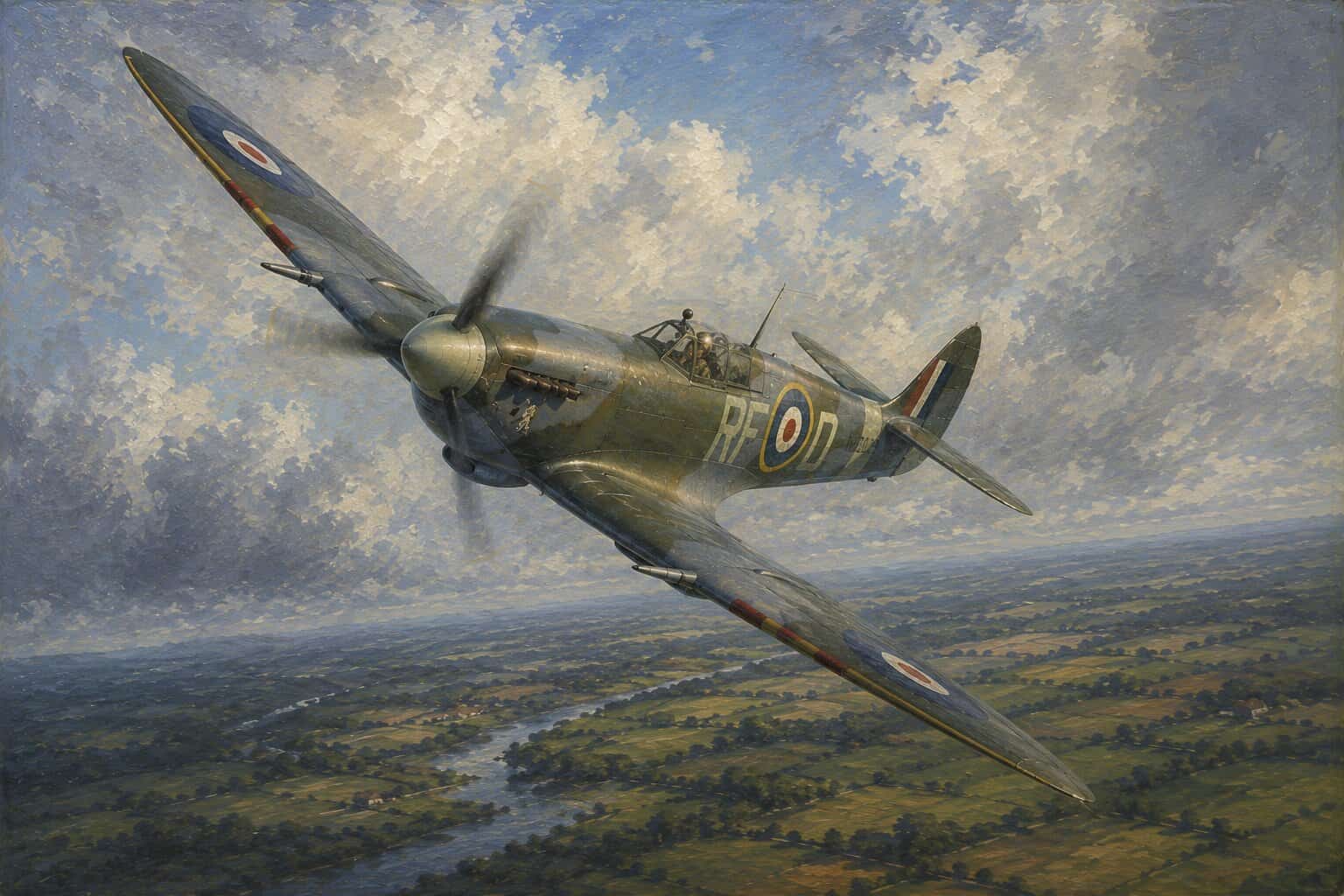
The Supermarine Spitfire is inseparable from the Battle of Britain, but its wartime importance did not end there. The aircraft endured because it could be adapted to changing operational needs and because the RAF continued to find uses for it across successive phases of the air war. Its later service reveals a broader importance than the iconic summer of 1940 alone suggests.
Beyond A Single Campaign
Public memory often freezes the Spitfire at the moment of Britain’s air defence crisis, when it stood alongside the Hawker Hurricane in Fighter Command’s battle against the Luftwaffe. Yet the aircraft’s real significance lay partly in what happened afterwards. It remained in demand because it combined performance with a capacity for development, allowing the RAF to continue employing it under evolving conditions.
That capacity mattered in a war of rapid change. Aircraft that could not be adapted quickly lost value. The Spitfire, by contrast, could be improved, re-equipped and employed in more than one operational setting.
Adaptation And Continued Service
As the RAF moved from defensive battle to wider offensive and overseas commitments, the Spitfire remained useful. It served not simply as a defensive interceptor but in varied forms suited to different tasks and theatres. Its presence in multiple phases of the war reflected a broader RAF need for a fighter that could remain competitive while circumstances changed.
This continuing relevance also had organisational effects. The Spitfire was woven into training, squadron identity, reinforcement and wider planning. It became part of the RAF’s enduring fighter structure rather than a machine associated with one celebrated emergency.
Operational Importance
The aircraft’s value lay in the combination of adaptability and familiarity. Crews, commanders, and maintenance systems could continue to work with a platform that remained operationally viable even as the war’s demands shifted. That gave the RAF a degree of continuity at a time when continuity was often difficult to preserve.
The Spitfire’s service after 1940 also demonstrates the importance of not measuring aircraft value only by publicity or symbolism. Some weapons become famous in one campaign and then recede; the Spitfire remained significant because it kept doing useful work.
Significance
In RAF terms, the Spitfire endured through the air war because it could evolve with the service’s needs. Its fame was secured early, but its historical weight rests on sustained utility rather than memory alone. The aircraft remained central not because it symbolised an earlier victory, but because it continued to contribute to later operations across the wider war.