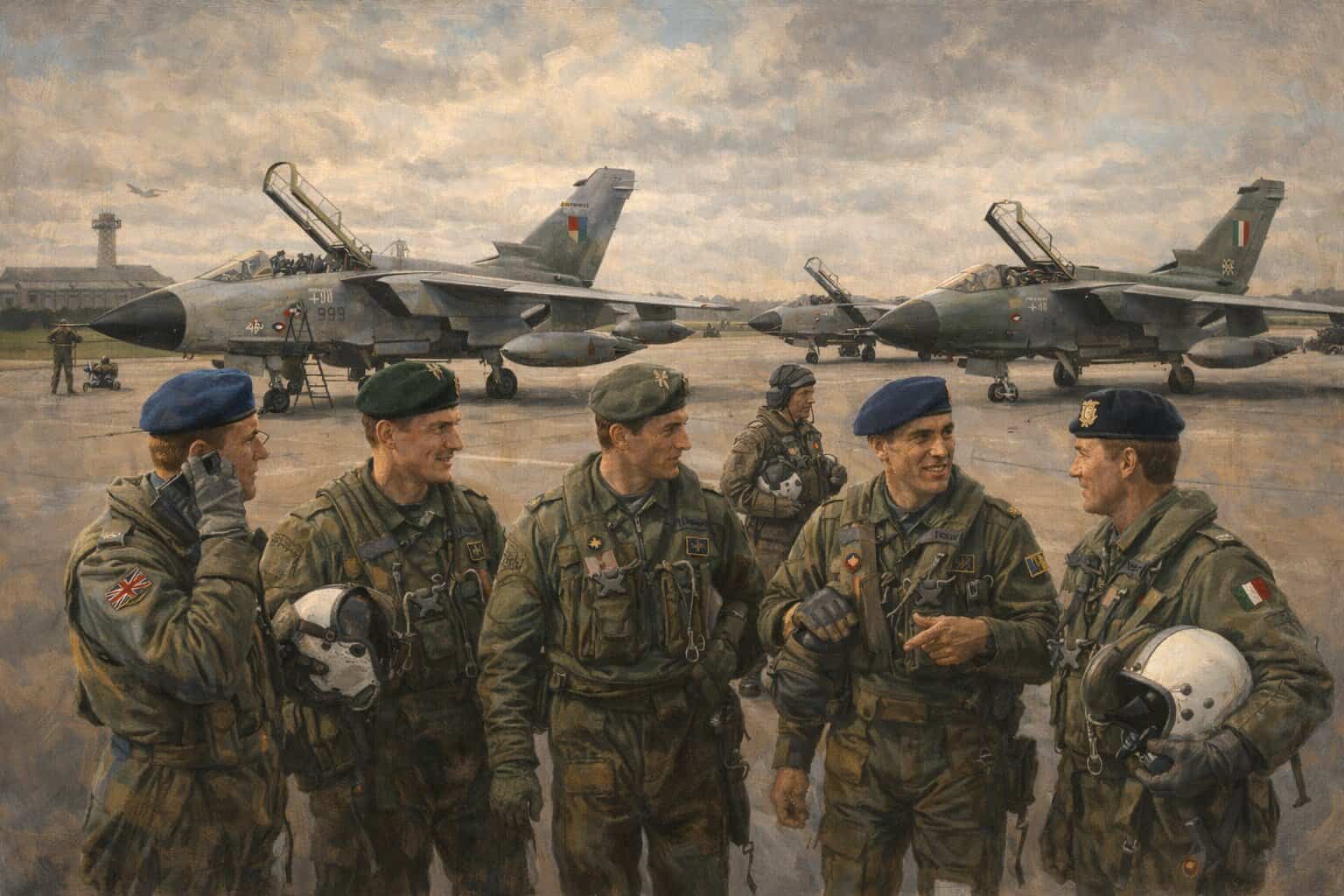
On 5 January 1981, the first course began at RAF Cottesmore for aircrew and ground personnel converting to the Panavia Tornado under the newly formed Tri-National Tornado Training Establishment, known as the TTTE. Course No. 1 marked the beginning of flying training at Cottesmore on an aircraft that would become a mainstay of the participating air forces’ strike capability. The TTTE was not formally inaugurated until 29 January 1981, when the establishment was opened as a permanent tri-national unit. The January course was the first practical step in a training partnership that had been years in preparation, and it should not be mistaken for the establishment’s formal creation.
Building the TTTE at RAF Cottesmore
The Tornado had been under development since the late 1960s, when Britain, West Germany and Italy agreed to produce a single advanced strike aircraft to replace a range of older types across their air forces. The three partner nations chose RAF Cottesmore as the base for a common Tornado conversion establishment, allowing the aircraft, instructors and training facilities to be concentrated at one station. Preparations were under way before the first course began on 5 January 1981. The TTTE was then officially opened on 29 January, when the air chiefs of Britain, Italy and West Germany and the commander of the West German Navy attended the inauguration. The two dates therefore mark different stages: training had already begun before the formal opening ceremony.
Why Tornado Crews Needed Specialist Conversion Training
The Panavia Tornado presented a significant step up from the aircraft it replaced. Its variable-geometry wings, terrain-following radar and low-level strike role demanded techniques and procedures that had no direct equivalent in earlier RAF, Luftwaffe or Italian Air Force service. Conversion at Cottesmore combined ground school and simulator instruction with flying training, preparing pilots and navigators to handle the aircraft’s systems and its demanding low-level profile before they moved on to operational squadrons in their home air forces. Instructors introduced students to the Tornado’s cockpit layout, its automated terrain-following system and the weapons-delivery methods that its strike role required, skills that could not simply be carried over from the older aircraft the Tornado was replacing. Ground crews trained alongside aircrew, learning the maintenance and support procedures that kept a shared fleet serviceable across three national contingents, each working to its own service’s standards within a common Cottesmore organisation.
How the Multinational Establishment Developed
As the TTTE matured, it grew into three flying squadrons, designated A, B and C Squadron, each staffed jointly by RAF, Luftwaffe and Italian Air Force personnel, together with a standardisation squadron responsible for maintaining common instructional practice across the establishment. A dedicated ground school handled classroom and simulator instruction before students progressed to flying training. This structure allowed the TTTE to run conversion courses for the partner services from a single site, rather than requiring each nation to duplicate the complete training system independently.
Cottesmore and the Tornado Generation
Over the following years, RAF Cottesmore became the shared home of Tornado conversion training, hosting successive courses of British, West German and, from 1982, Italian crews before they moved to front-line squadrons. The arrangement gave the three partner air forces a common standard for Tornado conversion even as each continued to operate the aircraft for its own national requirements, whether the RAF’s strike and reconnaissance squadrons, the Luftwaffe and Marineflieger’s interdiction and maritime-strike roles, or the Italian Air Force’s own Tornado units. Cottesmore’s airspace became closely associated with Tornado training sorties throughout the 1980s and into the 1990s, and the station’s name was, for a generation of Tornado crews, synonymous with conversion training rather than front-line operations.
Closure in 1999
The TTTE continued in this form for close to two decades. By the late 1990s, changing requirements in the three air forces, together with the RAF’s need to accommodate squadrons returning from Germany, led the partner nations to move towards national Tornado training arrangements instead of the shared Cottesmore establishment. The TTTE was disbanded in February 1999, with Tornado flying at Cottesmore under the arrangement ending on 31 March as the partner nations moved to their own training systems. The first course on 5 January 1981 opened a shared training arrangement that would remain at Cottesmore for nearly two decades, preparing successive Tornado crews from the RAF, Luftwaffe, Marineflieger and Italian Air Force.