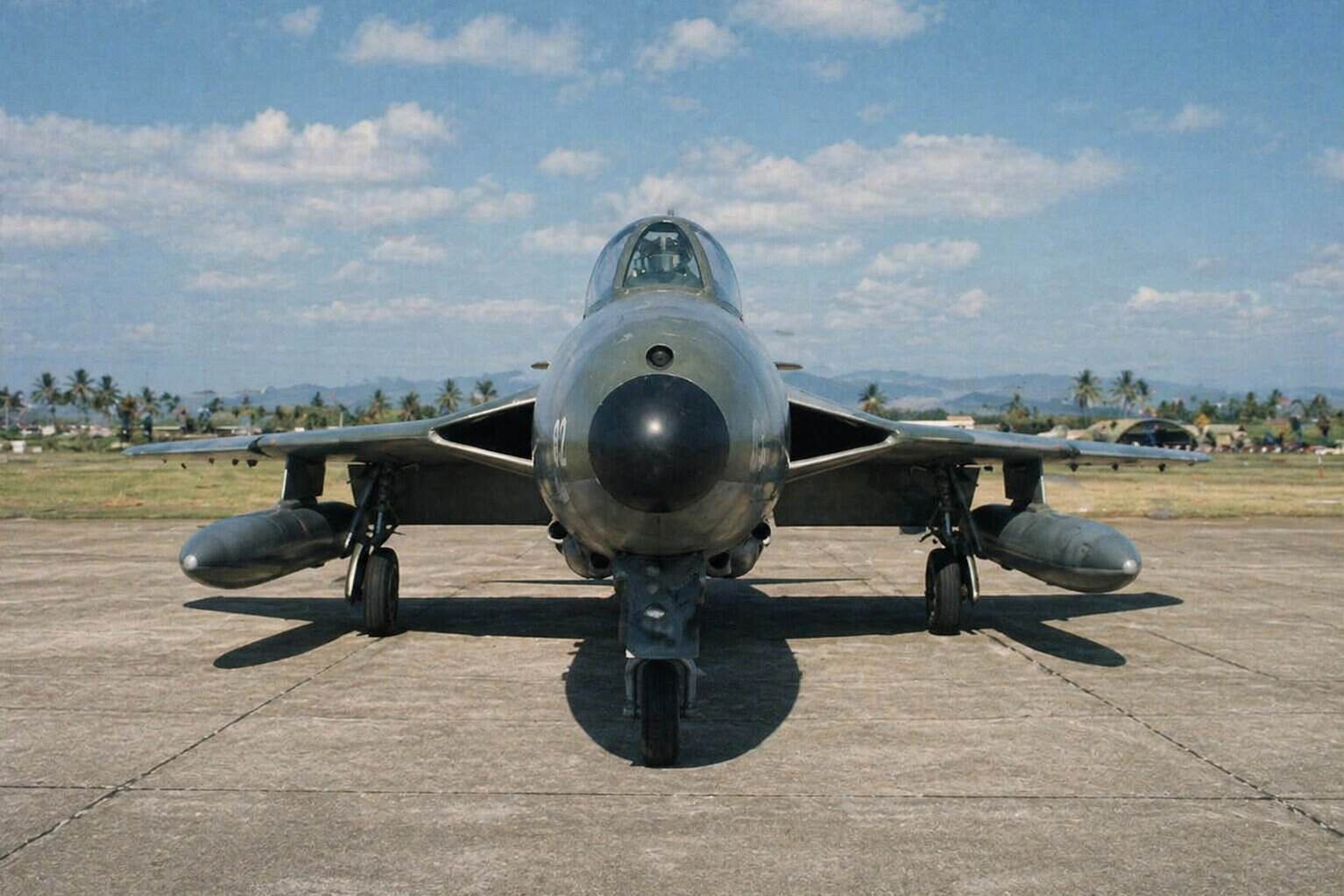
On 25 May 1962, Hunter aircraft were deployed to Thailand as part of a SEATO task force under Operation Bibber. The event belongs to a Cold War chapter that is less familiar than the confrontations in Europe, yet it reveals much about how the RAF was expected to act in a tense and uncertain world. Air power offered speed, visible commitment and the ability to reinforce an allied position without the delay of a larger ground deployment.
A Cold War deployment beyond Europe
The crisis atmosphere in South-East Asia gave added importance to rapid military signalling. In such circumstances, the arrival of combat aircraft could carry political meaning beyond their immediate tactical value. They showed that a commitment was real, that reinforcement could be delivered quickly, and that any adversary would have to reckon with an organised allied response.
Operation Bibber mattered as a deployment of presence as well as capability. The dispatch of Hunter aircraft to Thailand demonstrated that the RAF remained a globally deployable force during the Cold War. Britain’s air arm was not confined to home defence or European contingency planning. It could still move eastward at speed when alliance obligations and regional instability demanded attention.
Why the Hunter was suitable
The Hawker Hunter was one of the RAF’s most familiar jet fighters of the era, and by the early 1960s, it was a mature, proven aircraft. In an operation such as Bibber, that reliability had practical importance. A deployment designed to reassure allies and deter escalation depended upon aircraft that could be operated effectively in an unfamiliar theatre with minimal delay.
Even where the aircraft were not committed to combat, their presence had weight. Fast jets on the ground and in the air represented readiness, not merely symbolism. They provided immediate defensive value while also conveying a broader political message. In that sense, the Hunter force formed part of an air power tradition in which mobility and visibility could influence events before a shot was fired.
Execution and effect
Deploying aircraft overseas is never only about the flying. It requires support personnel, maintenance arrangements, supply planning and command organisation. A rapid movement to Thailand under alliance auspices reflected the RAF’s continuing expeditionary competence. The ability to put jets in place, keep them serviceable and integrate them into a wider task force was itself a measure of operational maturity.
Operation Bibber should also be understood as part of deterrence. During the Cold War, the purpose of many deployments was to prevent conflict from widening rather than to fight a set-piece air campaign. By reinforcing Thailand, the RAF and its partners sought to stabilise a tense situation through visible preparedness. Success in such cases is often quiet: the value lies in what does not happen.
Why the operation is significant
Bibber is not as widely remembered as Berlin, Suez, or the Cuban Missile Crisis, but that should not obscure its importance. It shows the RAF performing one of its enduring post-war roles: projecting credible force overseas in support of British policy and alliance commitments. It also demonstrates how air power could be used simultaneously as an instrument of reassurance and pressure.
Bibber illustrates the post-war RAF at short notice and long range: visible enough to reassure allies and warn opponents, yet restrained enough to serve a political purpose short of war.