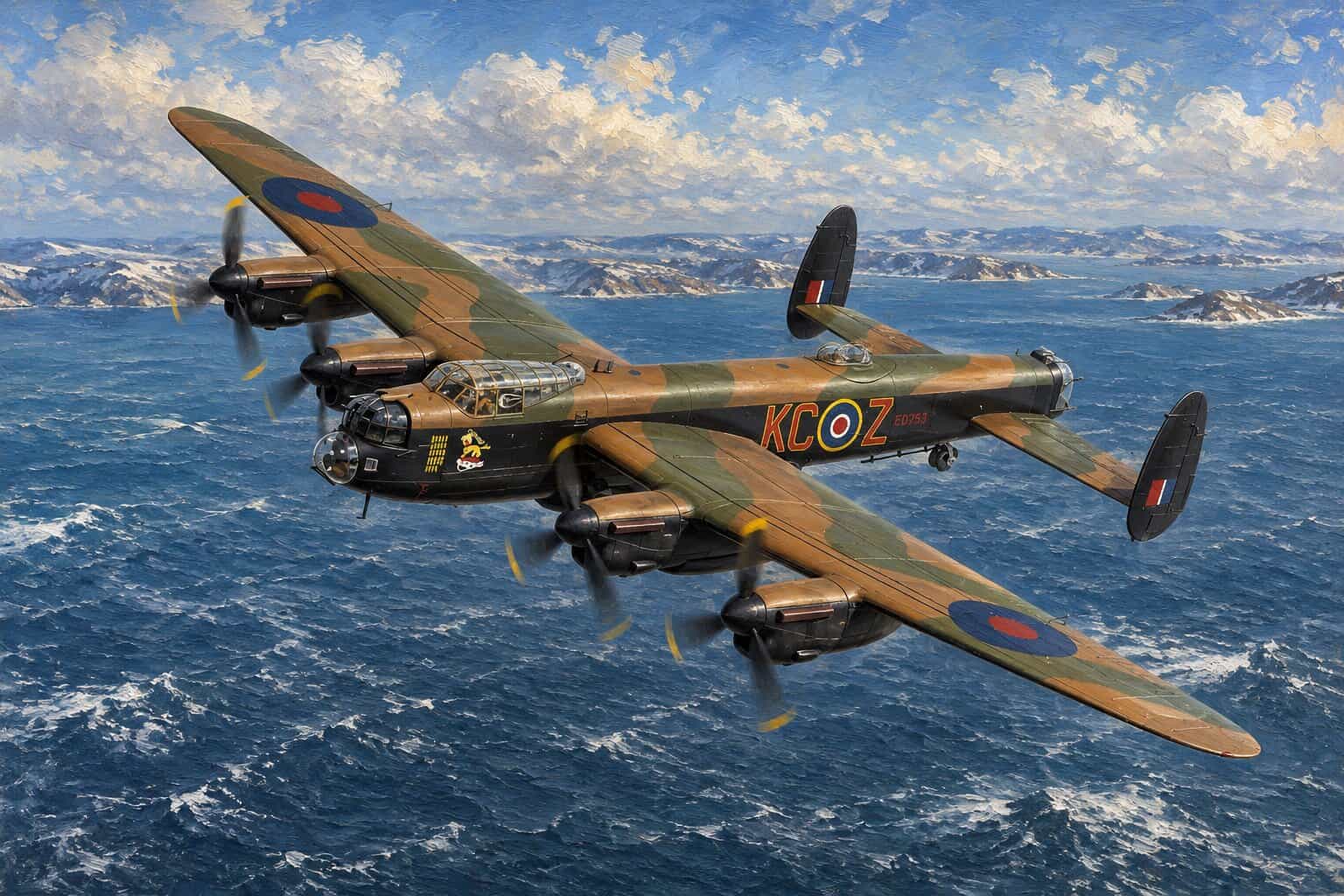
On 12 November 1944, Lancasters of No. 9 and No. 617 Squadron attacked and sank the German battleship Tirpitz near Tromsø in northern Norway. The aircraft had flown from airfields in northern Scotland, carrying the 12,000 lb Tallboy bombs that would deliver the final blow. Direct hits and damaging near misses caused Tirpitz to capsize, killing about a thousand German sailors.
The attack combined the range and carrying capacity of the Avro Lancaster with a specialised heavy weapon and crews experienced in attacking a difficult target. Both squadrons had taken part in the preceding autumn operations against Tirpitz, bringing practical knowledge of the approach, the defences and the demands of accurate bombing.
A damaged battleship at Tromsø
Tirpitz had absorbed sustained Allied attention because of the danger she posed to Arctic shipping. Her presence in Norway influenced naval planning and the protection of convoys carrying supplies to the Soviet Union. Attacks by midget submarines, naval aircraft and RAF bombers progressively reduced her fighting capability.
Operation Paravane on 15 September 1944 inflicted severe damage during an attack by 9 and 617 Squadrons operating through Yagodnik in the Soviet Union. Tirpitz subsequently moved south to the Tromsø area, where she was intended to serve as a floating gun battery. British intelligence continued to regard the possibility of repairs and renewed operations as a serious concern.
The move also changed the RAF’s operational problem. The ship lay within reach of Lancasters flying from Scotland, provided that the aircraft carried additional fuel and shed weight. Operation Obviate on 29 October tested that approach, but cloud obscured the target and frustrated the bombing. Weather remained a decisive consideration as the Arctic winter approached.
Preparing the Tallboy attack
For Catechism, the two squadrons again employed Tallboy, the deep-penetration bomb designed by Barnes Wallis. This unguided weapon depended on accurate delivery by the aircraft and its crew. Its great weight and explosive effect gave the attacking force a means of inflicting serious structural damage on the battleship.
Aircraft modifications balanced the demands of fuel, range and bomb load. Reports of favourable weather and reconnaissance over the target area provided the opportunity for another attempt. The crews faced anti-aircraft fire from the ship, while the presence of German fighters near Tromsø added a further potential danger to the operation.
The bombing and capsize
On 12 November the Lancasters pressed their attack through gunfire. The ship’s heavy guns contributed to the defensive barrage, and explosions buffeted the aircraft as the crews made their bombing runs. The short period over the target concentrated the force’s effort into a rapid succession of releases.
During the attack, the Lancasters dropped 28 Tallboy bombs. Two, possibly three, struck Tirpitz directly, while damaging near misses contributed to the battleship’s destruction. Tirpitz capsized at her anchorage off Håkøya.
About a thousand German sailors died in the sinking. The scale of that loss accompanied the immediate military outcome: the destruction of a battleship that had remained an important British target throughout repeated attacks and successive assessments of her condition.
The conclusion of the campaign
Catechism completed a sequence in which earlier operations had damaged Tirpitz, restricted her role and altered the conditions for the final attack. Her relocation, the adaptation of the Lancasters and the opportunity provided by the weather all shaped the outcome on 12 November.
For 9 and 617 Squadrons, the result demonstrated the effectiveness of their combined effort with Tallboy against a heavily protected target. For Allied naval planning, the overturned hull settled the continuing concern over Tirpitz’s possible return to operations against Arctic shipping.