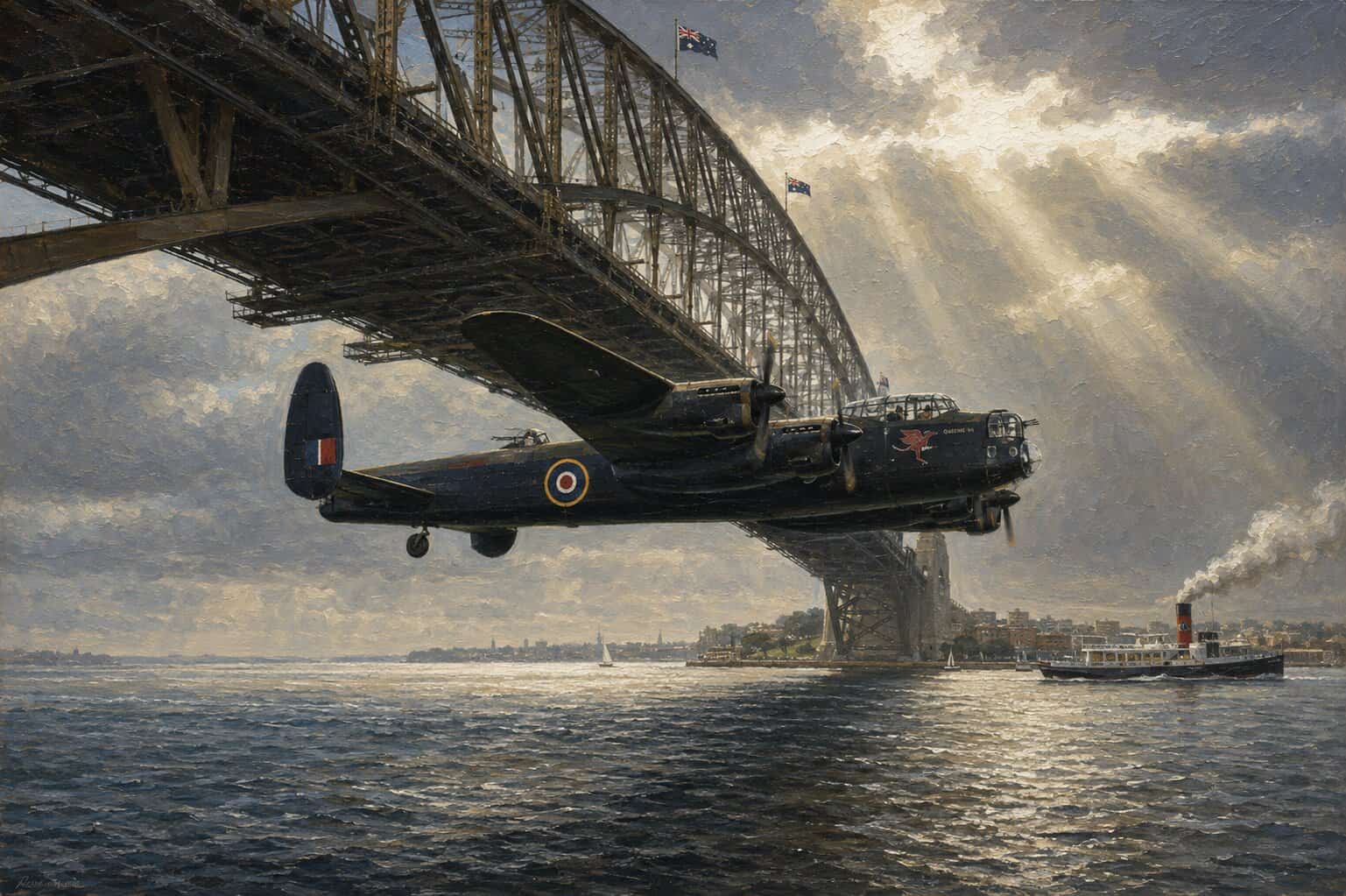
On 22 October 1943, Flight Lieutenant Peter Isaacson flew the Lancaster “Q for Queenie” beneath Sydney Harbour Bridge during its Australian war-loan tour. The British-built bomber, designated A66-1 in RAAF service, passed under one of the country’s most recognisable landmarks in an unauthorised manoeuvre that attracted widespread publicity.
Isaacson was a Royal Australian Air Force officer with experience in RAF Bomber Command. His aircraft’s presence in Sydney belonged to the Australian home-front campaign to finance the war. Together, pilot and Lancaster brought a direct connection with Britain’s bomber offensive into public view far from the European theatre.
A Lancaster for Australia
The aircraft had been earmarked during production for the journey to Australia. The aircraft was initially associated with the possibility of Australian Lancaster production, and subsequently became the centrepiece of an exhibition and war-loan tour. Its Australian work gave a British heavy-bomber design a prominent role in public fundraising.
The aircraft had its own distinctive history. Built without a mid-upper turret, it was prepared for the Australian journey and served as a touring and display aircraft. Its value to the campaign rested on what the Lancaster represented: the industrial resources behind the air war and the service of Australian airmen overseas.
War loans enabled members of the public to lend money to the government towards the cost of the conflict. An exhibition aircraft made that financial appeal tangible. Visitors could see the size and complexity of a heavy bomber and encounter airmen whose experience connected the fundraising campaign with wartime flying.
Isaacson’s Bomber Command experience
Isaacson’s operational service included 460 Squadron RAAF and 156 Squadron RAF, the latter within the Pathfinder Force. He had flown Wellingtons and Lancasters and received the Distinguished Flying Medal and Distinguished Flying Cross. His career reflected the close relationship between Australian personnel and the wider Bomber Command organisation.
In May 1943 he was selected to captain Q for Queenie on its journey from Britain to Australia across the Pacific. The subsequent touring work placed an experienced operational pilot in a highly visible public role. His task now included helping to sustain support for the war among communities at home.
That background gave the Australian appearances a particular authority. The aircraft demonstrated the scale of modern air power, while Isaacson embodied the experience of the Commonwealth aircrew taking part in the European campaign.
The passage beneath the bridge
The flight under Sydney Harbour Bridge introduced an unauthorised act into that publicity programme. Flying beneath the bridge contravened a prohibition dating from 1931. The manoeuvre attracted attention to both Isaacson and his Lancaster, giving the war-loan tour a striking episode around which publicity could gather.
The distinction between the organised tour and the bridge passage is central to the event. The tour had an established fundraising purpose; Isaacson’s decision to take the bomber beneath the bridge was his own unauthorised action. Its public impact arose within the broader campaign to encourage financial support for the war.
Bomber Command’s Australian connection
Q for Queenie’s tour brought together British aircraft manufacture, Australian aircrew service and home-front finance. The bridge flight became an enduring part of Isaacson’s wartime story, while the Lancaster’s exhibition work continued to serve the loan campaigns.
The Sydney episode gave a familiar Australian setting to an aircraft type closely associated with the bombing offensive over Europe. Through its pilot, its origins and its fundraising role, Q for Queenie made the connection between Australian households and the Commonwealth air effort unusually visible.