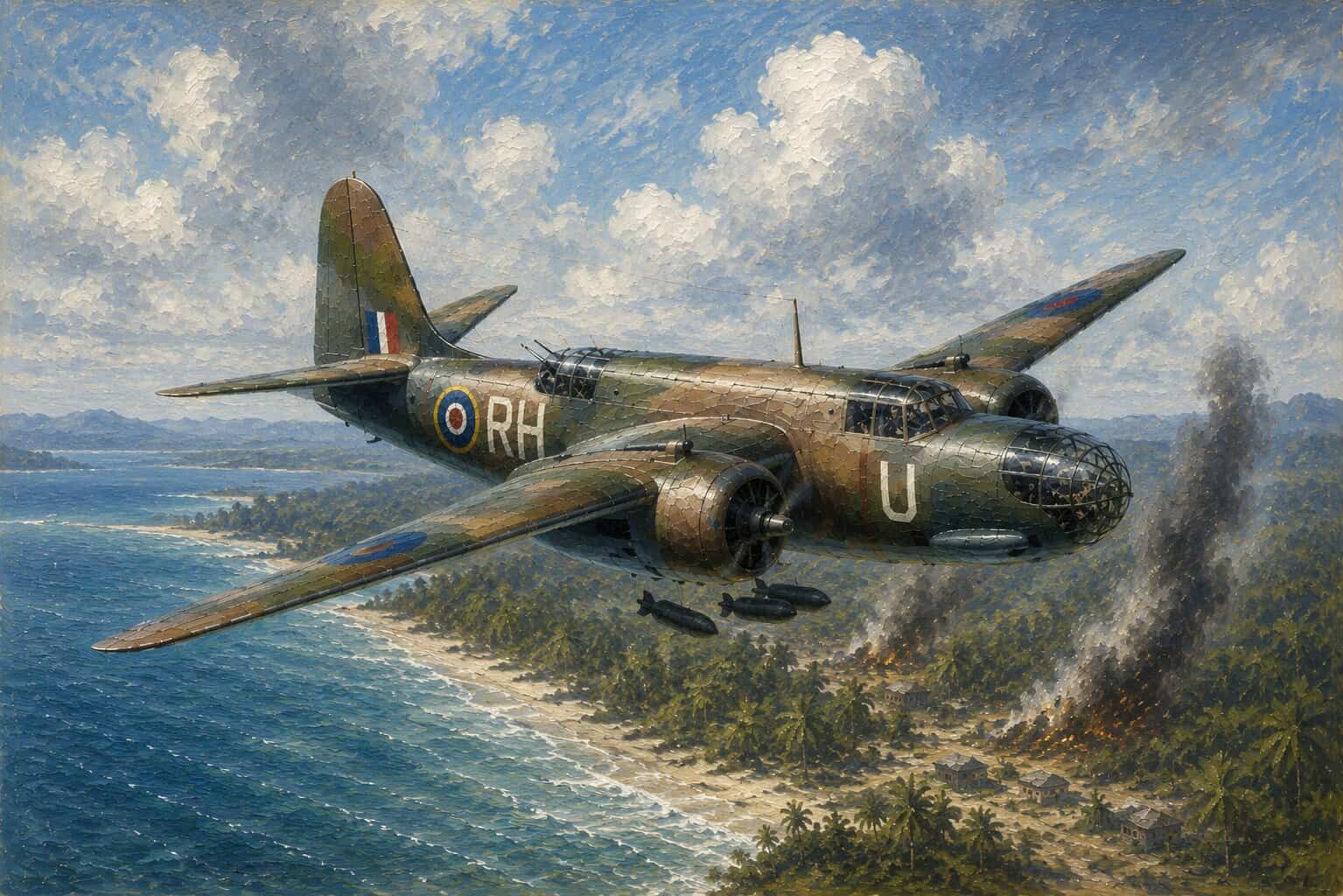
On 19 October 1943, the Air Ministry announced the posthumous award of the Victoria Cross to Flight Lieutenant William Ellis Newton of No. 22 Squadron, Royal Australian Air Force. The honour recognised his courage and leadership during low-level attacks in New Guinea, particularly the operations against Salamaua in March that ended with the loss of his Douglas Boston and his subsequent death in Japanese captivity.
The award honoured a sustained record of offensive flying. Newton had completed 52 operational sorties, repeatedly pressing attacks through anti-aircraft fire. His determination to reach his objectives, deliver accurate attacks and bring damaged aircraft home formed the foundation of his Victoria Cross.
Low-level attacks at Salamaua
Newton had enlisted in the RAAF in February 1940. After qualifying as a pilot and serving as a flying instructor, he joined No. 22 Squadron in May 1942. Its Boston light bombers became his means of attacking Japanese positions and supplies in New Guinea.
Salamaua presented a demanding target. Approaching at low level brought the bombers close to defended installations and exposed their crews to concentrated ground fire. Accurate bombing required a controlled approach while the aircraft remained vulnerable to hits on engines, fuel tanks and flying surfaces.
On 16 March 1943, Newton led an attack near Salamaua and continued towards his objective as his Boston was repeatedly struck. He held his course and released his bombs at low level. Buildings and supply dumps were destroyed in the attack.
The aircraft suffered extensive damage. Its fuselage and wings were torn, its engines hit and its fuel tanks pierced; a main tyre was also punctured. Newton nevertheless retained control, brought the Boston back and landed safely. The return flight demanded a further exercise of judgement and handling after the bombing run itself.
The final sortie
On 18 March, Newton returned to the Salamaua area for another attack. His assigned target was a single building. He again maintained his bombing approach through heavy defensive fire, and the target received a direct hit. During the attack his Boston caught fire.
Newton turned towards the sea and kept the burning aircraft under control long enough to ditch offshore. Sergeant Basil Eastwood died in the ditching. Newton and Flight Sergeant John Lyon survived, reached land and were captured by Japanese forces.
Both survivors were subsequently killed in captivity. Lyon was executed at Lae on 20 March. Newton was returned to Salamaua and executed there on 29 March 1943, aged 23. Details of Newton’s execution emerged from a captured Japanese diary and were reported in Australia later that year. After the war, his remains were recovered and buried in Lae war cemetery.
Recognition across Commonwealth air forces
The October announcement gave formal recognition to Newton’s repeated courage under fire. King George VI conferred the Victoria Cross on the advice of Australian ministers, honouring an Australian airman whose service belonged to the Commonwealth’s wider air war against Japan.
Newton was the only member of the RAAF to receive the Victoria Cross for service in the Pacific theatre. His distinction placed the work of a Boston squadron in New Guinea within the shared history of Commonwealth air gallantry, while preserving its specifically Australian identity.
His combat record joined offensive determination with the responsibility of aircraft command. At Salamaua he carried attacks through intense fire, returned a severely damaged bomber to base and subsequently controlled a burning aircraft into the sea. Those actions gave the announcement of 19 October its enduring substance: recognition of a pilot’s repeated commitment to his task and crew under exceptionally dangerous conditions.