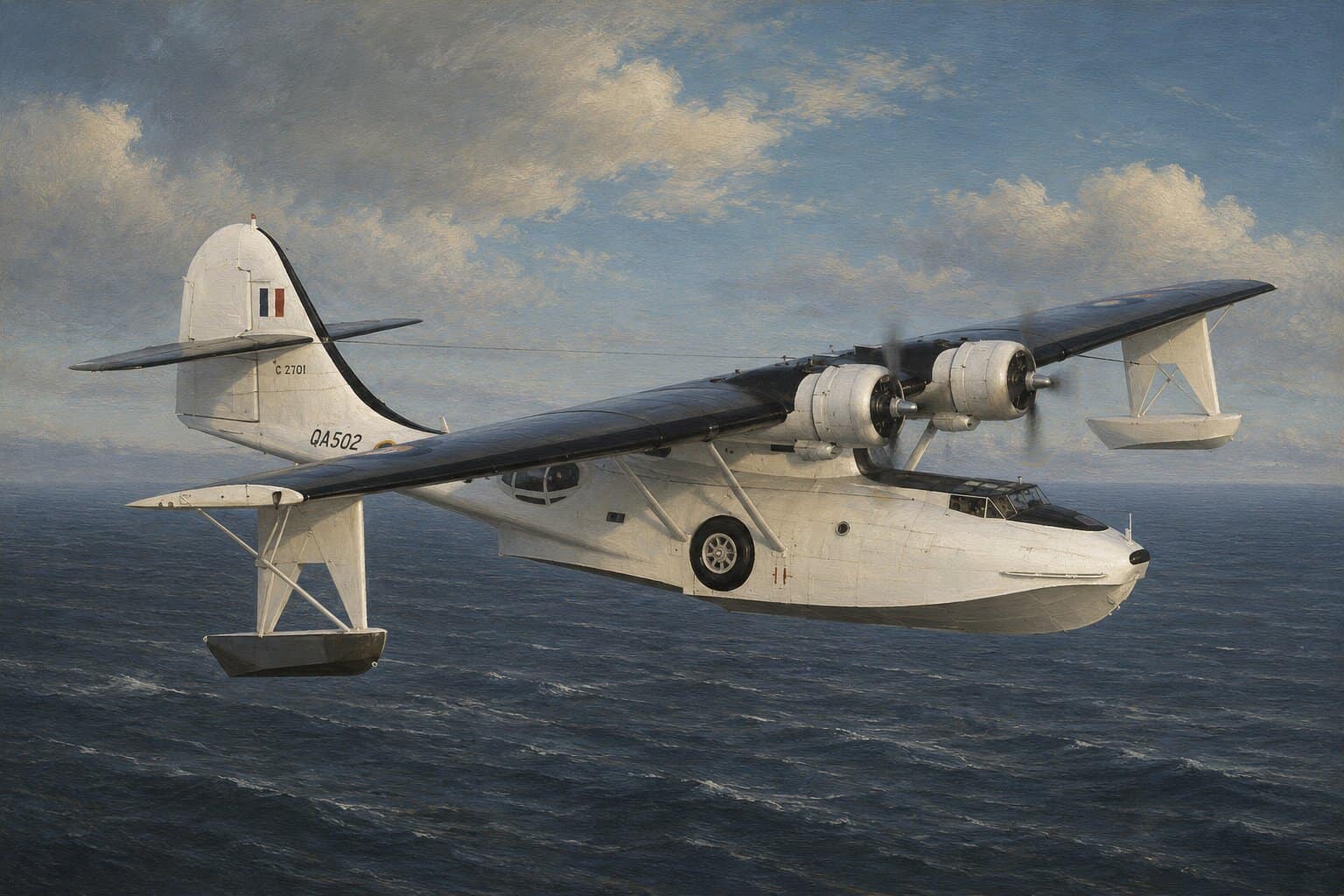
On 31 July 1942, the Royal Canadian Air Force destroyed U-754 off the Canadian coast, securing its first confirmed U-boat victory at a time when the Battle of the Atlantic had come alarmingly close to home waters. Whether viewed from Nova Scotia, Newfoundland or the wider Atlantic command system, the significance was clear. This was not only the loss of a German submarine. It was proof that Canadian air patrols could find, attack and finish a dangerous enemy operating in waters where merchant shipping and coastal communities had become exposed to sudden violence.
The Atlantic war reaches Canada
By mid-1942, the U-boat campaign had shifted decisively westward. German submarines were exploiting the shipping routes and coastal approaches of North America, and the sense of distance that had once protected Canada was rapidly disappearing. For the RCAF, anti-submarine warfare was becoming one of the most urgent and demanding tasks of the war. Long patrols, poor weather, uncertain sightings and the sheer size of the maritime battlespace made success difficult.
Aircraft such as the Catalina gave Allied commanders a way to quickly search wide expanses of ocean, shadow suspicious contacts, and bring weapons to bear before a submarine could disappear. Even when a single attack did not produce immediate certainty, the constant presence of aircraft altered the balance. U-boats had to spend more time submerged, made poorer tactical decisions and faced the growing risk that any time on the surface might be their last.
The destruction of U-754
The sinking of U-754 came only days after the submarine had committed one of the war’s ugliest crimes in Canadian waters, attacking survivors from a small fishing vessel. Its destruction carried immediate operational and moral weight. RCAF crews located the boat and attacked before it could escape, bringing to an end a patrol that had already inflicted serious damage.
For the airmen involved, success depended on training, observation and speed of action. Anti-submarine attacks were unforgiving. A submarine sighted on the surface could vanish in moments, and depth charges had to be released with care and at exactly the right point in the run. The destruction of U-754 showed that Canadian crews were learning the hard craft of maritime strike warfare under combat conditions, not merely patrolling in hope of contact.
Results beyond a single kill
As the RCAF’s first confirmed U-boat victory, the sinking had consequences beyond the tactical result. It boosted confidence in Eastern Air Command and in the wider Canadian war effort. Coastal air defence and maritime reconnaissance were sometimes overshadowed by better-known campaigns overseas, but this success made plain that the air war in home waters mattered profoundly. It protected trade, reassured the public and demonstrated that the enemy could be met effectively in Canada’s own approaches.
The victory also reflected a wider shift in the Atlantic struggle. Air power was becoming steadily more decisive against submarines, especially as patrol coverage, tactics and technical aids improved. A U-boat commander operating near North America in 1942 could no longer assume that daylight, distance or coastal clutter would guarantee safety.
In wider air-war terms, 31 July 1942 was important because it captured a central truth of the Atlantic campaign: control of the sea increasingly depended on control of the air above it. The destruction of U-754 was therefore more than an isolated success. It marked the moment when Canadian air power proved, in unmistakable fashion, that it could strike back.