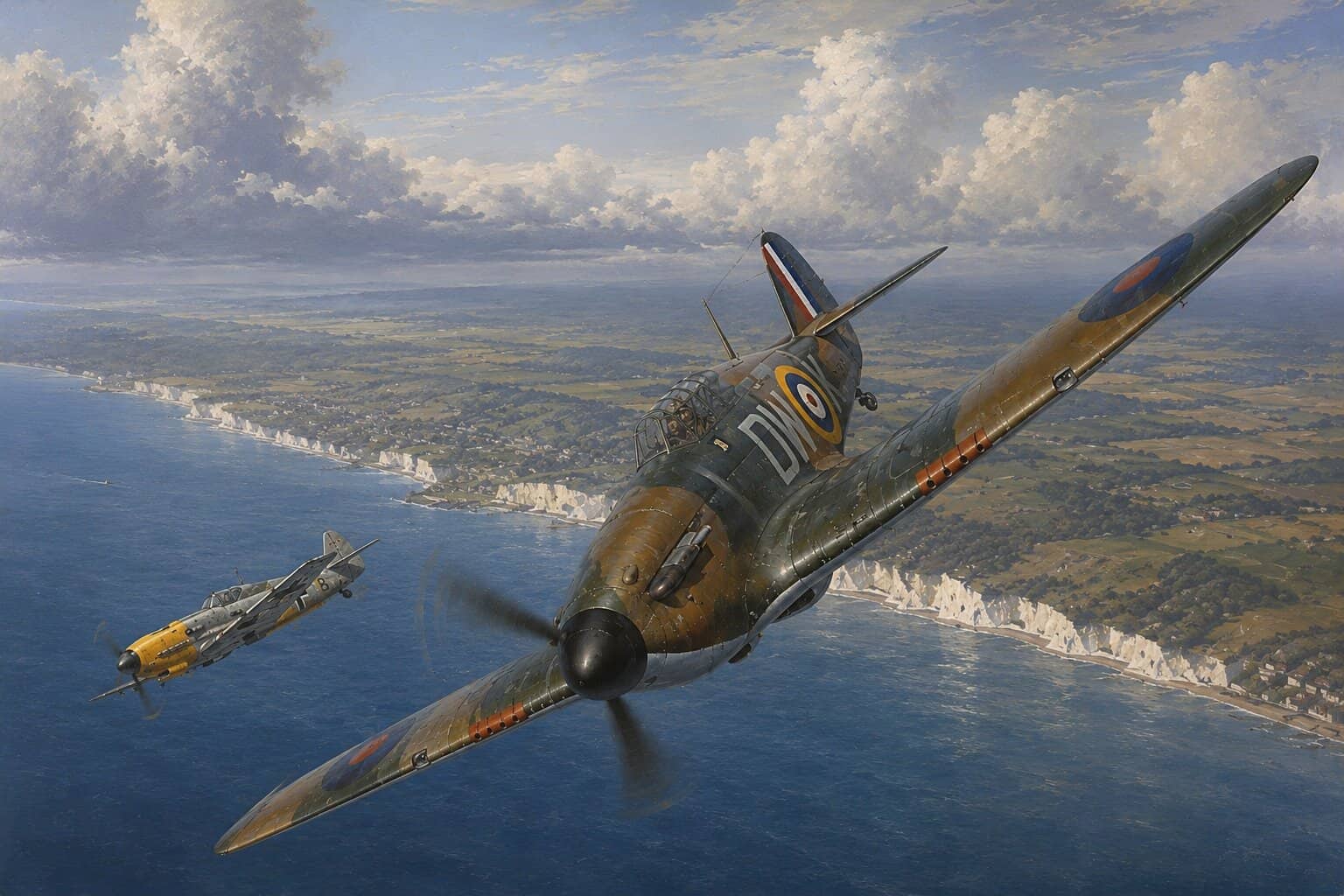
On 18 August 1940, the Hardest Day of the Battle of Britain brought Fighter Command and the Luftwaffe into one of the most punishing clashes of the entire campaign. Repeated German attacks on RAF airfields and radar stations drew British fighters into continual action, and by nightfall both sides had suffered severe losses. The date became fixed in memory because it captured the real character of the battle in August 1940: not a neat duel of symbols, but an exhausting contest of systems, endurance and attrition.
A day of repeated assaults
By mid-August, the Luftwaffe had moved beyond earlier pressure on convoys and coastal targets and was pressing harder against the machinery of British air defence. Airfields in southern England and radar installations on the coast came under repeated attack as German commanders tried to damage the network that allowed Fighter Command to detect raids, direct interceptions and keep squadrons in the fight. What made 18 August so intense was not a single dramatic blow, but the accumulation of successive attacks that forced the RAF to respond again and again.
Those responses depended on more than the aircraft themselves. The whole defensive system mattered: observation, reporting, sector control, ground crews and rapid turn-rounds between sorties. Hawker Hurricanes and Supermarine Spitfires carried the visible burden in the air, but the day also tested the organisation behind them. Every scramble consumed pilots, fuel, airframes and nerve.
Fighter Command under heavy pressure
For Fighter Command, the day demonstrated how vulnerable the air-defence system could be when radar stations, airfields and operations infrastructure were all threatened in close succession. Damage on the ground could disrupt flying just as surely as losses in the air, and the strain on personnel was immense. Pilots flew repeated sorties into fast-moving combats while airfield staff worked to keep aircraft serviceable under attack or the threat of attack.
Yet the fighting also showed that the British system could absorb heavy punishment without collapsing. Squadrons continued to rise, interceptions were still made, and the Luftwaffe was forced to pay dearly for every attempt to break the defence. The battle remained dangerously close-run, but it was not the knockout stroke German planners needed.
Losses and what they meant
The losses suffered on 18 August 1940 were among the heaviest combined losses of the entire Battle of Britain. That fact alone explains why the date later carried the label “The Hardest Day”. For the RAF, the casualties and material damage were a reminder that victory in 1940 was never inevitable or effortless. For the Luftwaffe, the day revealed the cost of attacking a defence that remained coordinated and resilient even under severe pressure.
The significance of those losses was strategic as much as tactical. An air campaign based on repeated heavy attacks could succeed only if Fighter Command broke before German losses became unsustainable. On 18 August, Britain was badly hit, but the Luftwaffe did not achieve the decisive collapse it needed. Instead, both sides were shown the price of continuing the battle at that level of intensity.
A battle measured in endurance
The Hardest Day matters because it strips away any comforting sense that the Battle of Britain was a smooth or certain defensive triumph. It was a brutal test in which the RAF endured damage to its airfields, pressure on its control system and continued attrition among its pilots, while still denying the enemy a decisive result. The Luftwaffe, for its part, showed the force and persistence that made the campaign such a genuine danger in the late summer of 1940.
Remembered in that light, 18 August stands as one of the clearest windows into the whole battle. It was a day when air power, organisation and human endurance were all pushed hard, and when the outcome remained in doubt even as the defence held.