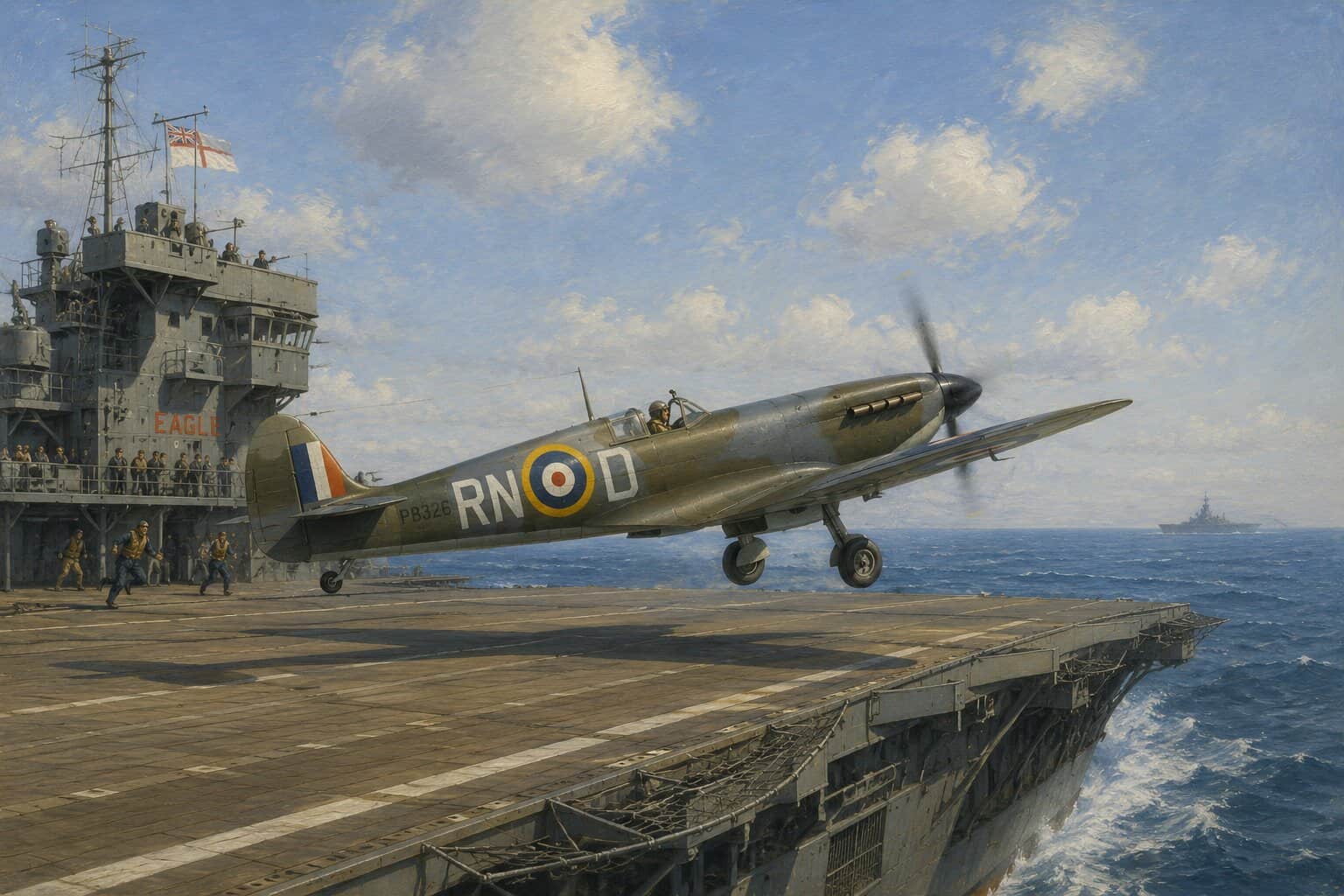
On 15 July 1942, Supermarine Spitfires launched from HMS Eagle and reached Malta under Operation Colima and Operation Pinpoint, continuing the hard-fought effort to keep the island in the war. The event was not as dramatic as a major battle, yet it carried real operational weight. Malta’s survival depended in large measure upon whether fighters could be delivered, assembled, maintained and thrown into action fast enough to resist relentless Axis pressure.
Why Malta still needed fighters
By the summer of 1942, Malta had already endured months of sustained assault. Its airfields, docks and supply system had been subjected to repeated attack, and the island’s position in the central Mediterranean made it too important for either side to ignore. From Malta, Allied forces could threaten Axis sea communications to North Africa; if Malta were neutralised, the balance of the campaign in the Mediterranean would tilt heavily against Britain and its allies.
That broader context explains why another fighter delivery mattered so much. Reinforcement was not a luxury or a token gesture. The RAF and Fleet Air Arm needed to keep a viable fighter force on the island simply to preserve Malta as an active base. Every successful ferry operation brought resilience as well as aircraft.
Carrier delivery as an operational solution
Operations Colima and Pinpoint showed the ingenuity required to sustain Malta under siege conditions. HMS Eagle served as the launch platform, allowing Spitfires to be carried by sea and then flown on to the island rather than attempting an impossible direct ferry route from Britain. That method demanded close naval and air coordination, careful timing, and confidence that the aircraft could complete the final stage and be quickly absorbed into local defence.
The operation also demonstrated how the Spitfire had become central to Malta's air battle. The type offered the RAF the performance needed to contest hostile raids more effectively, but performance alone was never enough. Fighters had to arrive in usable numbers and at the right moment. In the Maltese context, delivery itself became part of the campaign rather than a mere prelude.
Part of a continuing reinforcement effort
Colima and Pinpoint belonged to a wider sequence of attempts to strengthen Malta from the air. Earlier operations had shown both what could be achieved and how quickly success could be compromised if new arrivals were caught on the ground or pressed too hard before their support system had recovered. The lesson was clear: Malta could not be saved by one convoy, one raid or one delivery of fighters. It had to be sustained repeatedly.
Seen in that light, the July 1942 Spitfire arrival was another instalment in a campaign of endurance. Each reinforcement mission helped preserve the island’s ability to defend itself and continue offensive activity against Axis supply routes. The arrival of aircraft from HMS Eagle had significance well beyond the airfields where they landed.
Significance in the Mediterranean air war
Operations Colima and Pinpoint deserve attention because they reveal the practical foundations of air power. Air superiority is often discussed in terms of combat alone, but combat capability depends on transport, timing, organisation and the ability to move aircraft into threatened theatres under severe pressure. Malta was one of the clearest examples of that truth during the war.
For the RAF, 15 July 1942 showed that Malta could be held only if fighters could still be fed into the island despite Axis pressure. The Spitfires delivered under Colima and Pinpoint strengthened the defence at a critical moment and helped preserve the air battle on which the island’s wider strategic usefulness depended.