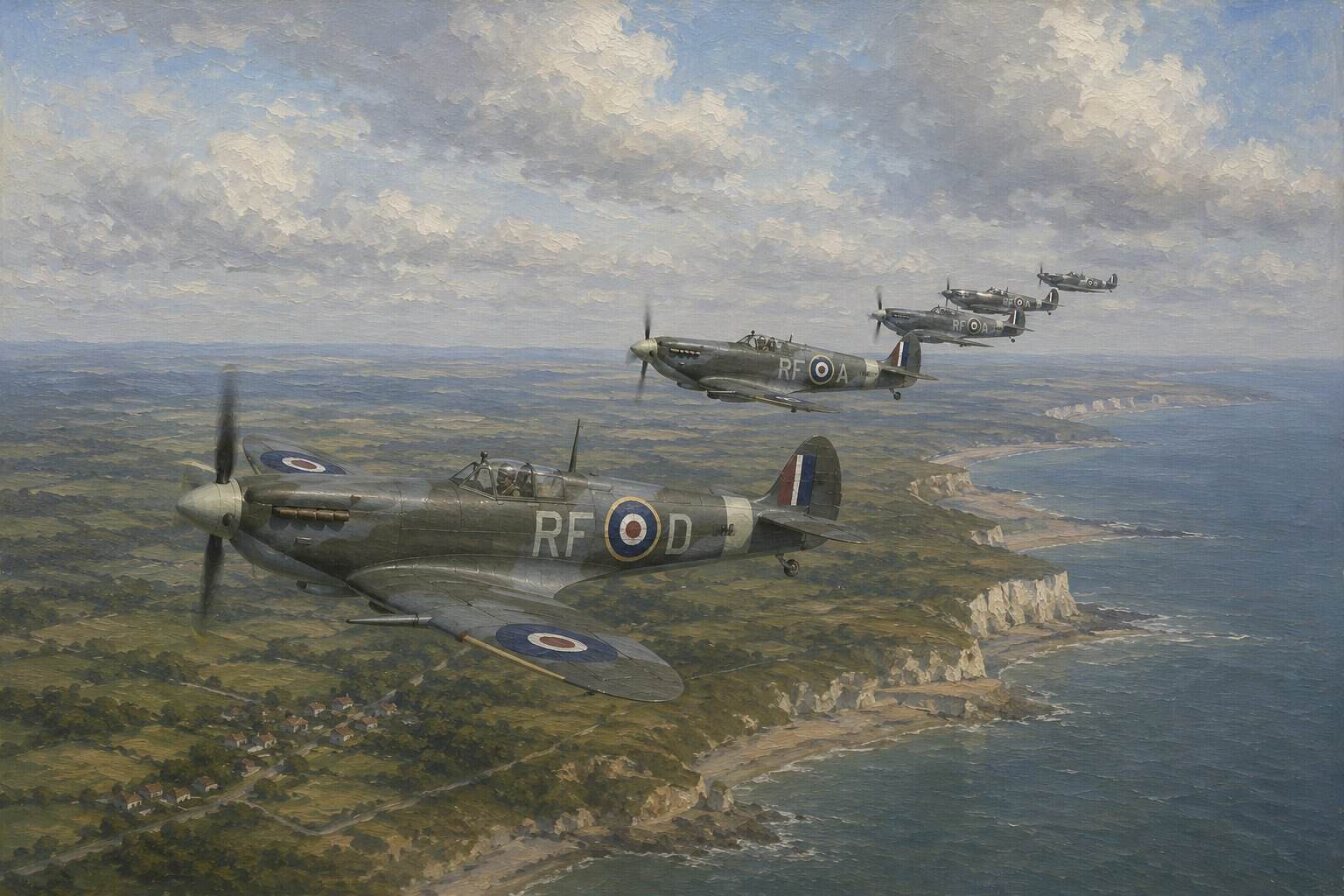
On 28 October 1939, Spitfires of 602 (City of Glasgow) and 603 (City of Edinburgh) Squadrons intercepted a Heinkel He 111 returning from reconnaissance over Scotland. The damaged German aircraft came down at Humbie in East Lothian, becoming the first German aircraft brought down on British soil during the Second World War. The encounter marked another early success for Scotland’s auxiliary fighter squadrons, which had already fought German aircraft over the Firth of Forth earlier that month.
The Heinkel belonged to Kampfgeschwader 26, a Luftwaffe bomber formation. Its reconnaissance flight brought it into the area defended by squadrons already engaged in protecting the Firth of Forth approaches. For these units, the opening weeks of the war had already involved direct combat with German aircraft over Scotland and its coastal waters.
Scotland’s auxiliary fighters
602 and 603 Squadrons had entered the war from the Auxiliary Air Force, whose pre-war organisation enabled part-time personnel to train for military flying and supporting duties. Mobilisation brought these locally rooted squadrons into wartime home defence. Their Glasgow and Edinburgh identities remained attached to units now carrying out operational fighter work.
Both squadrons flew the Supermarine Spitfire. Their task placed them between German aircraft approaching Scotland and an area containing important naval facilities and shipping. Reconnaissance over this region formed part of the Luftwaffe’s wider interest in British naval activity, while fighter interception offered a means of challenging aircraft gathering information as well as those carrying bombs.
The two squadrons had already fought over the Firth of Forth on 16 October. German Junkers Ju 88s attacked British warships, and Spitfires intercepted the raiders. German aircraft destroyed in that action fell into the sea. That earlier combat established the Scottish auxiliaries among the first RAF units to engage the Luftwaffe in the defence of British territory.
The interception at Humbie
The action on 28 October involved a separate German flight and a different aircraft type. Returning from reconnaissance, the Heinkel He 111 encountered Spitfires from the two Scottish squadrons. Archie McKellar of 602 Squadron was centrally involved in the interception, with 602 and 603 sharing in the victory.
The damaged bomber was forced down at Humbie. Its arrival on land gave the encounter its particular place in the chronology of the air war: a German aircraft brought down by defending fighters now lay on British soil. The distinction concerned where the aircraft came down, within a sequence of fighting that had already produced German losses over British waters.
McKellar had joined 602 Squadron in 1936 after learning to fly at the Scottish Flying Club at Abbotsinch. A plasterer’s son from Paisley, he represented the civilian flying experience drawn into the auxiliary organisation. At Humbie, his participation formed part of a shared success by two units with strong local identities.
Home defence in the opening weeks
The October encounters demonstrated the practical contribution of the auxiliary fighter squadrons during the first months of the war. Their Spitfires were confronting reconnaissance and attacking aircraft around Scotland well before the major fighter battles over southern England in 1940.
The two actions also showed the range of demands placed on local air defence. Protecting naval waters required fighters to respond both to raids against ships and to flights gathering information about the region. At Humbie, that defensive work ended with the first German aircraft brought down on British soil, adding a distinct milestone to the early combat record of 602 and 603 Squadrons.