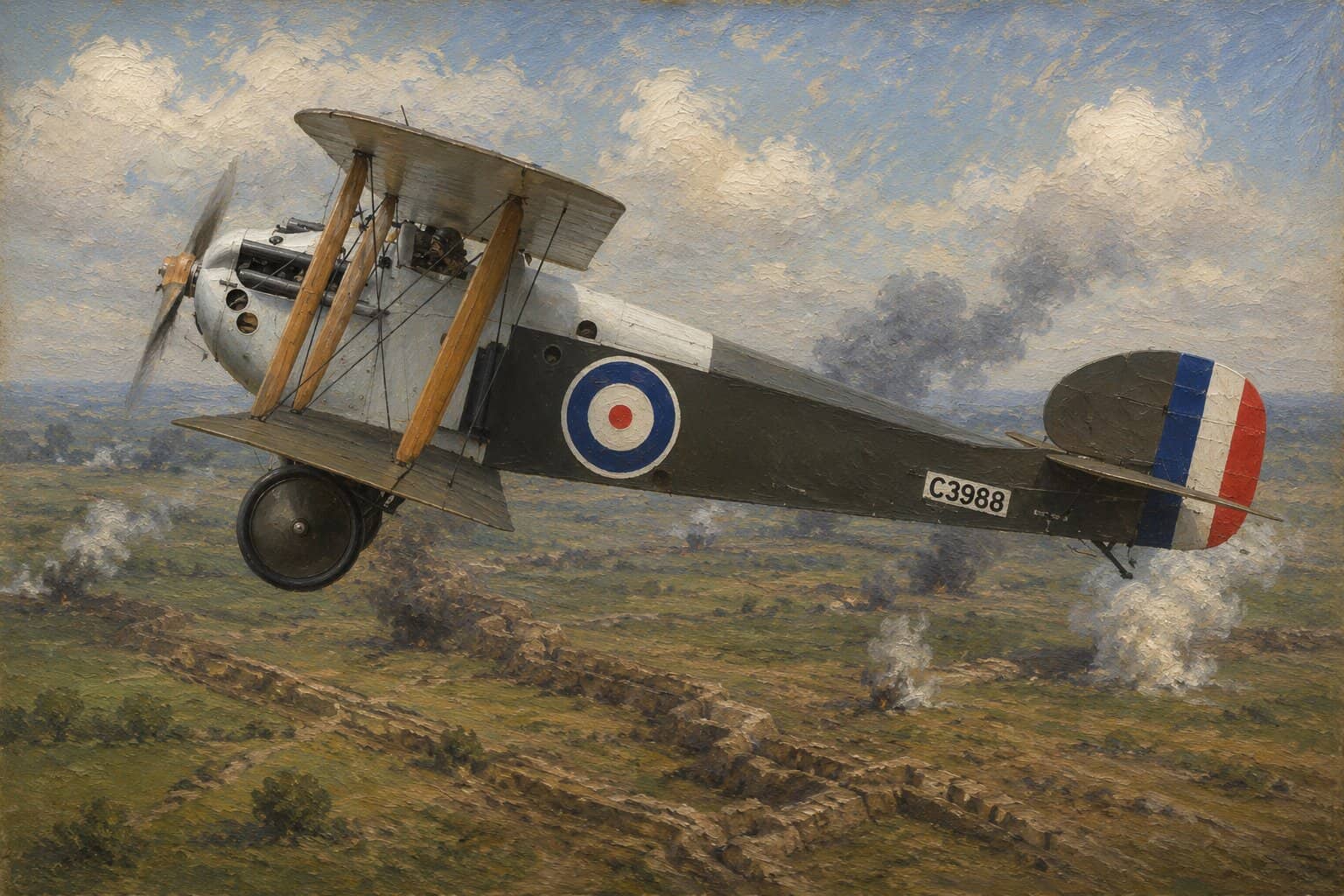
By 30 September 1918, the Hindenburg Line was no longer the unbroken barrier German commanders had hoped would steady the Western Front. Allied armies had forced their way into the defensive system, but the breach was not simply a matter of infantry and artillery alone. Air power had become an increasingly practical part of battlefield success, linking reconnaissance, observation, contact patrols, and air attacks to the final advance of the Hundred Days.
A defensive system under pressure
The Hindenburg Line was designed to absorb and break an attack through depth, wire, strongpoints and carefully prepared artillery positions. Even so, by the autumn of 1918, the balance on the Western Front had shifted. Allied forces were now attacking with greater confidence, better coordination and a more mature understanding of how to combine arms under modern conditions.
That wider shift mattered in the air as much as it did on the ground. The Royal Air Force, created only in April 1918, had inherited years of wartime experimentation. By late 1918, aircraft were no longer being used merely as distant observers. They were part of an increasingly integrated system that helped commanders see the battlefield, direct fire, monitor movement and keep pressure on retreating forces.
Air power in the final advance
During the fighting around the Hindenburg Line, aircraft supported operations in several connected ways. Reconnaissance machines photographed trench systems, roads and strongpoints, helping to build a clearer picture of German dispositions. Artillery observation crews worked to improve the accuracy and responsiveness of fire. Contact patrols tried to track the changing front line from above, an especially difficult task in confused conditions where infantry could move beyond the last reliable map reference within hours.
Aircraft were also used more aggressively against targets behind the immediate front. Low-flying attacks on transport, road traffic and movement points added to the strain on a defence already under intense pressure. The aim was not to win the battle from the air in isolation, but to complicate German recovery and reduce the defender’s ability to restore order once the line had been pierced.
By 30 September, as the breach widened, this combination of air support and ground pressure showed how far wartime air operations had developed. Air power was still limited by weather, communication and the vulnerability of aircraft flying low over the battlefield. Yet it had become valuable precisely because it could connect different parts of the battle in near real time, passing information, spotting movement and extending pressure beyond the trench immediately under attack.
What the breach revealed
The breaching of the Hindenburg Line was one of the clearest signs that the war had entered its final phase. For the RAF, the moment also demonstrated that air power had matured from an experimental arm into a practical operational tool. Aircraft could not by themselves force a decisive breakthrough, but they could make a combined offensive more coherent, more informed and more relentless.
That was the real significance of air power in the fighting of late September 1918. It helped turn battlefield success into sustained momentum. In doing so, it pointed towards the future conduct of war, where command of information, observation of movement and rapid attack on vulnerable points would matter as much as raw destructive force. The Hindenburg Line was breached by armies, but air power helped make that breach harder to contain and easier to exploit.