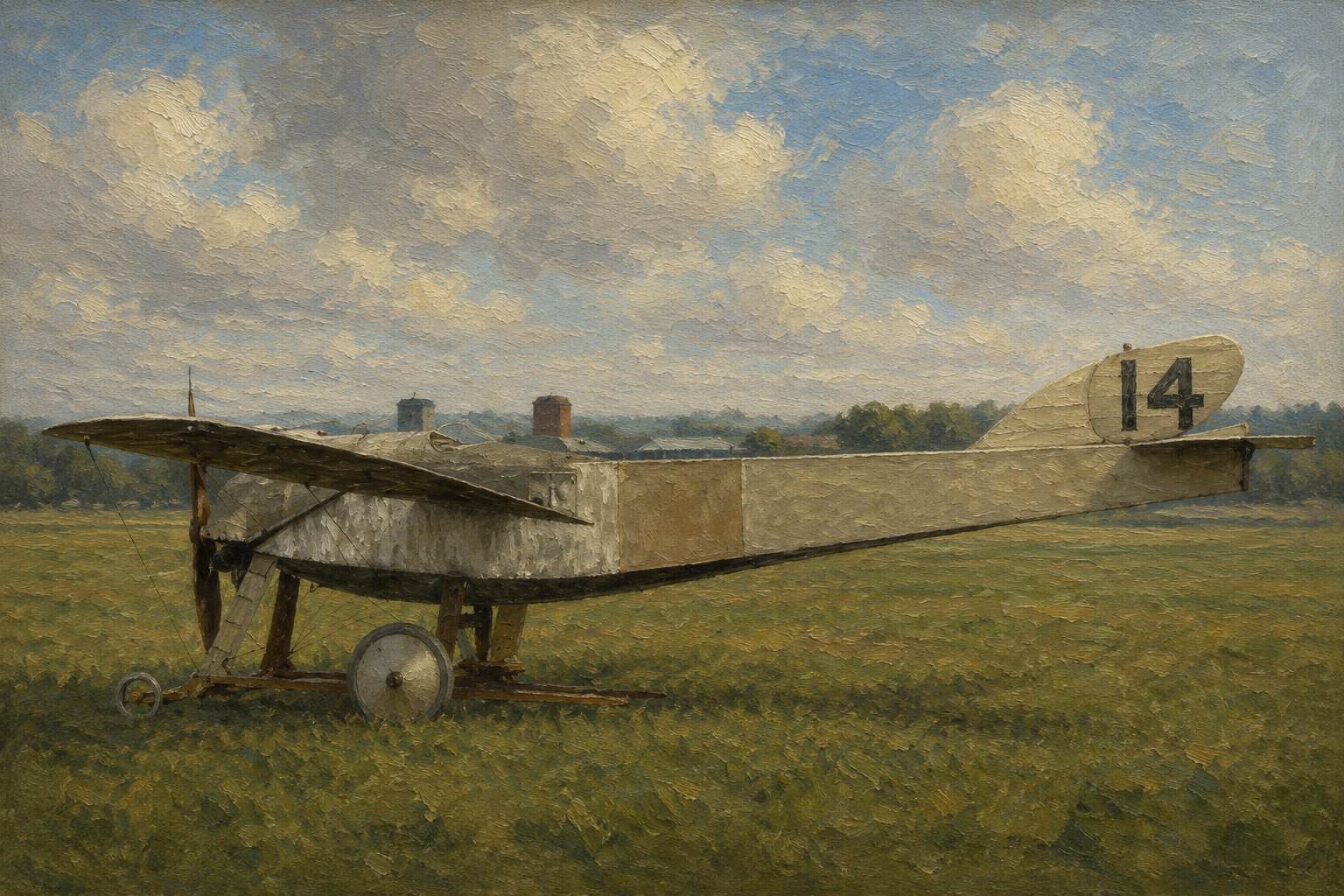
On 12 September 1912, the War Office ordered Royal Flying Corps pilots not to fly monoplanes after a series of accidents. The decision may look like a narrow administrative measure, but it had wider importance for the formative years of British military aviation. It showed how strongly safety concerns, procurement caution and institutional judgement influenced the development of air power long before the RAF existed.
Aviation in an experimental age
In 1912, military flying was still a new and uncertain enterprise. Aircraft design had not yet settled into reliable patterns, and the distinction between promising innovation and dangerous instability was often difficult to judge. The Royal Flying Corps therefore operated in a world where technical experimentation went hand in hand with real risk.
The monoplane controversy belonged to that setting. A series of accidents had raised concern over structural and handling safety, and the War Office responded by restricting their use. This was more than a reaction to isolated mishaps. It was an early example of the state trying to impose order on a field where enthusiasm for aviation had to be balanced against the practical need to preserve men, machines and public confidence.
Why the ban mattered
The significance of the ban lies in what it reveals about official attitudes to aviation. Military flying, in its infancy, was shaped not only by adventurous pilots or inventors. It was also shaped by administrators and commanders who had to decide what kinds of aircraft could be trusted for service. In this sense, the monoplane ban was part of the larger process by which military aviation was becoming institutional rather than experimental.
Such decisions influenced procurement, training and operational confidence. If one class of aircraft was judged too hazardous, its exclusion would affect the whole direction of development. The War Office order therefore helped shape the kinds of machines the RFC would rely on and the level of caution with which new designs were assessed.
Caution and progress together
The episode should not be read simply as hostility to innovation. Military aviation advanced precisely because institutions learned to distinguish between promising capability and unacceptable risk. In 1912, the balance could easily tilt too far either way. Excessive caution might slow development, but insufficient caution could undermine the entire project through preventable loss and scandal.
The monoplane ban clearly illustrates that tension. It belongs to an era in which aviation was still proving its worth to sceptics while struggling with the basic problems of reliability, structure and control. The War Office decision showed that military flight was already being shaped by formal oversight, not just technical daring.
Significance
The RFC monoplane ban of 12 September 1912 matters because it marks an early moment when British military aviation was forced to confront the practical limits of novelty. Safety concerns were not peripheral to air power’s growth; they were part of the process by which flying became a credible arm of service. In RAF history, the episode stands as a reminder that institutional caution helped shape the path from fragile experiment to organised air force, even when that caution seemed restrictive at the time.