The Air Ministry was created in war and spent the following peace trying to justify its own existence. Between the armistice of 1918 and the outbreak of the Second World War, it stood at the centre of one of Britain’s most difficult defence arguments: whether air power should remain an independent service, what it was actually for, and how a modern air force could be maintained when governments were determined to economise. The problem was never simply administrative. Every judgement made in Whitehall about bombing, home defence, imperial policing, aircraft procurement and inter-service responsibility fed directly into the shape of the Royal Air Force itself.
In the interwar years, the Air Ministry became more than a department. It was the institution through which the RAF defended its independence against the Army and the Admiralty, translated air theory into policy, managed a fragile industrial base and tried to reconcile imperial commitments with the reappearance of continental danger. It oversaw a service that was too new to rely on tradition and too expensive to escape Treasury scrutiny. Its officials and air staff were forced to argue not only that air power mattered, but that it mattered in a distinct way that justified separate budgets, separate planning and separate command.
That argument brought real successes. The RAF survived, developed a coherent strategic identity and entered the late 1930s with a clearer sense of national purpose than it had possessed in 1919. Yet the same system also carried weaknesses into the next war. Faith in the offensive bomber could overshadow other needs. Economies postponed modernisation. Imperial policing seemed to offer cheap utility while disguising the demands of major war. By 1939, the Air Ministry had helped preserve Britain’s independent air arm, but it had also shaped the assumptions, strengths and blind spots with which the RAF entered its greatest test.
Saving An Independent Air Arm
The Air Ministry’s first task was survival. The Royal Air Force had been formed in April 1918 from the Royal Flying Corps and the Royal Naval Air Service, but its institutional future was far from secure once the fighting ended. The Army and the Admiralty had strong reasons of their own for wanting aviation brought back under their control. To both older services, aircraft looked less like the basis of a separate arm and more like a useful extension of existing military functions. The RAF therefore entered peacetime not as an accepted national institution but as a creation that had still to win its argument.
The ministry became the shield behind which that argument was organised. It had to defend the principle that air warfare possessed its own logic, required unified planning, and could not be efficiently divided between the sea and land departments. That case rested partly on wartime experience, especially the rapid growth of strategic bombing, air defence and industrialised aerial operations. It also rested on a political reality: if the RAF lost its independence in the early 1920s, Britain would almost certainly revert to fragmented aviation policy, with procurement, doctrine and training split according to the rival priorities of older departments.
This bureaucratic struggle mattered because institutions shape strategy. A separate air ministry gave Britain a permanent body whose business was to think in air terms first. It produced policy papers, budget cases, training priorities and expansion arguments from the perspective of an air service trying to secure national effect in its own right. Without that machinery, the RAF might have survived in name for only a short time. With it, the service acquired something more durable: a central administrative structure able to turn claims about the importance of air power into continuous pressure on government.
That did not mean the Air Ministry was free from political constraint. Quite the reverse. Post-war Britain demanded retrenchment. Demobilisation, debt and social spending all pressed against defence budgets. The ministry therefore had to prove that an independent air arm was not merely desirable in war but economical in peace. This need for utility would shape almost every major interwar argument the department pursued, from imperial air control to bomber doctrine and home defence.
Trenchard’s Case For Air Power
No individual influenced the Air Ministry’s outlook more than Hugh Trenchard. As Chief of the Air Staff for most of the 1920s, he gave the young service a governing language: offensive spirit, moral effect, institutional independence and the belief that air power could strike at the enemy’s capacity and will rather than merely support surface forces. Trenchard was not the only voice in interwar aviation, but he was the dominant one, and the ministry became the instrument through which his assumptions were embedded in policy.
Trenchard’s importance lay not simply in advocacy of bombing, though that was central. He believed that air attack offered a way to carry war directly to vital centres and that defence alone could never be the organising principle of an air force. The service, in his view, had to remain offensive in temper even when performing defensive tasks. This was partly doctrinal conviction and partly bureaucratic necessity. A service that defined itself only as auxiliary would always be vulnerable to absorption by the Army and Navy. A service that claimed independent strategic effect had a much stronger case for institutional survival.
The Air Ministry therefore helped turn a broad philosophy into an official habit of thought. Staff work, training and procurement all reflected the idea that the bomber possessed unusual strategic value. Even where practical limitations were obvious, the ministry tended to favour concepts that reinforced the RAF’s separate identity. This did not mean that fighters, reconnaissance or cooperation with other services disappeared. It meant that they were often interpreted within a hierarchy of value in which offensive air action carried the greatest prestige and the strongest strategic promise.
There was a logic to this. The First World War had shown how quickly aviation developed. New bombers, better engines and larger formations suggested that future wars might reach beyond the battlefield with unprecedented force. In that sense, the ministry was responding to a genuine transformation in warfare. Yet the Trenchard tradition also encouraged a dangerous simplification. If the bomber was assumed to be decisive, then many other requirements could appear secondary, delayed or derivative. The Air Ministry’s achievement in giving the RAF a clear creed was therefore inseparable from its role in narrowing how air power was sometimes understood.
Empire, Economy And Air Control
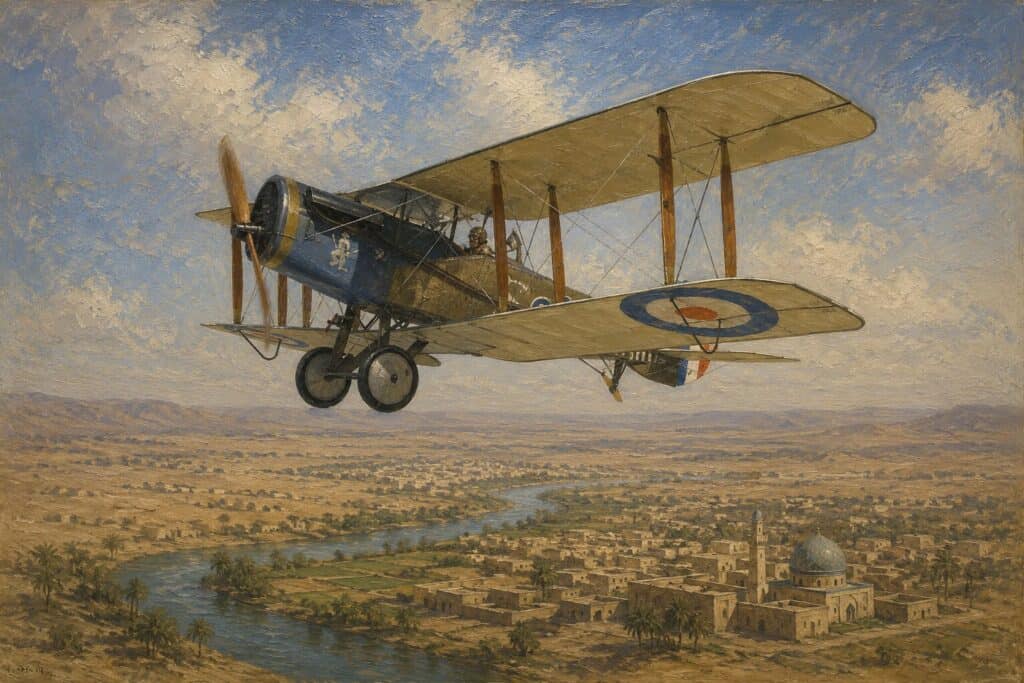
One of the strongest practical arguments for an independent air force in the 1920s came not from Europe but from empire. The Air Ministry presented air control as a cheaper alternative to large garrisons in difficult territories, especially in the Middle East. Aircraft could observe, threaten and, when required, strike quickly across wide areas where ground communications were slow and expensive. To politicians looking for economy, this seemed to prove that air power offered not just military novelty but administrative efficiency.
In Iraq, this policy became central to the RAF’s interwar identity. The ministry argued that aircraft, backed by limited ground forces, could police territory more cheaply than a conventional army-model occupation. Similar thinking influenced wider imperial planning, where distance, sparse infrastructure and financial caution all encouraged the search for lighter forms of control. Airfields, staging posts and communications networks became part of a broader imperial geography in which the RAF could claim a standing role far beyond the defence of Britain itself.
For the Air Ministry, air control solved several problems at once. It gave ministers an apparent economy. It supplied the RAF with a visible peacetime mission. It strengthened the case for independent command in overseas theatres. And it reinforced the belief that aircraft could produce strategic and political effects disproportionate to their numbers. In Whitehall terms, this was powerful evidence that the RAF was useful precisely because it was not simply another branch of land or naval force.
But imperial utility also distorted priorities. Air control operated under conditions very different from those of the major European wars. It could reward speed, intimidation and dispersed presence, yet tell planners less about what would be required against a heavily armed industrial opponent. There was also a moral cost, since coercive bombing against irregular resistance sat uneasily even in its own time and later attracted deeper criticism. The ministry’s reliance on imperial examples helped preserve budgets and institutional standing, but it could also make the RAF look most successful in precisely those environments least representative of the struggle that would confront Britain after 1939.
Disarmament And The Problem Of Preparation
If empire offered the Air Ministry an argument for relevance, disarmament imposed the conditions under which that relevance had to be sustained. Throughout the 1920s and into the early 1930s, Britain’s defence policy was shaped by fiscal caution and by the so-called Ten-Year Rule, the assumption that no major war was likely for the next decade. Renewed annually, it encouraged departments to postpone large preparations and made long-term modernisation difficult. For the Air Ministry, this was both a frustration and a temptation. It limited expansion, yet also encouraged the search for strategic theories that promised effect without unaffordable mass.
The bomber answered that need neatly. If air attack could threaten an enemy’s industrial centres, communications, and civilian morale from the start of the war, then Britain might offset weaknesses in manpower and its continental position. The language of deterrence and rapid offensive effect therefore gained both political usefulness and doctrinal force. By the early 1930s, public discussion increasingly reflected the fear that future bombers would penetrate defences and strike cities with little warning. Such anxieties did not arise from Air Ministry thinking alone, but the ministry worked within them and benefited from them, because they made air power appear both urgent and singular.
Yet the ministry’s position remained contradictory. It argued for the importance of air power while lacking the resources to build all the capabilities that argument implied. Aircraft obsolescence moved quickly. Industrial output was limited. Procurement decisions could be overtaken by technical change before machines entered squadron service. Home defence, modern fighter development and command-and-control arrangements all competed with bomber priorities inside a budget that never fully matched interwar rhetoric. The Air Ministry was trying to plan for a future war while the state still hoped, for much of the period, to avoid paying a high price for it.
Disarmament diplomacy added another complexity. Britain could not ignore international attempts to regulate armaments, but air power proved exceptionally difficult to fit into simple limitation schemes. Bombing could be condemned morally while still appearing militarily indispensable. Defensive and offensive aircraft were not easily separated in practical planning. The Air Ministry therefore inhabited a world in which formal restraint coexisted with growing fear. It had to prepare under ceilings, debates and uncertainties that repeatedly postponed clarity. By the time the Ten-Year Rule was abandoned in 1932, valuable years had already gone.
Rearmament And The Turn Back To Europe
The European crisis of the 1930s forced the Air Ministry to revise its emphasis. Japanese aggression, the collapse of collective security and, above all, the rise of Nazi Germany made it impossible to rely on imperial policing and abstract deterrence alone. Once Germany openly rearmed and the Luftwaffe emerged from concealment, the ministry faced a much sharper question: how should Britain organise an air force capable not merely of punitive reach overseas but of sustained war against a first-rate industrial enemy close to home?
This was not a complete break with earlier doctrine. The bomber remained central to official thinking, and fears of attack on British cities gave bomber policy renewed urgency. But rearmament altered the balance inside the Air Ministry. Home defence gained weight. Fighter development became more difficult to postpone. Research, communications and warning systems that had once seemed specialised now became strategically indispensable. The ministry had to think less about proving a theory of air power and more about constructing a functioning system capable of surviving the first weeks of a European war.
The institutional expression of that change was visible in the late 1930s as the RAF was reorganised for modern conflict. Fighter Command, Bomber Command and Coastal Command emerged as clearer operational pillars, replacing older arrangements that were less suited to the scale of war to come. Within this structure, men such as Hugh Dowding pressed for an integrated air defence system in which fighters, radar, observers, communications and sector control worked together rather than separately. The importance of this shift can hardly be overstated. It meant that the Air Ministry was no longer dealing only in general claims about air power; it was now sponsoring the practical architecture of national survival.
Even so, rearmament was uneven and late. The ministry had to translate expansion programmes into factories, trained crews, ground staff, stations and supply chains. Modern types such as the Hurricane and Spitfire were promising, but that promise was not the same as mature squadrons. Industry had to expand under pressure. Technical innovation outran production routines. Strategic choices still had to be made about where limited resources would go first. The Air Ministry’s interwar culture did not vanish when circumstances changed. It adapted, but under strain and with the clock running.

Machines, Factories And The Limits Of Expansion
The Air Ministry’s interwar record cannot be understood only in terms of doctrine and high policy. It was also an industrial story. Every theory about offensive bombing or home defence eventually had to become a specification, a contract, a production line, a training syllabus and a maintenance burden. In the 1920s and early 1930s, this was a persistent weakness. Aircraft design moved fast, but procurement moved through committees, trials and financial caution. By the time one generation of machines entered service, another could already be on the horizon. The ministry was often deciding under uncertainty, trying to buy for a future that might arrive before the aircraft themselves did.
This problem was especially acute because Britain did not maintain a vast peacetime aircraft industry ready for sudden war. Firms could design impressive machines, but capacity, labour, subcontracting and engine output all had to be built up. The Air Ministry therefore spent much of the 1930s attempting to create depth where only fragments existed. Expansion meant more than ordering aircraft. It meant enlarging stations, widening training pipelines, securing engines, instruments, and wireless equipment, and ensuring that squadrons could actually absorb new types without collapsing under the strain of technical change.
The ministry’s role in this process was difficult and sometimes contradictory. It had to encourage innovation while also demanding standardisation. It needed modern fighters for home defence, long-range aircraft for maritime work and a bomber force that ministers believed essential to deterrence. Every choice created opportunity cost. A stronger emphasis on one branch could delay another. Air staff and officials therefore worked in a climate where the need for speed was obvious, but the material means of speed were limited by industrial reality.
This helps explain why the later success of Fighter Command should not be read as proof that rearmament had been simple or smoothly directed. The integrated system associated with Dowding required not only sound ideas but radio networks, plotting rooms, radar stations, trained controllers, airfields, repair capacity and a steady flow of serviceable aircraft. The Air Ministry’s great late-interwar achievement was that it increasingly treated those elements as a single, interconnected problem rather than as isolated purchases. Its failure was that such integration came only after a long period in which economic caution had narrowed what could be done. Britain entered the war with important foundations in place, but not with every industrial weakness solved.
The War Machine Britain Carried Into 1939
By the eve of war, the Air Ministry had achieved something substantial. It had preserved an independent air force through years in which that outcome was far from guaranteed. It had moved the RAF from post-war uncertainty towards a recognisable command structure, a growing industrial base and a more serious home defence system. It had also fostered a cadre of officers, planners and technical specialists who understood that modern air war would be national, industrial and continuous rather than confined to the front.
The Britain that entered the Second World War possessed advantages that were not accidental. Fighter Command’s foundations had been laid before the emergency became total. Radar and reporting systems were being integrated into a wider defensive network. Expansion had increased the scale of the service, while the Royal Auxiliary Air Force and reserve arrangements widened the pool of trained personnel. Bomber Command, though still limited in accuracy and equipment compared with later wartime standards, existed as a standing force because the interwar ministry had insisted that strategic air action belonged at the centre of national policy.
Yet the Air Ministry also handed forward unresolved problems. Belief in the bomber’s political and military effect remained stronger than the practical record of interwar technology entirely justified. Cooperation with the Army was better than in the early 1920s, but still not the governing instinct of the service. Industrial preparation, though improved, could not erase the years lost to the economy and hesitation. The RAF in 1939 was larger and more coherent than its critics had once expected, but it was still a force shaped by compromise between theory, Treasury pressure and late urgency.
That mixture explains much about the RAF’s early war experience. Britain did not enter the conflict with an air force improvised from nothing. Nor did it enter with a fully balanced instrument perfected by foresight. It entered with a service whose most important institutions had been built in argument: argument about whether the RAF should exist, argument about what bombers could achieve, argument about how to defend the country and argument about whether empire or Europe should dominate planning. The Air Ministry had won enough of those arguments to create a viable force, but not enough to remove every weakness from the structure it had created.
Conclusion
The Air Ministry’s interwar history is the story of Britain trying to think strategically about air power before the nature of the next war was fully clear. It defended the RAF’s independence, gave the service a doctrine, found peacetime missions in empire and eventually directed rearmament towards the demands of European conflict. In doing so, it ensured that air questions would not be treated as mere appendages of older services.
Its record was neither a straightforward success nor a simple failure. The ministry preserved what mattered most: an independent air arm with enough institutional strength to expand and fight. But it also embedded assumptions that proved costly, especially when confidence in bombing outpaced the realities of preparation. The RAF that went to war in 1939 was, in large measure, the Air Ministry’s creation. Its resilience, its organisation and some of its most serious blind spots had all been forged in the long, difficult peace between two world wars.