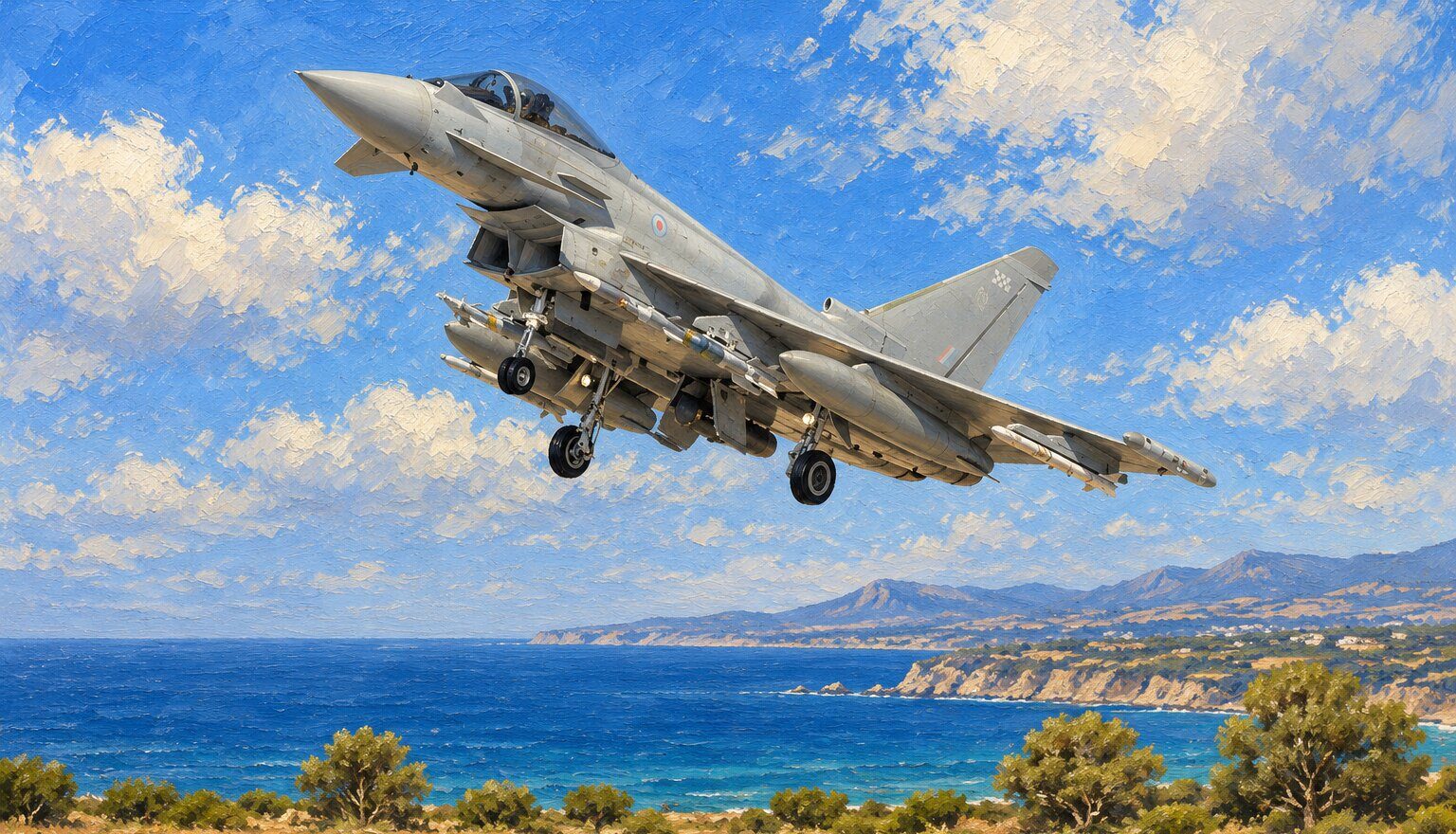
When Cyprus became independent on 16 August 1960, RAF Akrotiri remained under British sovereignty. The island’s colonial government ended, but the airfield continued operating within territory retained by the United Kingdom. That distinction gave British air power an enduring position in the eastern Mediterranean while creating a lasting relationship between military operations, Cypriot independence and the politics of the surrounding region.
Akrotiri’s location offered access towards Egypt, the Levant and the wider Middle East. Its value nevertheless changed considerably over time. The demands of colonial security, the attack on Egypt in 1956, Cold War strike commitments and modern expeditionary operations required different aircraft, organisations and arrangements on the ground. A base established amid the retreat from Britain’s Egyptian positions became a platform for missions extending far beyond the circumstances of its foundation.
Cyprus also presented immediate local responsibilities. Aircraft supported security forces during the Emergency, assisted evacuation during the crisis of 1974 and provided rescue and emergency-response capabilities. The island was both a place from which the RAF operated and a society directly affected by British military decisions. Greek Cypriot and Turkish Cypriot political concerns, the presence of civilian communities within the base areas and the consequences of division all formed part of that setting.
The continuity of the RAF presence therefore rested on more than a favourable position on the map. Wartime construction at Nicosia, rapid expansion at Akrotiri and the particular settlement reached in 1960 each supplied something different: usable infrastructure, operational capacity and a legal basis for remaining after empire.
Wartime Nicosia And The Imperial Geography Of Cyprus
Britain assumed the administration of Cyprus in 1878 under the Cyprus Convention, while Ottoman sovereignty initially remained. British annexation followed in 1914, and the island became a Crown colony in 1925. These successive arrangements marked distinct stages in Britain’s relationship with Cyprus. The administrative foothold of the nineteenth century and the sovereign colonial territory of the twentieth were different political foundations for the military presence that followed.
The island lay close to several areas central to British regional strategy. Egypt and the Suez route connected Mediterranean policy with communications farther east, while the Levant formed another nearby zone of concern. Cyprus offered a position from which movement and communications across this region could be supported. Yet geographical advantage did not immediately produce a large air station. Aircraft required suitable landing surfaces, communications and servicing facilities before a location could become a dependable part of an operational system.
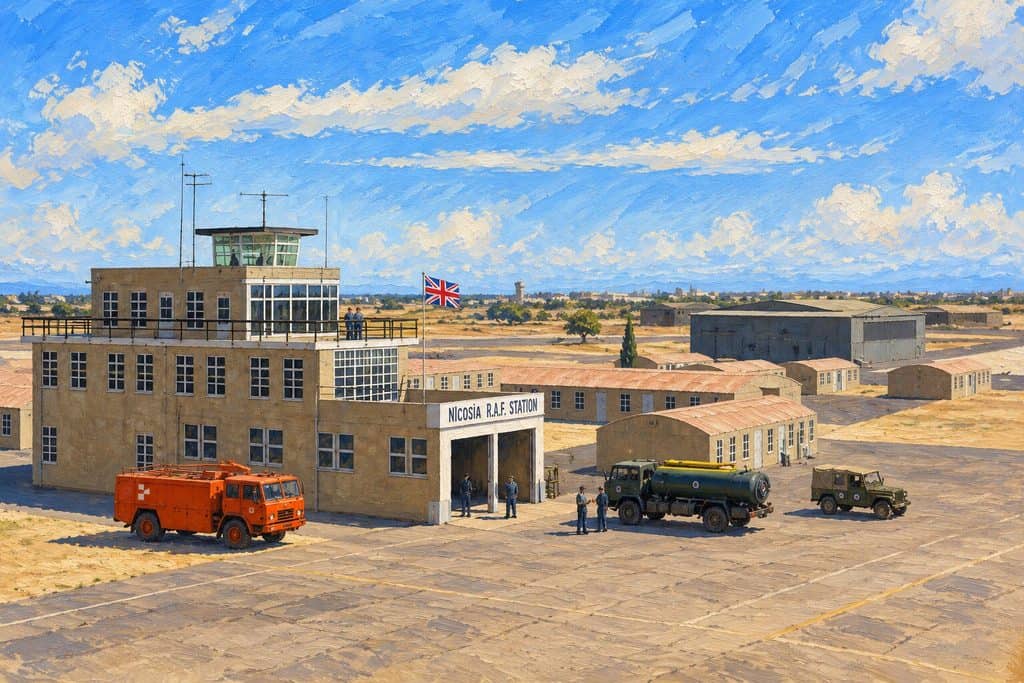
Nicosia’s landing ground developed from the 1920s. The approach of the Second World War brought a more substantial commitment to its infrastructure. Construction of three all-weather runways began in October 1939 and was completed in May 1940. The United Nations history of Nicosia Airport records the arrival of RAF radio personnel in June 1940, placing communications alongside the physical preparation of the airfield in its wartime expansion.
Runways and radio facilities performed complementary functions. A serviceable landing ground allowed aircraft to use the island more reliably; communications connected those movements with the organisations directing and supporting them. Their significance lay in the practical integration of Cyprus into wartime flying and defence. The island’s contribution included communications, air warning and defensive activity, without making it a major centre of the RAF bomber offensive.
That distinction matters because the later scale of Akrotiri can obscure the more limited beginnings at Nicosia. Wartime Cyprus should be understood through the facilities and duties it actually possessed. An airfield might be valuable as a point of arrival, support or communication even when it did not house the striking force that dominated a campaign. Such functions also left infrastructure that could acquire new importance when regional circumstances changed.
By the post-war period, Britain’s problem was increasingly one of maintaining access across a region in which older imperial arrangements were becoming harder to sustain. Cyprus already had an airfield with wartime improvements, and it remained under British colonial government. Those advantages made it available for further development, although they did not remove the need for construction or resolve the island’s political future. The major expansion of the RAF presence emerged from this combination of inherited facilities and mounting pressure elsewhere, especially in Egypt.

Britain Leaves Egypt And Akrotiri Emerges
The withdrawal from Britain’s positions in the Egyptian Canal Zone increased the strategic importance of Cyprus. Facilities in Egypt had supported a much wider regional presence, and their loss placed additional weight on locations where Britain could still organise and sustain air operations. Cyprus offered proximity to the same broad theatre while remaining, for the moment, under direct British control.
The formation of Air Headquarters Cyprus at RAF Nicosia in January 1954 reflected this changing emphasis. A headquarters supplied the command organisation through which activity on the island could be directed. It should be distinguished from the establishment of Akrotiri itself, which followed later. The sequence began with an existing airfield and an expanding command role before the new station became a substantial operational base.
Jet aircraft also altered the practical relationship between Britain and its eastern Mediterranean facilities. The Canberra flight from Scampton to Nicosia in 1955 demonstrated speed and reach over the route. It was a demonstration flight, not a combat operation. Its significance was the ability to connect a British station with Cyprus quickly, illustrating how a forward location could work with aircraft arriving from much farther away.
The arrival of an aircraft, however, was only the beginning of a sustained military commitment. A station receiving operational units needed accommodation, maintenance support and the means to service repeated flying. These requirements became particularly visible at RAF Akrotiri, which opened on 1 July 1955 with just 30 personnel. Its subsequent growth was exceptionally rapid: by August 1956, the station held 260 officers and 2,864 other ranks.
Those figures describe an expanding organisation whose human requirements grew alongside its flying responsibilities. Construction and accommodation had to catch up with the concentration of personnel. The official station history records overcrowding and sickness during this period. Akrotiri’s early importance was consequently accompanied by the strains of turning a small establishment into a functioning base at speed. A location selected for strategic reasons still had to be made habitable and operational on the ground.
Command arrangements changed as well. In January 1956, Air Headquarters Levant moved from Habbaniya and absorbed Air Headquarters Cyprus. The island was becoming a receiving point for responsibilities displaced or reorganised elsewhere in Britain’s regional system. Headquarters movements and airfield expansion belonged to the same wider adjustment, although each represented a different element of the growing military presence.
This expansion took place under two pressures that would soon overlap. Within Cyprus, the Emergency required support for British security operations. Across the eastern Mediterranean, the confrontation over Suez brought preparations for a major external operation. Nicosia and Akrotiri therefore developed within a setting where local security and regional intervention competed for attention. The RAF needed facilities from which it could project power, while the territory providing those facilities was itself becoming the scene of an armed struggle over British rule.

The Cyprus Emergency And Helicopter Mobility
EOKA’s armed campaign began in 1955 in pursuit of enosis, or union with Greece. It challenged British colonial rule and drew upon Greek Cypriot aspirations whose expression and political implications varied across the community. Turkish Cypriot concerns about the island’s future were distinct and increasingly important. British emergency measures operated within this contested setting, where the political dispute extended well beyond the immediate task of locating armed opponents.
For the RAF, support to internal security involved transport, reconnaissance, communications and rescue as well as assistance to forces on the ground. These activities could connect dispersed positions and help overcome difficult terrain. They also differed from the bomber operations being prepared for Egypt. The presence of military aircraft on the island did not make every security operation an air strike, and the RAF contribution is best understood through the specific tasks its aircraft performed.
The Bristol Sycamore was particularly useful in demonstrating the possibilities of helicopter mobility. Mountain country complicated movement by road and on foot. A helicopter could carry a small party to a position that would otherwise require a slower approach, while rescue work offered another application of access from the air. Roping techniques added to the possibilities where a conventional landing was difficult. Each method depended on suitable conditions and the limited capacity of the aircraft.
No. 284 Squadron reformed in Cyprus in October 1956 from Sycamore helicopter elements. Its experience belonged to the RAF’s early practical exploration of rotary-wing support. The small loads involved are important to understanding the scale of this work. Helicopters could provide speed and access at a selected point, but they did not remove the need for ground forces to occupy, search or hold the surrounding area.
A June 1957 operation at Kharch in the Kyrenia mountains provides a concrete example. The RAF Air Historical Branch account describes five Sycamores carrying three troops each to establish a cordon. The tactical advantage lay in placing small groups where they were required without making the whole approach over the intervening ground. The cordon was established in approximately 45 minutes. The operation also affected people living in the area, showing how helicopter-supported security measures could disrupt civilian life. The aircraft served a particular part of a security operation, concentrating their mobility advantage at the moment when the cordon was being formed.
The example also shows the limits of the technique. The payload carried by each helicopter was small, so the effect depended on coordination and the usefulness of the chosen positions. Aircrew and troops had to work within what the aircraft could deliver. The mobility gained was real, but it did not make the helicopter a substitute for the larger organisation conducting the operation. Nor should RAF experience be merged indiscriminately with that of Army or naval aircraft operating in the same wider period.
Such operations helped establish helicopters as practical instruments of military support. Rescue, movement and communications could be improved even when the underlying conflict remained unresolved. That distinction was especially clear in Cyprus. Faster deployment into the mountains might assist a cordon or a search, but it could not determine the island’s constitutional future or reconcile the political demands of its communities. The eventual settlement required negotiations and agreements beyond the reach of aircraft, however effectively those aircraft supported the forces engaged in the Emergency.
Suez And The Limits Of Operational Reach
The Suez crisis in 1956 placed the RAF’s Cyprus facilities at the centre of a much larger external operation. The confrontation with Egypt developed into an Anglo-French military campaign in which air attacks were intended to weaken Egyptian air power and support the subsequent intervention. Operation Musketeer drew upon a regional network of bases, with Cyprus providing a major part of the RAF’s operational position.
The distinction between individual stations is essential. The Canberra B.2 squadrons operating from Cyprus were based at Nicosia: Nos. 10, 15, 18, 27, 44 and 61 Squadrons, supported by No. 139 Squadron’s Canberra B.6 target-marking aircraft. Their concentration placed a substantial bomber force at the established airfield. Valiant bomber squadrons operated from Malta. Moving those Valiants into an account of Akrotiri would create a misleading picture of both the campaign and the new station’s early history.
The RAF Air Historical Branch dates the bombing sorties to 31 October–5 November. Attacks on Egyptian airfields formed part of the effort to establish the conditions for further military action. The presence of target-marking aircraft alongside the Canberra bomber squadrons also shows that the operation required differentiated duties within the force. Launching bombers from a forward airfield was one element of an organised campaign involving preparation, direction and the repeated support of aircraft returning from sorties.
Akrotiri had other flying and support functions within the wider effort, while Nicosia carried the principal Canberra concentration described here. Cyprus’s contribution cannot therefore be reduced to a single station or aircraft type. The island’s value came from the facilities available across it and their relationship to the rest of the theatre. The rapid expansion already under way made sense in this operational setting, even as it exposed the difficulty of preparing a new base under pressure.
Air superiority, transport and airborne assault were connected requirements. The attack at El Gamil brought air transport directly into the intervention on the ground, demonstrating that the campaign depended on moving troops as well as delivering bombs. Aircraft could open routes, suppress opposition and carry an assault force, but these functions served a political enterprise whose success could not be measured solely through the progress of flying operations.
The military effort was overtaken by political failure. Britain possessed aircraft and regional bases from which it could mount substantial action, yet it lacked the diplomatic freedom to carry that action through on its own terms. Tactical achievements did not secure the intended political outcome. Suez exposed the narrowing limits within which British power could be exercised, even when the RAF was able to assemble and employ an effective force.
For Cyprus, the result was a revealing contrast. The island had demonstrated its value as a platform close to the area of operations, while the campaign showed that access to a platform could not guarantee strategic success. The RAF’s future there would depend on a new political foundation as British colonial rule on the island itself approached its end.
Independence And The Sovereign Base Areas
The end of the Emergency and the agreements reached in 1959 opened the way to an independent Republic of Cyprus. Independence followed on 16 August 1960. For Britain, the settlement separated the end of colonial government from the retention of specified territory for military purposes. For the new Republic, it established independence within boundaries that excluded those retained areas.
Article 1 of the Treaty of Establishment provided the central legal distinction. Akrotiri and Dhekelia were excepted from the territory of the Republic and remained under United Kingdom sovereignty. British possession of the base areas therefore rested on retained sovereignty, not a lease granted by the Republic. Describing the arrangement as leased access obscures the particular settlement that allowed the RAF station to continue operating after colonial rule ended elsewhere on the island.
The two Sovereign Base Areas together covered roughly 256 square kilometres. The Western Sovereign Base Area comprised the Akrotiri and Episkopi area; the Eastern Sovereign Base Area encompassed Dhekelia and Ayios Nikolaos. These were separate geographical areas with their own installations and responsibilities. RAF Akrotiri belonged within the western area, while the wider British presence extended beyond that single station.
The boundaries enclosed more than military compounds. Cypriot residents and privately owned land formed part of the base areas, making civilian administration an enduring responsibility. Sovereignty over territory did not mean that every parcel of land belonged to the British military. The distinction between jurisdiction and ownership was important to daily life, as was the difference between an operational airfield and the larger area within which it stood.
The treaty arrangements also included specified British ancillary rights outside the Sovereign Base Areas. Those rights must be distinguished from the sovereignty retained within the areas themselves. Access or use under an agreed provision did not make every associated location British territory. The resulting framework combined retained areas with particular rights elsewhere, allowing military requirements to be addressed without making the whole island part of the British basing jurisdiction.
For the RAF, the settlement supplied a durable foundation for operations. Akrotiri could remain a British station even as the surrounding political order changed fundamentally. Yet the legal security of the base did not remove its relationship with the Republic or the sensitivities of operating from Cyprus. Aircraft missions, the movement of personnel and the station’s regional purpose all existed alongside the interests of the island’s population and government.
This was a negotiated transition with different consequences for the parties involved. Britain preserved a military position after giving up colonial government; the Republic acquired independence while the retained areas remained outside its territory. Cypriot concerns about sovereignty could consequently persist alongside a treaty-defined British position. Legal continuity and political acceptance were related questions, but they were never identical.
The arrangement explains why Akrotiri outlasted the circumstances that had produced its hurried construction. Its survival depended on a settlement specific to Cyprus, not merely on the continued usefulness of its runway. It also helps explain the character of the base thereafter: a British operational installation situated on an independent island, with responsibilities to local civilian life and a regional role that could draw it into crises beyond the island’s shores.
Cold War Strike Forces And The Crisis Of 1974
After independence, Akrotiri continued to serve a British regional posture shaped by Cold War commitments. Strike, air defence, transport and helicopter duties gave the station different forms of military value. The aircraft associated with its history included Canberras, Lightnings, Vulcans, Hercules, Argosies, Whirlwinds and Wessexes. These types belonged to different periods and functions; they should not be assembled into an imaginary single force permanently present throughout the Cold War.
Canberra and Vulcan service placed Cyprus within Britain’s regional strike arrangements, including the conventional and nuclear dimensions of Cold War planning. Lightning aircraft represented air-defence requirements, while Argosy and Hercules operations belonged to the movement and support side of the force. Helicopters answered a different set of local needs. Together, these roles show the range of tasks that a regional station could sustain as policy and equipment changed.
Britain’s CENTO-era commitments formed part of this setting. They did not make Cyprus a NATO member, nor were CENTO and NATO interchangeable organisations. The RAF’s use of the island reflected British commitments and the basing settlement, while the Republic’s own position remained distinct. Keeping these relationships separate is necessary to understanding how British military activity could continue on an independent island without absorbing that island into the same alliance structure.
The withdrawal east of Suez changed the scale and purposes of Britain’s wider presence. As commitments contracted and forces were reorganised, Cyprus retained value as a location from which regional activity could be supported. The continued existence of a station did not require every earlier mission to survive unchanged. This became particularly apparent when the island itself faced a severe crisis in 1974.
The coup against President Makarios on 15 July was followed by Turkish military action beginning on 20 July. The fighting and the island’s subsequent division produced profound humanitarian consequences. For British forces, protection of installations and assistance with evacuation became immediate concerns. RAF records describe 10,132 dependants and tourists evacuated through Akrotiri in July 1974. RAF Regiment personnel contributed to base security, while the air organisation supported the movement of people away from danger.
On 23 July, two No. 41 Squadron Phantom FGR.2s arrived at Akrotiri. Their deployment formed part of the British response to the crisis and the reinforcement of the station’s defensive posture. Phantom air-defence patrols must be distinguished from offensive intervention: their arrival did not mean that the RAF joined the fighting. Further Phantom deployments followed as the crisis developed. Reinforcement, reconnaissance, protection and evacuation were distinct activities, each requiring a clear description of its purpose.
A Puma helicopter detachment also supported British forces during the crisis, supplementing local helicopter capabilities. Vulcans also performed maritime reconnaissance and airborne communications duties during the crisis, as recorded by the RAF Air Historical Branch. These tasks show aircraft associated with strategic strike being employed to support awareness and communication in an immediate regional emergency. Their contribution needs to be understood through those actual duties, without assuming that the type’s best-known role defined every sortie it flew.
In January 1975, the Vulcans of Nos. 9 and 35 Squadrons withdrew to Britain. Their departure marked a contraction of Akrotiri’s permanent strike role, while the station itself remained. The timing should not collapse the wider changes in British strategy into a single consequence of the 1974 crisis. The base was moving through a broader transition in which permanent force structure, regional commitments and the practical demands of emergencies interacted.
Cyprus’s division left the British presence in a changed local setting. Akrotiri continued under the existing sovereignty arrangements, but operations now took place on an island whose political and humanitarian circumstances had been transformed. The ability to sustain flying remained important; so did the need to distinguish Britain’s base responsibilities from the conflict surrounding them.
A Forward Base For Modern Operations
By the late 1980s, according to the official station history, No. 84 Squadron’s helicopters were Akrotiri’s only permanently based flying squadron. That change marked a substantial reduction in the resident force compared with the earlier strike era. It did not mean that the station had ceased to serve wider RAF operations. Training, logistics and the reception of deployed aircraft gave the base a continuing purpose beyond the size of its permanent flying establishment.
The distinction between resident and deployed aircraft became central to Akrotiri’s modern role. A station could maintain the facilities and support needed for operations while receiving aircraft according to the requirements of a particular deployment. Permanent presence and temporary reinforcement therefore measured different things. Counting only the resident squadron would understate the activity that the base could accommodate; treating every deployed aircraft as permanently based would exaggerate its standing force.
Forward staging linked Cyprus with operations across the surrounding region. Air transport brought personnel and equipment through a location already equipped for military flying, while exercises allowed aircraft and crews to use the station outside an immediate combat commitment. The value of the base lay partly in this readiness to receive changing demands. Its runway and support organisation could serve several purposes without each requiring a separate permanent squadron.
Humanitarian response provided a clear example in 2006, when Akrotiri supported the reception of people evacuated from Lebanon. The movement of evacuees required a place where arrivals could be received and onward arrangements supported. In this setting, the same regional position that made Cyprus useful for military deployment also made it valuable for bringing people out of a neighbouring crisis. Reception and support were substantive operational tasks, even when they lacked the visibility of combat flying. Thousands of people evacuated from Lebanon passed through British facilities in Cyprus, although figures for reception at Akrotiri must be distinguished from totals for the wider UK-assisted evacuation.
Operation Shader, beginning in 2014, brought sustained expeditionary air activity to the station. Tornado GR4 and Typhoon aircraft, Voyager tankers and transport support formed part of the wider effort associated with 903 Expeditionary Air Wing. Different aircraft contributed different capabilities: strike aircraft, air-to-air refuelling and movement could support a common operation while retaining separate duties. The organisation at the base had to sustain that combination over time.
The RAF Air Historical Branch records 24 RAF aircraft of six types based at Akrotiri at the October 2016 peak of Shader activity. That figure applies to the aircraft at Akrotiri, excluding those based elsewhere. It provides a useful measure of the station’s deployed operational concentration without confusing it with the entire force committed to the operation. It also demonstrates how far the scale of activity could expand beyond the permanent helicopter presence described in the late 1980s.
Regional access brought exposure as well as opportunity. A drone struck Akrotiri in early March 2026, causing limited damage and no reported casualties. The launch origin was not established in the initial official statements. The Ministry of Defence subsequently assessed that the drone had not been launched from Iran; that conclusion did not establish a precise launch site. The incident and the associated regional defensive reinforcement underlined the vulnerability of a forward location to threats emerging from the surrounding crisis. The ability to support operations close to a troubled region also required attention to the protection of the base itself.
Local emergency duties continued alongside these wider demands. Following the transition away from the Puma helicopter in 2023, the RAF announced the introduction of No. 84 Squadron’s H145 Jupiter HC2 emergency-response capability in July 2026, including its firefighting role. Introduction of the type should not be confused with completion of all operational training and readiness milestones. This continued the station’s connection with practical assistance on and around Cyprus, while the aircraft and arrangements differed markedly from the Sycamores of the Emergency. Helicopter service remained one of the links between the RAF installation and the immediate needs of its setting.
Continuity of Place, Change of Purpose
Akrotiri endured because successive British governments retained a use for its location and because the 1960 settlement supplied a particular legal basis for remaining. Neither explanation is sufficient alone. Geography made the station valuable, but construction, personnel, support arrangements and sovereignty made that value usable. Its survival through the contraction of permanent strike forces depended on the ability to receive new tasks as older commitments diminished.
The movement from the improvised station of 1955 to a modern forward base was therefore a change in purpose as well as scale. Imperial security and regional strike gave way to a different balance of mobility, deployed air operations, defensive readiness and local response. The continuing helicopter role and the reception of evacuees show how the same installation could serve immediate human needs alongside wider military policy.
Cyprus’s independence and division remain central to that history. The RAF operates from territory retained by Britain, on an island whose communities and government have their own interests in the consequences of those operations. The base’s durability has never removed that relationship. It has made the connection between air power, sovereignty and the life of the surrounding region a lasting feature of Britain’s presence in Cyprus.