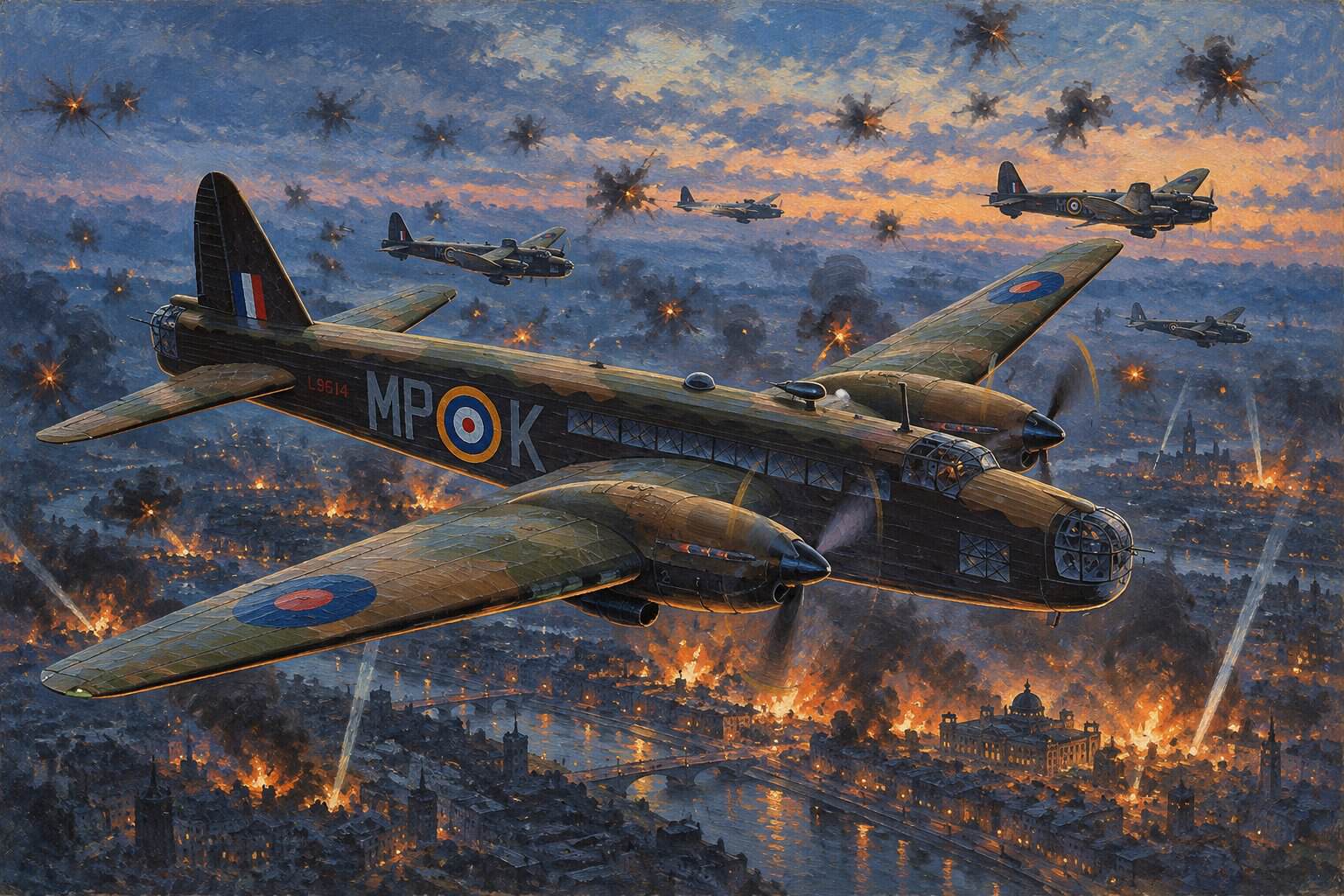
On 8 November 1941, RAF Bomber Command counted the losses from its overnight attack on Berlin: 21 aircraft had failed to return from a force of 169 dispatched. Only 79 had reached the target. The operation, flown on the night of 7–8 November, encountered severe weather and icing alongside German defences, and produced limited damage in the capital.
Berlin formed part of a wider offensive that night, with other aircraft sent against Mannheim, Cologne and additional objectives. Across the whole effort, 37 bombers were missing. The separate totals captured the scale of the Berlin reverse and the broader cost to Bomber Command.
A distant target in the autumn offensive
Air Marshal Sir Richard Peirse commanded Bomber Command during a period of growing scrutiny of its effectiveness. The Butt Report, circulated in August 1941, had exposed serious shortcomings in night-bombing accuracy. Reaching the vicinity of a distant city and identifying an aiming point remained fundamental operational problems.
Berlin imposed a demanding journey on aircraft and crews. Distance increased the importance of navigation, fuel management and weather throughout the outward and homeward flights. The capital had already been attacked by RAF bombers during 1940, and the November operation represented a further substantial attempt to carry the offensive deep into Germany.
The wider force employed the twin-engined Vickers Wellington, Handley Page Hampden and Armstrong Whitworth Whitley alongside newer heavy bombers. These aircraft belonged to an offensive still developing the equipment and methods needed to concentrate bombing at night. The scale of the dispatch placed considerable demands on crews flying through deteriorating conditions.
Weather over the route
The Berlin force encountered bad weather and severe icing. Such conditions threatened aircraft performance while complicating navigation and the task of locating the objective. Some aircraft suffered fuel exhaustion. German defences added to the dangers facing crews already engaged in a prolonged flight over hostile territory.
An individual Wellington loss illustrated the weather’s direct effects. Wellington T2554 of 99 Squadron, commanded by Flight Lieutenant John Patrick Dickinson, became heavily iced over Germany and lost power and height. After control was lost, Dickinson ordered the crew to abandon the aircraft. Sergeant Ronald Joshua Bell was killed when his parachute failed to open; the other five crew members became prisoners of war.
For the Berlin operation as a whole, the difference between aircraft dispatched and aircraft reaching the target was substantial. The 79 that reached Berlin represented fewer than half of the original force. Poor conditions also impaired the effectiveness of the bombing, leaving limited damage despite the considerable effort committed.
Losses across the night’s operations
The 21 aircraft missing from the Berlin force formed part of the 37 lost across Bomber Command’s operations that night. The wider loss rate exceeded nine per cent.
The results brought the pressures of the 1941 offensive into sharp focus. Bomber Command could assemble a large force for distant objectives, while weather, navigation and target identification continued to determine how much of that force could deliver an effective attack.
The Berlin operation of 7–8 November exposed the limitations of Bomber Command’s offensive in late 1941. Although the Command could dispatch large forces against distant targets, severe weather, navigation difficulties and German defences continued to restrict their effectiveness. The loss of 21 aircraft from the Berlin force, and 37 across the night’s operations, demonstrated the considerable cost of attempting deep-penetration bombing before more reliable navigation and target-marking methods became available.