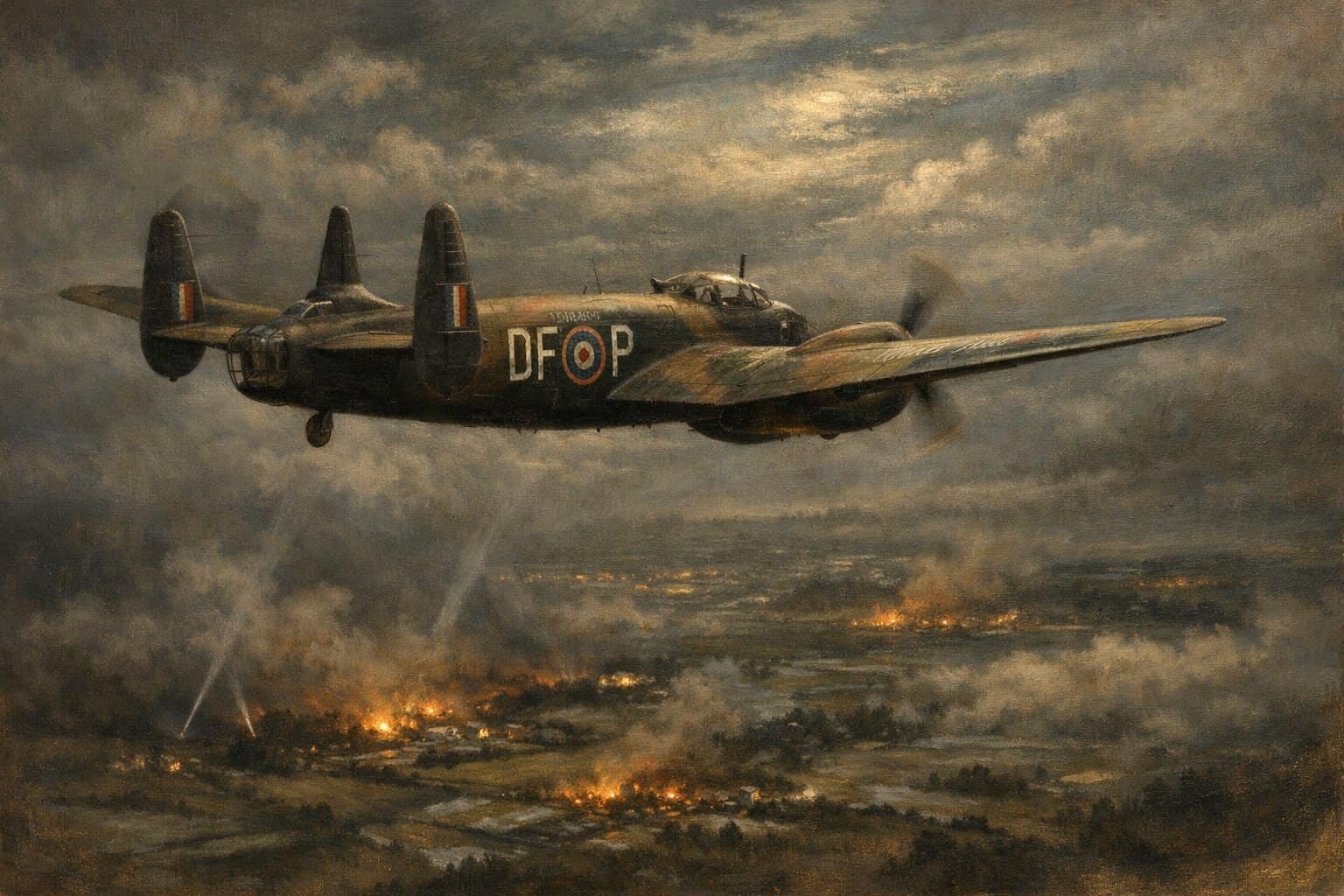
On 24 February 1941, the Avro Manchester entered operational service for the first time when it was employed on Bomber Command attacks against targets in France. In itself, the occasion was not one of the great headline raids of the war, but it marked an important step in the RAF’s effort to expand and modernise its striking force during a difficult phase of the air offensive. The Manchester had been designed as a modern medium-to-heavy bomber capable of carrying a substantial load over a useful range. Its arrival on operations carried significance beyond the immediate raid: it represented an attempt to strengthen Bomber Command with a new generation of aircraft at a time when Britain was still searching for the most effective way to take the war back to occupied Europe.
A New Bomber in an Uncertain Air War
The Manchester appeared at a moment when the RAF’s bomber force was in transition. Early-war operations had exposed the limits of several existing types, while night bombing was becoming more central to British strategy. The need was for aircraft with greater capacity, better endurance and scope for future development. The Manchester was part of that search.
Its operational debut, however, came before the type had established any settled reputation. The aircraft promised much on paper, but in-service use soon revealed serious shortcomings, most notably in reliability and in the performance expected of a bomber intended for sustained offensive work. That made its first mission noteworthy not because it transformed the campaign at once, but because it placed a new and still unproven machine into the real conditions of war. RAF crews, ground staff and commanders were now testing the aircraft not in trials or evaluation, but on active service.
Operational Reality
The raid against targets in France formed part of the continuing pattern of attacks designed to harass German-controlled territory, disrupt infrastructure and maintain pressure on the enemy. In these months, Bomber Command was engaged in a campaign that was still developing in method, accuracy and scale. The Manchester’s presence on such an operation showed the RAF’s determination to bring new equipment forward as quickly as possible, even while broader questions remained about doctrine, navigation, target-finding and aircraft performance.
No single first sortie could settle the Manchester’s future. What mattered was whether the type could deliver consistently under operational strain. In that respect, the early record proved mixed at best. The aircraft did serve in front-line units, but it never fulfilled the larger hopes attached to it. Technical difficulties restricted its usefulness and limited the confidence that could be placed in it for the sustained expansion of the bomber offensive.
Significance in Retrospect
Even so, the Manchester’s first operation deserves notice because it sits at an important point in RAF development. Wartime air power advanced through a process of trial, disappointment, adaptation and improvement as much as through clear-cut success. Some aircraft became decisive weapons; others served briefly, revealed what did not work, and pointed the way towards something better. The Manchester belongs to that second category.
Its real historical importance lies partly in what followed. The design experience associated with the type fed into the development of the four-engined Lancaster, which would become one of Bomber Command’s most important aircraft. In that sense, the Manchester’s operational debut on 24 February 1941 can be seen as part of a larger story: the RAF’s painful but necessary movement from early-war improvisation towards a far more formidable offensive force.
This date is worth remembering not because the Manchester became a triumph in its own right, but because its first mission captures the experimental, often unforgiving character of the wartime air effort. Aircraft were introduced under pressure, judged by harsh operational experience, and either proved themselves or were overtaken. The Manchester did not ultimately define Bomber Command’s offensive. Yet on this day in 1941, it crossed the threshold from promise to combat, and in doing so took its place in the evolving history of Britain’s air war.