On This Day, 1944: On 27 November 1944, the RAF Fauld explosion devastated an underground bomb store and nearby workplaces, killing about…
Read the entry →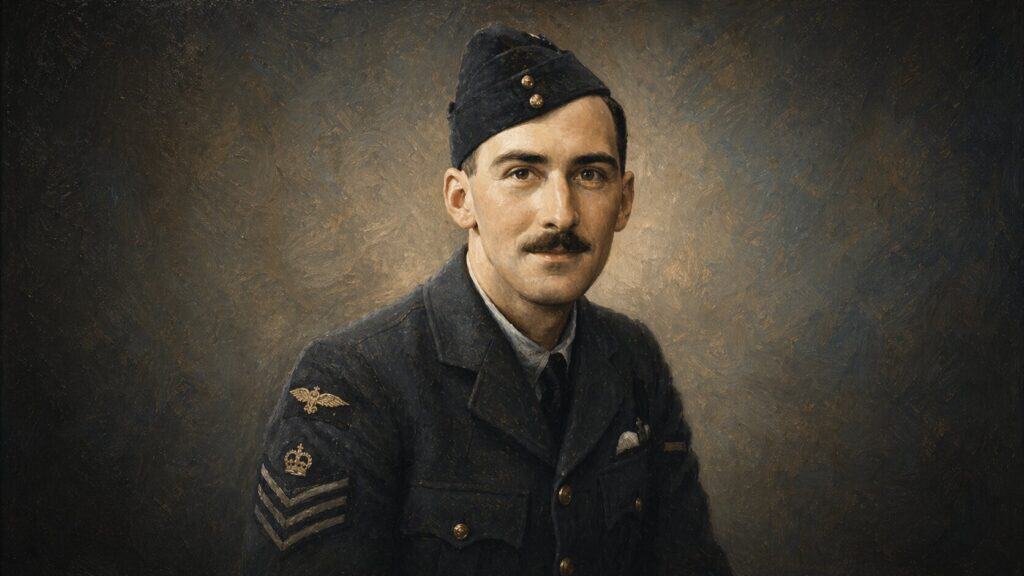
Eric Edward Williams
Flight Sergeant Eric Edward Williams flew Hurricanes with 46 Squadron in the Battle of Britain and was killed over the Thames Estuary on 15 October 1940.
Flight Sergeant Eric Edward Williams was a pre-war regular RAF pilot who flew Hurricanes with No. 46 Squadron in the Battle of Britain. He was shot down over the Thames Estuary on 15 October 1940, and his Hurricane buried itself so deep in the Gravesend waterfront that he has never been recovered.
Who was Eric Edward Williams?
Eric Edward Williams was born at Taplow, Buckinghamshire, in 1912, the son of William and Amelia Williams, and joined the RAF as an aircraft apprentice in 1928. He trained as a pilot in the 1930s and was a Flight Sergeant with No. 46 Squadron when he was killed in action on 15 October 1940, aged 28 (Battle of Britain London Monument).
The apprentice scheme at Halton gave technically able boys a long-service career in the inter-war RAF and supplied much of its skilled manpower. Williams belonged to the small professional service that existed before 1939 and gave the RAF continuity when it expanded rapidly at the outbreak of war.
How did Eric Williams become a fighter pilot?
Williams passed out from his apprenticeship in 1931 and was accepted for pilot training in 1934, moving from ground trade to flying duties as a sergeant pilot. By 1939 he was serving with 29 Squadron at RAF Debden, a fighter squadron then re-equipping for war.
The twelve years between his enlistment in 1928 and his Battle of Britain service in 1940 made him one of the most experienced NCO pilots in his squadron.
What did Eric Williams do in the Battle of Britain?
Williams joined No. 46 Squadron at RAF Digby by July 1940, and moved south with it at the beginning of September to fly Hawker Hurricanes from Stapleford Tawney in Essex. On 3 September 1940 he was wounded in combat off the Essex coast and landed his damaged Hurricane at Debden.
He recovered in time to fly again during the autumn phase of the battle. The Hurricane carried a larger share of RAF fighter work in 1940 than the Spitfire, and 46 Squadron’s pilots met raids over the Essex and Kent coasts and the Thames Estuary.
What happened to Eric Williams on 15 October 1940?
On 15 October 1940 Williams took off from Stapleford with 46 Squadron to intercept German aircraft approaching the Thames Estuary, and the Hurricanes were attacked by Messerschmitt Bf 109s before they could gain height. Williams was shot down and his Hurricane I, V6550, dived into Barton’s Timber Wharf on the Gravesend waterfront.
No parachute was seen, and the aircraft drove so deep into the ground that it could not be recovered at the time. Later accounts link the engagement to Adolf Galland’s Jagdgeschwader 26, though the individual victory claims cannot be matched with certainty.
Where is Eric Williams commemorated?
Because his body was never recovered, Williams is commemorated on the Runnymede Memorial rather than in a war grave. He left a wife, Joan Margaret Williams, née Glenister, whom he had married in Brighton in 1938.
In 2007, before the wharf was redeveloped, a Ministry of Defence-licensed excavation searched for the Hurricane. Fragments of metal were found about four metres down, but no human remains were recovered and the main wreckage was not located (KentOnline).
Why is Eric Williams remembered?
Williams represents the regular NCO pilots who made up much of Fighter Command‘s strength in 1940: men who joined as apprentices, trained as pilots before the war and flew until they were wounded or killed. Few of them became famous, and most appear only briefly in squadron records.
His crash at Gravesend, his name at Runnymede and the unresolved search for Hurricane V6550 have given him a lasting place in local and Battle of Britain remembrance. He is one of the few pilots of the battle still lying where he fell on British soil.
| Dates | Role | Unit | Aircraft |
|---|---|---|---|
| 1928–1931 | Aircraft Apprentice | Royal Air Force | |
| 1934–1939 | Pilot trainee; later fighter pilot | Royal Air Force | |
| 1939–1940 | Fighter pilot | 29 Squadron | |
| 1940 | Flight Sergeant pilot | 46 Squadron | Hawker Hurricane |
Eric Edward Williams is remembered less through public fame than through the particular circumstances of his loss. He belonged to the large body of regular and long-service RAF fighter pilots whose names did not become widely mythologised, yet whose service carried the burden of the Battle of Britain at squadron level.
His final combat also gave his story an unusual afterlife. Hurricane V6550 plunged into Barton's Timber Wharf at Gravesend and was never fully recovered, making him one of the Battle of Britain dead whose resting place remained an active subject of memory and attempted recovery long after the war. That has kept his name alive in local history, Battle of Britain remembrance, and discussions of unrecovered wartime wrecks on British soil.
Williams is therefore significant both as an individual fighter pilot and as a representative of the less celebrated regular airmen who moved from training, station service, and squadron routine into the most intense air fighting of 1940, often leaving only a thin official paper trail behind them.
Hurricanes Defend Singapore Against Japan
On 20 January 1942, RAF Hurricanes of 232 Squadron went into action over Singapore for the…
20 January 2026 · 3 minRAF Meteor Sets the First Official Jet World Speed Record
On 7 November 1945, H. J. Wilson flew a Gloster Meteor at approximately 606 mph, setting…
7 November 2026 · 3 minLeonard Trent and the Amsterdam Power Station Raid
Squadron Leader Leonard Trent won the Victoria Cross after pressing home the 1943 Amsterdam power station…
3 May 2026 · 3 min