On This Day, 1956: On 11 October 1956, a Valiant of No. 49 Squadron dropped a live Blue Danube atomic bomb at…
Read the entry →
83 Squadron
Strike to Defend
History of RAF 83 Squadron, from First World War night bombing to Pathfinder work, Lincoln operations in Malaya and Vulcan service.
Bomber squadron that evolved from First World War night bombing and reconnaissance to Bomber Command heavy bombing, pathfinder marking, post-war Lincoln service and the V-force nuclear deterrent.
No. 83 Squadron was formed at Montrose on 7 January 1917, initially as a Royal Flying Corps night bomber unit. After training at Spitalgate and Wyton, the squadron completed its work-up at Narborough before moving to France in March 1918 with Royal Aircraft Factory F.E.2b and F.E.2d aircraft. It arrived as the German spring offensive opened and spent the remainder of the war on night bombing and reconnaissance duties, striking troop concentrations and transport targets behind the front. That service gave the unit an early identity as a squadron used for difficult work in poor conditions and at night. Reduced to cadre after the Armistice, it returned to Hawkinge and disbanded on 31 December 1919.
Re-formation, Hampdens and the opening of the bombing war
The squadron re-formed at RAF Turnhouse on 4 August 1936 as part of the RAF’s inter-war expansion. Equipped first with Hawker Hinds in the day bomber role, it moved to RAF Scampton in March 1938 and joined No. 5 Group. Later that year, it converted to the Handley Page Hampden, one of Bomber Command’s principal twin-engined bombers at the start of the Second World War.
Unlike many bomber squadrons, No. 83 went into action on the first day of the war, flying a sweep over the North Sea in search of German warships. It then took part in attacks on German naval and coastal targets before the losses of daylight bombing forced a wider shift to night operations. During 1940, the squadron joined the campaign against invasion ports and shipping concentrations, and on the night of 15 September 1940, a crewman from the unit, Flight Sergeant John Hannah, won the Victoria Cross after fighting a major fire in his Hampden during a raid on Antwerp despite suffering severe burns.
In December 1941, the squadron began replacing its Hampdens with Avro Manchesters. The change was important, but brief. The Manchester’s promise was undermined by the weakness of its Vulture engines, and No. 83 soon moved on to the Avro Lancaster, the aircraft most closely associated with its wartime reputation. Among officers who had served with the squadron before achieving greater fame elsewhere was Guy Gibson, later leader of the Dams Raid.
Pathfinders, Lincolns and Malaya
A decisive change came in August 1942 when No. 83 transferred to the Pathfinder Force at RAF Wyton, later part of No. 8 Group. There it served as a marker squadron for the main bomber force, helping guide larger formations onto their targets. Pathfinder work demanded accuracy, discipline and experience, and the squadron became associated with some of Bomber Command’s most exacting operations over Germany.
In April 1944, No. 83 returned to No. 5 Group at RAF Coningsby, where it acted as the group’s own pathfinder unit for independent operations. That role linked the squadron to the later precision-minded phase of the night offensive. After the war, it was re-equipped with Avro Lincolns and settled at RAF Hemswell. In 1953, the squadron deployed to Singapore and flew bombing missions during the Malayan Emergency, attacking insurgent positions before eventually returning to Britain. It disbanded again on 31 December 1955.
Vulcans and the final years
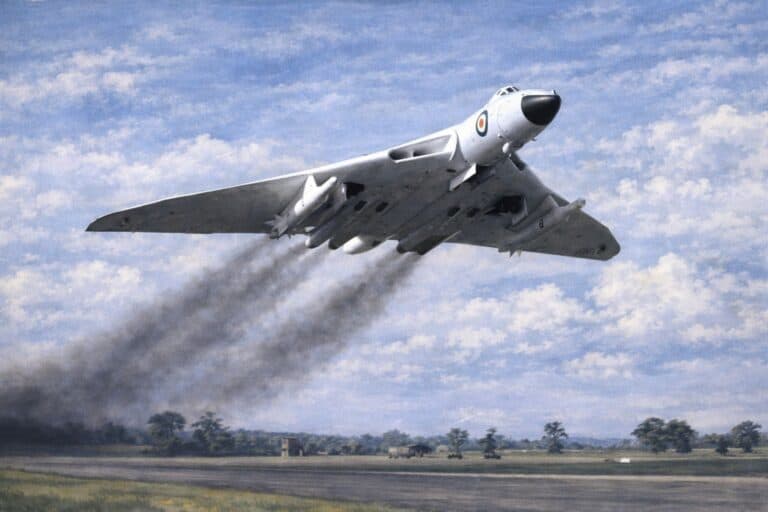
No. 83 Squadron re-formed once more on 21 May 1957 at RAF Waddington as the RAF’s first Avro Vulcan squadron, placing it at the centre of Britain’s early V-force development. In August 1960, it handed over its Vulcan B.1 aircraft to No. 44 Squadron and moved to RAF Scampton, where it became the first unit to receive the Vulcan B.2. Its nuclear role first involved the Yellow Sun weapon and later the Blue Steel stand-off missile, reflecting the rapid evolution of Britain’s air-delivered deterrent in the early Cold War.
The squadron disbanded for the final time on 31 August 1969. Its history spanned the Western Front, Bomber Command’s night offensive, post-war heavy bomber service in Malaya and the Cold War V-force. Few RAF squadrons moved so clearly through the major phases of British air power across the first half of the twentieth century and into the nuclear age.
Western Front, 1918
Somme, 1918
France & Low Countries, 1940
Channel & North Sea, 1939–45
Invasion Ports, 1940
Biscay Ports, 1940–44
Fortress Europe, 1940–44
German Ports, 1940–45
Ruhr, 1940–45
Berlin, 1940–45
Normandy, 1944
France & Germany, 1944–45
German spring offensive, 1918
North Sea anti-shipping operations, 1939
Invasion Ports campaign, 1940
Battle of the Ruhr
Malayan Emergency
Flight Sergeant John Hannah of 83 Squadron received the Victoria Cross for his actions during a raid on Antwerp on 15 September 1940, when he fought a severe fire in his Hampden despite sustaining serious burns.
| Period | Station | Notes |
|---|---|---|
| 1917 | Montrose | Squadron formed. |
| 1917 | RAF Spitalgate | Initial training phase. |
| 1917 | RAF Wyton | Mobilisation and preparation for overseas service. |
| Late 1917–early 1918 | Narborough | Operational work-up on F.E.2 aircraft. |
| 1918 | France | Night bombing and reconnaissance on the Western Front. |
| 1919 | RAF Hawkinge | Reduced to cadre before disbandment. |
| 1936 | RAF Turnhouse | Re-formed with Hawker Hinds. |
| 1938–1942 | RAF Scampton | Hampden conversion and opening war operations. |
| 1942–1944 | RAF Wyton | Pathfinder Force target-marking duties. |
| 1944–1945 | RAF Coningsby | No. 5 Group pathfinder work. |
| 1946–1955 | RAF Hemswell | Lincoln operations and post-war heavy-bomber service. |
| 1953–1954 | Singapore detachment | Malayan Emergency bombing operations. |
| 1957–1960 | RAF Waddington | First Vulcan squadron. |
| 1960–1969 | RAF Scampton | Vulcan B.2 and Blue Steel role until disbandment. |
| Name | Dates | Notes |
|---|---|---|
| Dermot A. Boyle | 1937–1939 | Led the re-formed squadron through its pre-war Hind and Hampden transition. |
| R. A. B. Learoyd | 1941 | Commanded during the squadron’s wartime bomber period and was already a Victoria Cross holder. |
| John H. Searby | 1943 | Associated with the squadron’s Pathfinder Force phase. |
| Alan D. Frank | 1957–1958 | Commanded in the opening Vulcan period. |


Operation Bold Resumes RAF Lincoln Deployments to Malaya
On 1 March 1953, Operation Bold resumed RAF Lincoln deployments to Singapore, reinforcing Operation Firedog during…
1 March 2026 · 3 minRAF Pathfinders: How Bomber Command Evolved Target Marking
How RAF Pathfinders improved Bomber Command’s night offensive through specialist crews, navigation aids and disciplined target-marking.
22 April 2026 · 5 minTwo RAF Lancasters Collide Over the Netherlands
On 8 February 1945, two RAF Lancaster bombers collided over the Netherlands after a Dortmund–Ems Canal…
8 February 2026 · 5 min