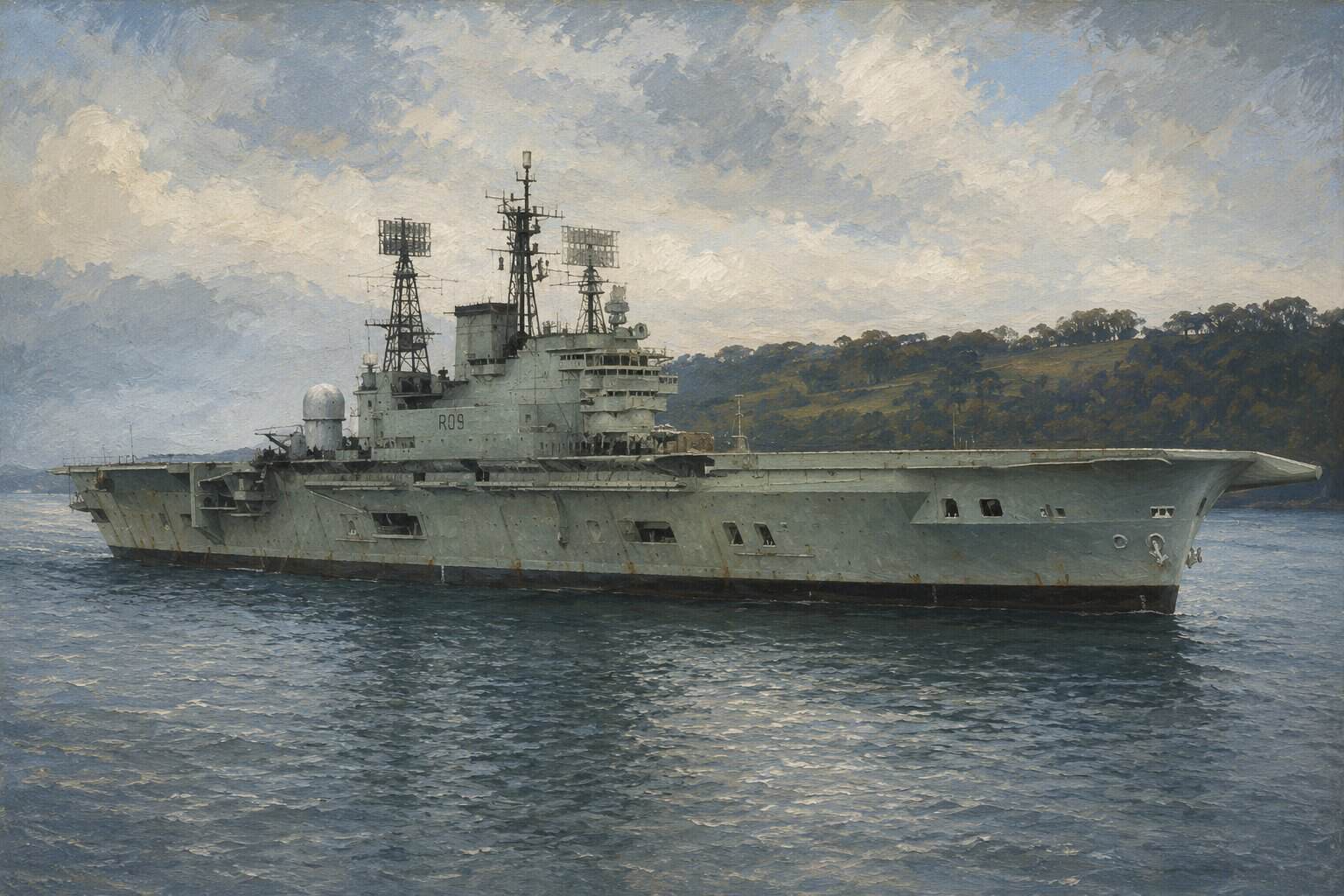
On 22 September 1980, HMS Ark Royal sailed from Plymouth for disposal, ending the career of the Royal Navy's final conventional aircraft carrier. Although fundamentally a Fleet Air Arm story, the ship's departure also belongs within the wider history of British air power. Carrier aviation had long been connected to sea control, fleet defence and the projection of air power beyond land bases. Ark Royal's final sailing marked more than the loss of a single ship. It reflected a broader change in how Britain intended to organise and sustain military aviation at sea.
The End Of A Distinct Carrier Era
Ark Royal was the last Royal Navy carrier designed to operate conventional fixed-wing aircraft using catapults and arrestor gear. That made her the final expression of a type of maritime air capability Britain had maintained through the Second World War and into the Cold War. In practical terms, such carriers offered a combination of fighter defence, strike reach and airborne surveillance that could be moved with the fleet rather than tied to overseas bases.
By 1980, however, the assumptions that had sustained that model were under pressure. Defence spending, changing naval priorities and the high cost of maintaining large fleet carriers all shaped the political and strategic climate in which Ark Royal's future was decided. Her withdrawal did not simply remove an ageing vessel from service. It closed the chapter on Britain's conventional carrier force in its established post-war form.
Why The Departure Mattered
The significance of Ark Royal's departure lay in what it revealed about changing defence priorities. For much of the post-war period, carrier aviation had been one of the clearest ways in which British air power could be applied independently of local infrastructure. A carrier group could move where required, bringing aircraft, maintenance support and command facilities with it. Once that capability was reduced, British maritime aviation had to be reconsidered within narrower limits.
This was especially important in the Cold War setting. Naval air power remained relevant to fleet protection, anti-submarine operations and broader alliance commitments, yet the means of delivering it were changing. Ark Royal's departure from Plymouth stood as a public and symbolic moment in that transition. It showed that a long-familiar model of naval aviation was giving way to a different and more constrained structure.
British Air Power Beyond The RAF. The event also serves as a reminder that British air power history extends beyond the Royal Air Force. The Fleet Air Arm formed part of the same national air story, particularly where strategy, technology and defence planning overlapped. Carrier aircraft, maritime reconnaissance, fleet defence and expeditionary reach all sat within a broader conversation about how Britain could deploy aviation in war and deterrence.
Seen in that context, Ark Royal's last sailing represented a contraction in options. It narrowed the country's ability to operate conventional carrier air groups and illustrated the pressure that financial and strategic choices could place on aviation capability. The issue was not merely one of naval tradition. It affected the range, flexibility and independence of British military air operations.
A Post-War Turning Point
As an On This Day subject, 22 September 1980 captures a decisive moment in post-war defence change. Ark Royal's departure was outwardly simple: a ship leaving Plymouth for disposal. Yet the meaning of that journey was far larger. It marked the disappearance of Britain's last conventional carrier from active service and highlighted a major shift in maritime aviation.
For students of British military history, the episode stands as a clear point of transition. It showed how capabilities that had once seemed central could be reduced or abandoned under new strategic conditions. Ark Royal's final departure therefore remains an important marker in the story of Cold War defence policy, naval aviation and the changing shape of British air power.