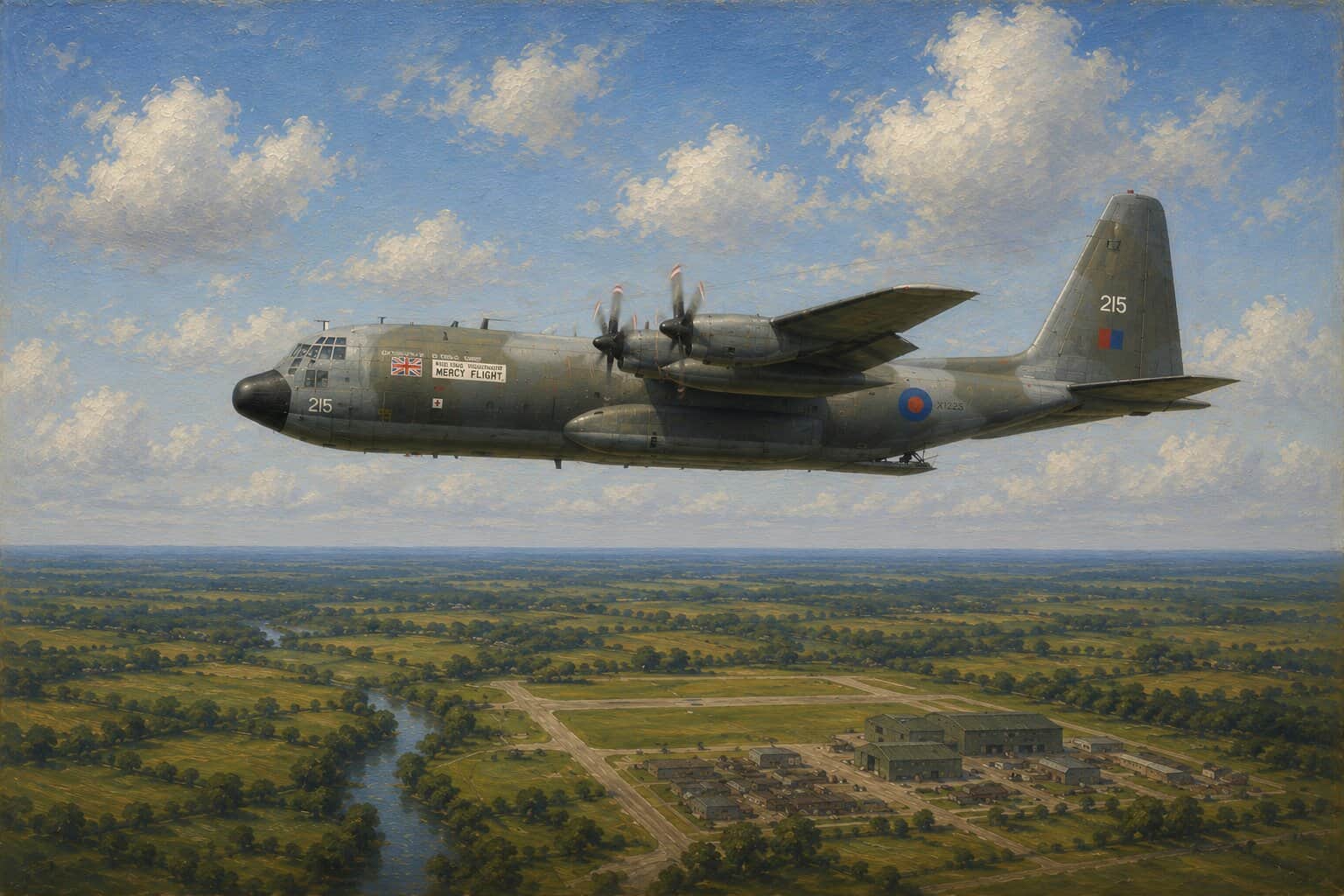
On 18 September 1978, a flypast at RAF Lyneham marked 500,000 flying hours completed by the RAF Hercules fleet. At first glance, it looked like a neat round-number anniversary, the sort of milestone that can pass quickly in a service diary. In practice, it represented something larger: by the late 1970s, the Lockheed Hercules had become one of the central instruments of British air mobility, carrying troops, freight and essential support across a wide range of tasks that rarely attracted the glamour attached to fighters or bombers.
The significance of the occasion lay not in a single dramatic operation, but in accumulated service. Flying hours are a measure of utility over time. They reflect training, routine transport, urgent movement, overseas reinforcement and the steady demands of keeping Britain’s air transport capability available at home and abroad. Reaching half a million hours said as much about reliability and institutional importance as it did about endurance in the air.
A transport aircraft built for modern RAF needs
The Hercules entered RAF service in the late 1960s, replacing older piston-engined transports with a more flexible turboprop aircraft suited to post-war requirements. Its rear-loading ramp, ability to use shorter airstrips, and capacity for tactical lift made it valuable in a service that still needed global reach, but now under very different political and military conditions from those of the Second World War.
By 1978, the aircraft was already firmly associated with RAF Lyneham and with the wider business of transport support rather than headline-grabbing combat. That did not make its contribution secondary. The RAF depended on air transport to move personnel, equipment and stores quickly, and the Hercules was especially useful because it combined payload capacity with adaptability. It could work in austere conditions, support exercises and deployments, and sustain the everyday connective tissue of air power.
What 500,000 flying hours really represented
The Lyneham flypast was therefore a public marker of long-term operational value. Half a million flying hours implied not just airframes in service, but crews, engineers, loadmasters and planners sustaining a demanding fleet over many years. It also reflected confidence in an aircraft that had proved itself capable of handling the practical burdens of RAF transport work without requiring constant ceremony around it.
That mattered in the Cold War setting. British strategy still relied on the rapid movement of people and materiel, whether for reinforcement, overseas commitments, or support tasks that fell below the level of major conflict. The Hercules helped give the RAF a dependable means of doing that. In this sense, the 1978 milestone was less about celebration for its own sake than about recognising that modern air power depended on mobility as much as on striking power.
A milestone with a longer legacy
The importance of 18 September 1978 also becomes clearer in hindsight. The Hercules would continue to serve the RAF for decades after the Lyneham flypast, supporting humanitarian, expeditionary and operational tasks far beyond the circumstances of the late 1970s. The half-million-hour mark showed that this was already an established success story, not an aircraft still proving its worth.
For RAF history, the date offers a useful reminder that service milestones can illuminate deeper institutional change. The Hercules fleet’s 500,000 flying hours marked the maturity of a transport capability that had become indispensable to British operations. It was a moment that recognised not spectacle, but sustained usefulness — and that is often where the true weight of air power can be found.