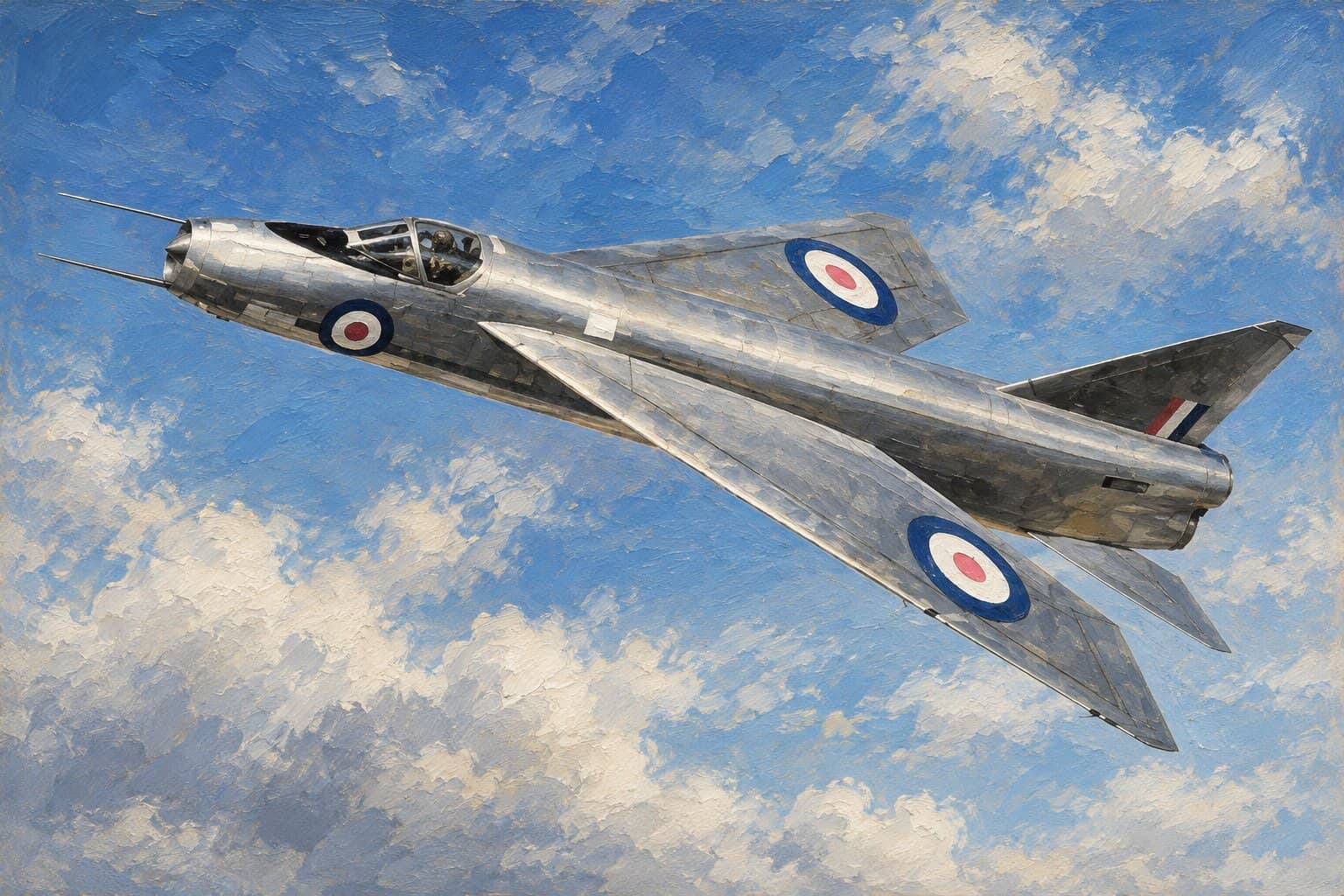
On 23 October 1958, the English Electric P.1B was officially named Lightning at Farnborough. Air Chief Marshal Sir Dermot Boyle, Chief of the Air Staff, performed the naming, accompanied by English Electric chairman Sir George Nelson. A champagne christening marked the occasion, giving the developing supersonic fighter the name under which it would enter RAF service.
The ceremony belonged to the aircraft’s development period. Its experimental predecessors had already flown, while further performance trials, production deliveries and front-line introduction lay ahead. At Farnborough, the future interceptor acquired its official public identity.
From the P.1 to the Lightning
English Electric’s programme grew from Britain’s post-war pursuit of high-speed flight and the requirement for a supersonic interceptor. The P.1A first flew in 1954, demonstrating a distinctive configuration with sharply swept wings and two engines mounted vertically within the fuselage. That arrangement became one of the family’s most recognisable features.
The P.1B, which first flew in 1957, carried the project towards a practical fighter. Rolls-Royce Avon engines, a circular nose intake and provision for radar and guided missiles brought the design closer to the equipment an operational interceptor would require. The progression involved the integration of propulsion, weapons and detection systems into an aircraft intended for squadron use.
Radar and Firestreak air-to-air missiles were central to that development. Together with the aircraft’s speed and climb performance, they addressed the task of reaching and engaging an approaching bomber. The Lightning’s unusual appearance reflected an exacting air-defence requirement, with the pursuit of rapid interception shaping its development.
A fighter in the missile age
The RAF’s requirement developed against the Cold War threat of high-speed, high-altitude Soviet bombers and nuclear attack. Warning time, the speed of the defending aircraft and its ability to gain height all influenced the prospects of a successful interception. The Lightning was being developed to bring substantially greater performance to that task.
Its progress also coincided with a major reassessment of British defence policy. The 1957 Defence White Paper placed increasing emphasis on guided missiles and the implications of nuclear weapons, with serious consequences for several manned-aircraft projects. English Electric’s fighter programme was sufficiently advanced to continue through this period of change.
The naming therefore came at a significant stage in the relationship between the manufacturer and the RAF. Boyle represented the service that would operate the aircraft; Nelson represented the company bringing it through development. Their participation connected the ceremony directly with the fighter’s intended military future.
Towards Mach 2 and squadron service
Flight testing continued under the new name. On 25 November 1958, P.1B XA847 reached Mach 2, establishing a further milestone in the programme. The sequence placed the October ceremony between the P.1B’s first flight and a major demonstration of its performance.
Production and RAF introduction followed as separate stages. The transition to squadron service required aircraft, trained personnel and the supporting arrangements necessary to turn a development programme into an operational capability. The Lightning would become a prominent component of Britain’s Cold War fighter force.
On 23 October 1958, the developing interceptor formally became the Lightning. Farnborough’s champagne christening attached an enduring name to an aircraft whose engineering identity was already distinctive and whose RAF career was still taking shape. Subsequent trials and service would give that name its operational reputation.