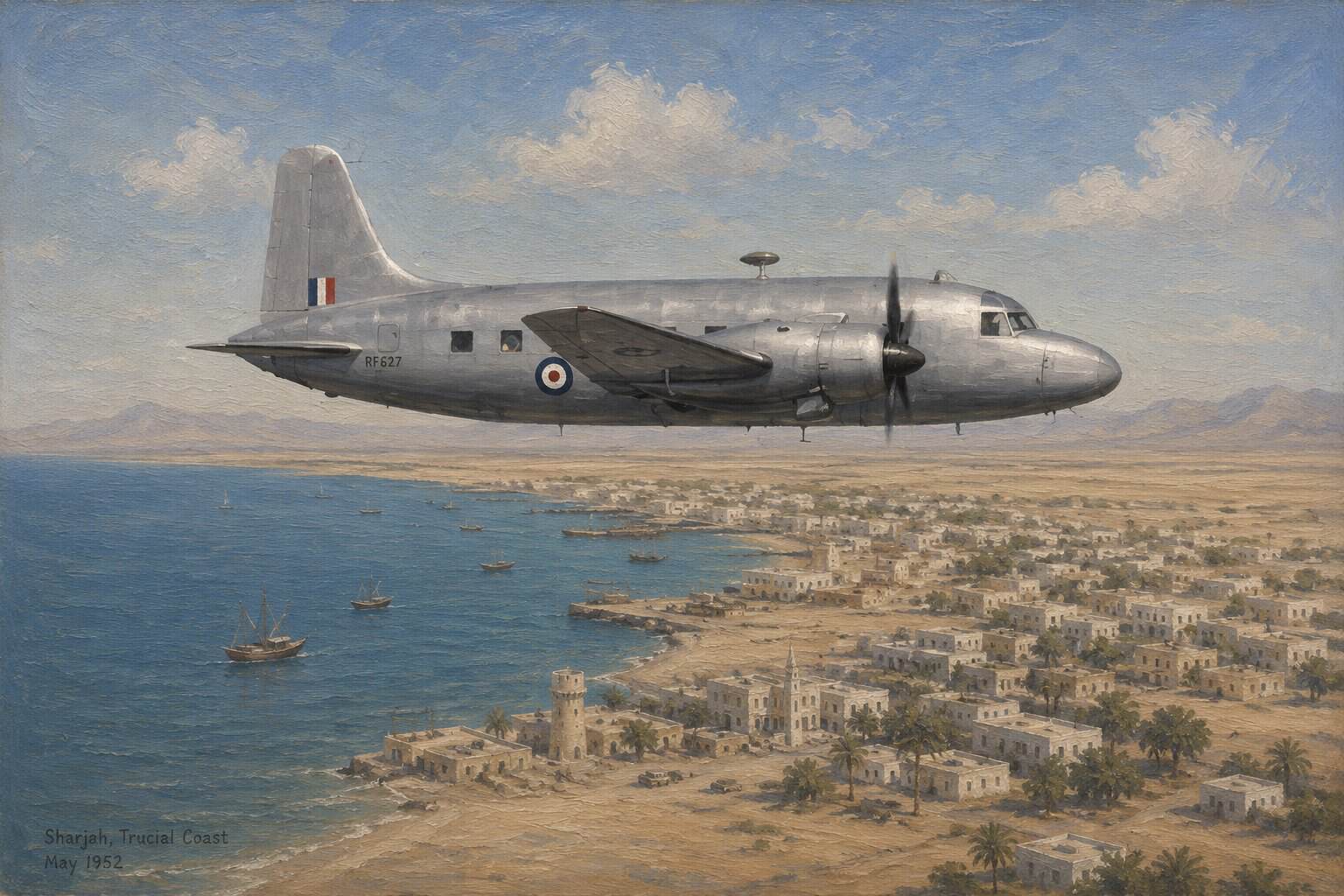
On 15 September 1952, the RAF deployed to Sharjah in response to the Buraimi dispute between Oman and Saudi Arabia, using Vampire FB.5 fighters and Vickers Valetta transport aircraft. The move illustrated the Service’s continuing role in imperial policing, rapid reinforcement and regional deterrence in the early Cold War Middle East. It was not a large war and it is rarely remembered besides Europe or Korea, but it showed how often post-war RAF activity was shaped by local crises on the imperial periphery.
The Gulf in the early Cold War
In 1952 Britain still maintained significant political and military interests across the Gulf and Arabian Peninsula. These interests overlapped with local dynastic authority, oil concerns and wider Cold War anxieties about instability and influence. The Buraimi dispute therefore had significance beyond the immediate oasis or frontier line at issue. It touched on questions of authority, prestige and Britain’s ability to support clients and uphold a regional position.
The RAF’s place in this setting was practical as much as symbolic. Aircraft could move troops, reinforce threatened positions, project force, and shorten response times over long distances. In a region where communications and infrastructure were limited, that mattered greatly.
Why Sharjah mattered
Sharjah was important because it functioned as a forward base from which Britain could respond quickly. The deployment of Vampires and Valettas demonstrated the RAF's ability to combine visible combat capability with the transport flexibility needed to sustain operations. This was a pattern seen elsewhere in post-war imperial air operations: a fighter element for deterrent value and a transport element for movement, support and persistence.
The operation also reveals the continued relevance of air power in disputes that fell short of major war. The RAF did not need a full-scale campaign to make a difference. Its presence alone could alter the political and military calculation of a local crisis.
Air power and imperial control
The Sharjah deployment belongs to the broader history of British air power being used to maintain influence in areas where local disputes, imperial commitments and regional politics intersected. This was not the strategic bomber force of the nuclear age and not the fighter battle of 1940. It was a different but still important RAF function: the rapid projection of authority in support of British policy.
That is one reason the episode remains significant. It shows the Service operating in the ambiguous ground between war and peace, where deployment, reinforcement and implied force could be more important than actual combat. In the early 1950s, that was a recurring reality of RAF service.
Significance
The RAF deployment to Sharjah on 15 September 1952 matters because it captures the Service in one of its characteristic post-war roles: swift reinforcement in support of British regional policy. The Buraimi dispute may seem peripheral beside larger Cold War crises, but it reveals how air power functioned in imperial deterrence and political signalling. In RAF history, the episode stands as a reminder that the Service’s post-1945 record was shaped not only by major wars, but by repeated interventions in contested frontier spaces.