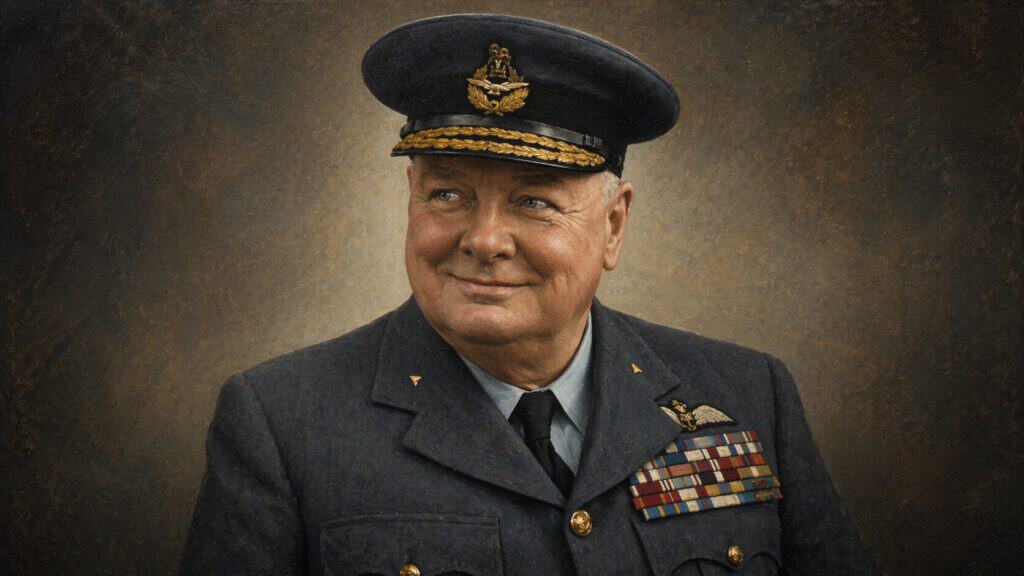
On 20 August 1940, Winston Churchill stood in the House of Commons and delivered the speech that fixed Fighter Command’s struggle in the national memory. In a few measured sentences, spoken while the Battle of Britain was still being fought, he gave lasting form to a moment of crisis: “Never in the field of human conflict was so much owed by so many to so few.” The line would outlive the immediate emergency and become one of the defining public statements of the air war.
A speech delivered in the midst of battle
Churchill was not speaking after a settled victory. In August 1940, Britain remained under direct threat, and Fighter Command was still engaged in a daily contest against the Luftwaffe. The recent phase of the battle had already shown the scale of the strain. Airfields, sector stations and aircraft production all mattered, but so too did the men flying the sorties and the wider organisation that kept them in the air. The speech therefore came not as retrospective commemoration but as an intervention during an active campaign.
That context helps explain its force. Churchill’s words recognised that Britain’s defence depended on a comparatively small body of airmen bearing a disproportionate burden. Although the phrase “the Few” became attached above all to fighter pilots, the speech also reflected the larger system behind them: ground crews, controllers, observers and the command structure that sustained Fighter Command’s effort. In public memory, however, it was the fighter battle itself that the speech most powerfully captured.
What Churchill said and what it achieved
The famous sentence did not alter the tactical conduct of the battle, but it achieved something different and arguably just as important in political and moral terms. It framed the defence of Britain as a national act of endurance concentrated in the work of a visible front-line service. In doing so, it offered both gratitude and clarity. The struggle in the air was not an abstract exchange of losses; it was a decisive barrier between Britain and defeat.
Churchill’s language also helped define how Fighter Command would be remembered. Public understanding of the Battle of Britain was shaped by many factors: the sight of aircraft overhead, the period's communiqués, and the ongoing threat of air attack. Yet this speech supplied the phrase that gathered those experiences into a single idea. It gave the RAF a memorable place in Britain’s wartime story and linked a contemporary defensive battle to a larger moral narrative of national survival.
Significance beyond the moment
The importance of the “Few” speech lies partly in timing. Churchill spoke before the Battle of Britain had passed into history, while uncertainty still governed events. That made the tribute an act of confidence as much as of recognition. It affirmed that Fighter Command's efforts mattered at the highest level of government and deserved acknowledgement before the outcome was secure.
In the wider history of the air war, the speech illustrates the relationship between operational reality and public meaning. Aircraft, radar, control systems and industrial output were all essential to Britain’s defence, but wars are also remembered through language. Churchill’s words did not win the battle, yet they helped define what the battle meant. For that reason, 20 August 1940 remains significant not only as a parliamentary occasion, but as the day the RAF’s most famous wartime tribute entered history.