
Air power became one of the most distinctive instruments of British imperial rule in the years between the two world wars. For the Royal Air Force, the idea carried obvious promise. Aircraft could move quickly across vast spaces, observe difficult country from above, strike isolated targets and project force without the weight of a full land campaign. For ministers worried by cost, for imperial officials faced with distance, and for senior airmen determined to defend the RAF’s independence, air control appeared to offer a modern answer to an old imperial problem.
The attraction lay in more than technology. After 1918, Britain was trying to hold together an immense empire while reducing military expenditure and avoiding the burden of another continental war. In that climate, the RAF argued that command of the air could police remote territories more economically than large garrisons of soldiers. Iraq became the best-known example, but the broader story extended far beyond a single mandate. From the deserts of the Middle East to the mountains of the North-West Frontier, aircraft became part of a system of imperial coercion that relied on surveillance, intimidation, punitive attack and rapid communication.
Yet imperial air policing was never as clean, cheap or decisive as its advocates liked to suggest. It depended on intelligence from the ground, on local allies, on secure bases and on the political willingness to accept coercion from above as a routine instrument of rule. It could punish, unsettle, and overawe, but it could not, by itself, build durable authority. The history of the RAF on Britain’s imperial frontiers is therefore not simply a story of innovation. It is also a story of economy, improvisation, institutional self-preservation and the hard limits of air power when strategy rested on fear more than consent.
After the First World War
The imperial role of the RAF emerged from the unsettled conditions of the post-war settlement. The Service itself was young, having been created in 1918, and still had to justify its existence to sceptics in both the Army and the Royal Navy. Peace did not bring strategic simplicity. Britain had won a world war, but it faced debt, domestic pressure for retrenchment and a sprawling set of imperial commitments that remained expensive to defend by traditional means. Vast distances, poor communications and recurrent unrest made many territories difficult to control without large military establishments.
For the RAF leadership, this difficulty offered an opportunity. Hugh Trenchard and other senior airmen believed that aircraft could do more than support armies in the field. They argued that air power could watch, warn and punish across a country that would otherwise require slow and costly columns of troops. The claim had operational force, but it also had an institutional edge. If the RAF could present itself as the cheapest guardian of imperial order, it strengthened the case for an independent air service in a period of financial austerity.
This argument found an attentive audience because governments of the early 1920s were deeply concerned with the economy. Air control was not offered as a humanitarian alternative to military power. It was offered as a cheaper one. Aircraft could reach tribes, villages or lines of communication faster than ground troops; they could demonstrate presence over a wide area; and, when necessary, they could deliver punitive force without the long build-up required for a major expedition. In theory, that meant smaller garrisons, lower transport costs and a quicker political effect.
The theory suited the geography of the empire as British officials imagined it. Peripheral regions that seemed remote from London were often governed through small administrative staffs, indirect rule and selective coercion. Air power fitted neatly into that pattern. It promised a visible symbol of authority without the expense of permanent occupation everywhere. The machine itself carried political meaning. Aircraft were modern, noisy and difficult to evade in places where anti-aircraft defence scarcely existed. Their appearance could reinforce the impression that resistance was both futile and expensive.
From the beginning, however, air control was more than bombing. It involved reconnaissance, message dropping, the movement of officials, the support of police and levies, medical evacuation, the protection of communications and the maintenance of contact across inhospitable spaces. Aircraft widened the reach of imperial administration, but they did not replace the need for ground power. Even in its most celebrated form, imperial air policing was part of a wider system of control rather than a purely aerial substitute for politics and soldiery.
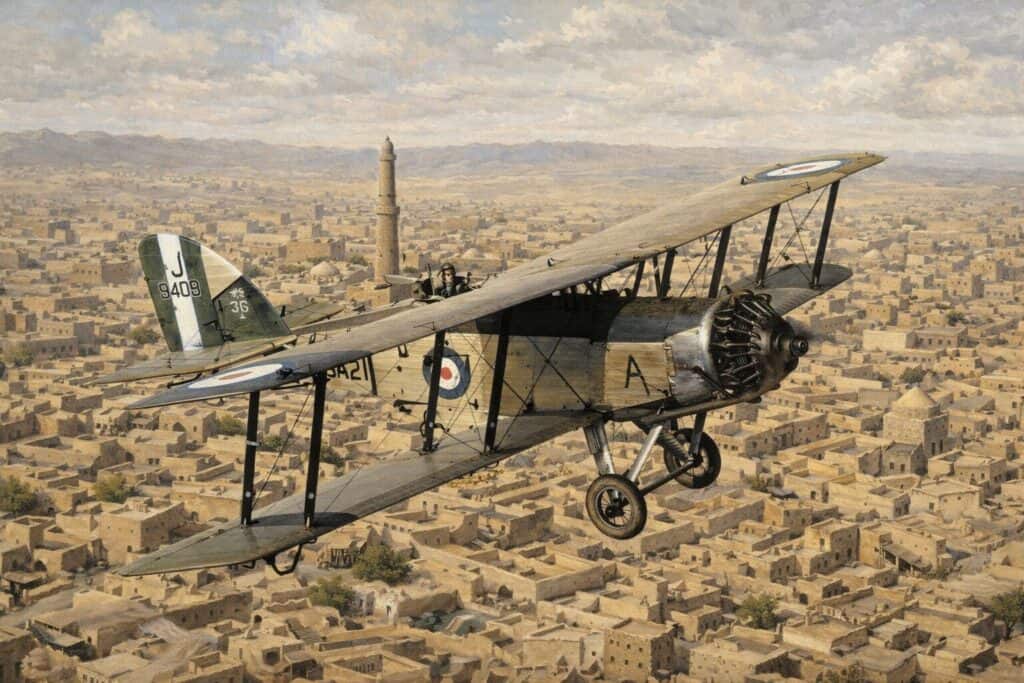
Iraq And The Making Of A Model
The best-known test case for inter-war air control was Iraq. British power there had been shaken by the 1920 revolt, which exposed the cost of maintaining the territory through a heavy military presence. The search for a cheaper method of control gave the RAF its opening. During the early 1920s, responsibility for imperial security in Iraq shifted towards an air-centred system in which the Service became the principal instrument of rapid coercion and surveillance, backed by local forces and limited ground elements.
Iraq mattered because it appeared to demonstrate that air power could sustain British influence across a large and difficult territory at a lower cost than maintaining a garrisoned army. Bases, aircraft, wireless communications and a network of political reporting allowed the RAF to react quickly to tribal unrest, threats to lines of communication or challenges to the authority of the new state that Britain was trying to shape under mandate conditions. Aircraft could overfly trouble spots, drop warnings, demonstrate presence, and, if resistance continued, strike villages, encampments or concentrations judged to be hostile.
To advocates of air control, the Iraqi system seemed efficient and modern. Aircraft could cover distances in hours that might take columns days to cross. They could reinforce imperial prestige simply by appearing overhead, and their speed created pressure that slow-moving ground forces struggled to match. In a territory where rivers, desert and sparse infrastructure complicated movement, those qualities mattered a great deal. Iraq became central to the RAF’s claim that imperial policing could be reorganised around air power rather than around the old methods of occupation.
But the Iraqi example was never as simple as later legend suggested. The RAF did not govern Iraq from the sky alone. It operated from defended bases, relied on maintenance and fuel chains, used armoured cars and ground detachments, and depended heavily on intelligence from political officers and local intermediaries. When stronger action was required, air-based coercion still had to be linked to authority on the ground. Even the threat of bombing worked only where Britain possessed sufficient local reach to translate fear into compliance.
The methods used in Iraq also exposed the character of inter-war imperial rule. Warning notices and demands for submission were often presented as evidence of restraint, as though air action were merely the final stage in a measured process. In practice, the system rested on the assumption that the destruction of property, the disruption of daily life and the fear of sudden attack would compel obedience more cheaply than a conventional campaign. That was the heart of air control: coercion packaged as administrative efficiency.
Even so, Iraq gave the RAF something it badly needed. It provided a living argument in Whitehall. Every apparent saving in money, every avoided army commitment, and every episode in which aircraft seemed to impose order reinforced the Service’s institutional case. Iraq was therefore important not only because it was policed from the air, but because it became the example constantly cited whenever the RAF sought to prove that imperial commitments and financial retrenchment could be reconciled.
Beyond Iraq: Frontier Uses Of Air Power
Although Iraq became the classic case, imperial air policing spread across a wider frontier world. The RAF was used in territories and situations that differed sharply in geography, politics and military difficulty, yet the governing assumptions remained recognisable. Aircraft would extend reach, reduce response time and impose pressure before unrest grew into a more expensive crisis.
In the Middle East, air power helped Britain manage spaces that were strategically linked by routes, bases and imperial communications. Aircraft supported surveillance, liaison and punitive action in areas where British authority depended on thin administrative structures and on arrangements with local rulers. The method suited a style of imperial management that preferred influence and intimidation to dense occupation. Air presence became part of the everyday grammar of power.
Elsewhere, the same approach was adapted rather than copied exactly. Conditions on the North-West Frontier of India were not those of Iraq, and the political structure of tribal resistance could not be treated as though it were a simple policing problem. Yet the RAF was still expected to provide economy, mobility and pressure. Pink’s War in South Waziristan in 1925 remains the clearest example. Directed by Wing Commander Richard Pink, the campaign used sustained air attack, including warning leaflets before bombing, in an effort to compel the Mahsud tribes to seek terms without launching a large ground expedition. In immediate military terms, it seemed to work. In larger political terms, it showed both the reach and the narrowness of air coercion. Opposition could be punished; the frontier could not be solved.
The imperial repertoire also extended into regions such as Aden and Somaliland, where aircraft were valued for their ability to move quickly over difficult terrain and support fragile systems of control. In such settings, the RAF offered a means of demonstrating resolve at short notice, especially when road networks were poor and regular troop concentrations expensive to maintain. The promise was always speed and economy. The reality depended on weather, range, available aircraft, prepared landing grounds and reliable intelligence.
These frontier operations encouraged a particular style of imperial thought. Resistance was often described as a disturbance to be corrected through pressure rather than as a political problem with deeper causes. Air power suited that language because it made coercion appear technical. A sortie could be counted, a target listed, a warning dropped, and a punitive action reported in clean administrative prose. The violence itself was thereby absorbed into the empire’s normal paperwork.
Yet the differences between theatres mattered. Desert flying was not mountain flying. A loosely governed mandate territory posed different problems from tribal borderlands or coastal protectorates. Air control never became a single universal formula. It was a collection of practices united by a common belief that aircraft could substitute for a portion of the military and financial burden of empire. In some places, that belief proved persuasive for a time. In none did it remove the political fragility of imperial rule.

Economy, Doctrine and Institutional Self-Preservation
The attraction of imperial air policing cannot be understood without recognising how closely strategic argument and institutional interest were bound together. The RAF championed air control because it believed in air power, but also because the imperial role helped secure the Service’s place inside the British defence system. Every successful frontier operation strengthened the claim that an independent air force was not a luxury but a practical necessity.
This mattered intensely in the 1920s. The Army and Navy each had older traditions, clearer constituencies and firmer assumptions behind their claims on public money. The RAF had to demonstrate unique value. Imperial policing allowed it to do so in terms that ministers could understand. The Service was not merely asking to exist; it was claiming that it could hold troublesome regions more cheaply than soldiers could, while preserving British prestige and reducing the likelihood of protracted campaigns.
That promise shaped doctrine. RAF officers wrote and argued as if mobility, shock and constant pressure could produce obedience at an acceptable cost. The emphasis fell on the speed of response, the concentration of force against selected targets, and the psychological effect of being vulnerable from above. What emerged was a doctrine of coercive economy. It did not seek a decisive battle in the traditional sense. It sought to convince opponents that continued resistance would bring only damage, dislocation and eventual submission.
The same doctrine encouraged a managerial view of warfare. Air policing seemed measurable. Aircraft hours, squadron strength, maintenance demands and operating costs could all be compared with the expense of army formations and long lines of supply. In Whitehall debates, this mattered greatly. Air control was repeatedly defended as much a balance sheet as a strategy. The imperial frontier became one of the places where military policy was argued in the language of budgets.
There was also a cultural dimension within the RAF. Frontier service fostered a sense that the Service was adaptable, technically proficient and capable of acting with unusual independence in remote theatres. It linked flying skill to imperial purpose. Officers and airmen working from isolated stations often saw themselves as maintaining order across spaces that would otherwise drift beyond effective control. That self-image fed the wider mythology of the inter-war RAF as a modern force solving problems that older services approached too heavily and too slowly.
The mythology was powerful, but it came with distortion. Cost comparisons were often more favourable on paper than in the field. They could understate the support structure required to keep aircraft operating or overlook the degree to which air action depended on auxiliary forces on the ground. They could also ignore the political cost of coercion, which was harder to quantify but no less real. The doctrine of economy made air control attractive precisely because it translated imperial violence into administrative efficiency.
Limits, Resistance and Moral Burden
The limits of imperial air policing were visible from the start, even when officials preferred not to dwell on them. Aircraft could punish and intimidate, but they could not hold territory, gather political consent or guarantee reliable information about the societies over which they flew. Much of the supposed precision of air control rested on intelligence that was fragmentary, delayed or shaped by local rivalries. Decisions about whom to threaten or bomb were therefore never as clinically certain as official language implied.
Operational limits were equally important. The weather could ground aircraft. Terrain could shield movement. Distance-reduced sortie rates and complicated maintenance. Frontier campaigns required robust bases, fuel, trained crews and a supply system that itself depended on secure lines of communication. The imperial sky was not frictionless. Air control only looked simple when the infrastructure behind it was hidden from view.
There were political limits as well. Coercion from the air could force temporary submission, but it rarely resolved the underlying tensions that produced resistance. In territories shaped by contested authority, tribal politics, economic grievance or anti-colonial feeling, bombing might compel a pause without producing a durable settlement. The most that air policing could usually achieve was to reinforce an existing structure of rule, and even that required the continued presence of administrators, local forces and political arrangements on the ground.
The moral burden was harder still. Imperial air policing exposed civilian populations to violence in ways that British governments often preferred to describe in neutral administrative language. Villages, crops, livestock and homes formed part of the pressure system because the whole point was to make resistance materially painful. The existence of warnings did not remove the coercive logic. The method worked by making air attack an argument directed at both communities and armed opponents.
That fact gave air control an importance beyond the empire itself. It helped normalise the idea that aircraft could be used to discipline populations through fear and selective destruction. The inter-war RAF did not invent aerial coercion, but imperial policing made it routine. In official papers, the practice could sound bloodless. On the ground, it was neither bloodless nor abstract. It was force applied to vulnerable places to sustain an unequal political order at a reduced imperial cost.
Critics, then and later, saw in this system both overclaim and evasion. The promise of cheap control often concealed the degree to which violence had merely been redistributed rather than reduced. The avoidance of a major ground campaign could be hailed as economy in London while destruction fell on villages far from the metropolitan public. Imperial air policing revealed a great deal about how Britain wanted to manage distance: quickly, cheaply and with as little domestic political friction as possible.

Legacy And The End Of The Imperial Illusion
The RAF’s imperial policing role left a complicated legacy. On one level, it gave the Service practical experience in operating from remote bases, maintaining aircraft in difficult climates, coordinating communications across wide areas and linking air action to political purpose. It also reinforced habits of flexibility and expeditionary thinking that remained part of RAF culture. Frontier stations, desert routes, and thin imperial infrastructure forced the Service to become highly competent at making limited resources cover vast distances.
On another level, the imperial experience encouraged assumptions that were less durable than they seemed. Air control worked best where Britain faced opponents with little organised air defence, limited heavy weaponry, and no industrial base capable of sustaining modern war. Those conditions did not apply to a future conflict against advanced European states. The very years in which the RAF was perfecting coercive control on colonial frontiers were also years in which air warfare between major powers was becoming faster, heavier and far more destructive.
By the late 1930s, the contrast was unmistakable. The challenge facing Britain was no longer how to punish dispersed resistance on the edge of empire at minimum cost, but how to survive and fight in an age of rearmament, air defence systems and mass industrial warfare. Frontier bombing could not answer that challenge. The RAF had to turn from imperial policing towards home defence, strategic bombing, fighter control and the demands of coalition war. In that sense, the empire years were both formative and misleading: formative in experience, misleading in the confidence they sometimes bred about what air power alone could achieve.
Even after the inter-war period, the underlying temptation did not disappear. Air power remained attractive to governments because it promised reach without full occupation and pressure without immediate mass mobilisation. That was one reason why the imperial record continued to matter. It offered an early modern example of the enduring political desire to control difficult spaces from the air while limiting one’s own costs.
The real significance of the RAF’s role in policing Britain’s imperial frontiers lies there. It showed how air power could become woven into the everyday mechanics of imperial rule, not as a miraculous substitute for politics, but as a force multiplier for a system already dependent on hierarchy, distance and coercion. It also showed that such methods could sustain order only within strict limits. Aircraft could help an empire endure for a time. They could not resolve the contradictions on which that empire rested.
Conclusion
Inter-war imperial air policing gave the RAF one of its most distinctive early roles. It helped the Service defend its independence, offered ministers an apparently economical way to manage far-flung territories and demonstrated how aircraft could reshape the practice of coercion across distance. Iraq provided the model, Pink’s War supplied one of the sharpest examples, and a wider arc of frontier operations turned air power into a routine instrument of imperial administration.
What that history finally reveals, however, is not the simple triumph of a modern method. It reveals a bargain. Britain gained speed, reach and a measure of economy; the RAF gained a powerful institutional argument; imperial subjects bore the pressure of a system designed to enforce obedience from above. Air control could intimidate, punish and sometimes compel. It could not by itself create stable political authority. For that reason, its history belongs not only to the story of the RAF, but to the larger history of empire at the point where technology made coercion look efficient without making it any less fragile.