Operation Herrick was the codename for British military operations in Afghanistan from 2002 to 2014, launched as the successor to the earlier Operation Fingal deployment in Kabul. Across those twelve years the campaign became one of the longest sustained British military commitments since the Second World War, and the Royal Air Force provided air power throughout its length: fast-jet close air support, long-endurance surveillance and strike, helicopter lift, and the transport aircraft that kept the deployed force supplied.
The RAF’s contribution grew substantially once British forces deployed into Helmand province in 2006, moving the campaign’s centre of gravity into one of Afghanistan’s most contested regions. From Harrier and Tornado fast jets flying overwatch for troops on the ground, to Reaper aircraft flying armed surveillance for hours at a time, to Chinook and Hercules aircraft keeping isolated bases supplied, RAF air power shaped how the British campaign in Helmand was fought and sustained. The Army Air Corps’ Apache helicopters and Royal Navy aircraft also operated over Helmand throughout the campaign; this article concentrates on the RAF’s own contribution to Herrick. For much of the period, Herrick also ran alongside Britain’s commitment in Iraq under Operation Telic, and the two campaigns drew on the same pool of RAF aircraft, crews and support units.
What Operation Herrick Was
Herrick took its name from the operation that replaced Operation Fingal, Britain’s contribution to the UN-mandated International Security Assistance Force established in Kabul after the fall of the Taliban government in 2001. Fingal ran under British command until command of ISAF passed to Turkey in 2002, and the reduced British presence in Afghanistan was reorganised under the new operation name Herrick, initially focused on training the Afghan National Army and providing security around Kabul.
The operation’s character changed decisively in 2006. The British government announced that a Helmand Task Force would deploy to southern Afghanistan to extend the reach of the Afghan government and support reconstruction, and the first elements arrived in the province that spring. The reconstruction mission announced in 2006 evolved within months into a demanding counter-insurgency campaign, and the RAF’s contribution grew accordingly, in scale and in the range of tasks it was asked to perform.
Herrick continued for a further eight years, structured throughout as a rolling series of six-month roulements, each numbered in sequence. Every roulement brought a new headquarters, a new brigade or equivalent formation for Task Force Helmand, and a rotation of the RAF squadrons and support units attached to it, so that the campaign was sustained through a continuous cycle of preparation, deployment and reconstitution across its full eight years in Helmand. British combat operations in Helmand ended in 2014, and Herrick concluded that December alongside the wider drawdown of ISAF forces.
Fast Jets Over Helmand: Harrier and Tornado
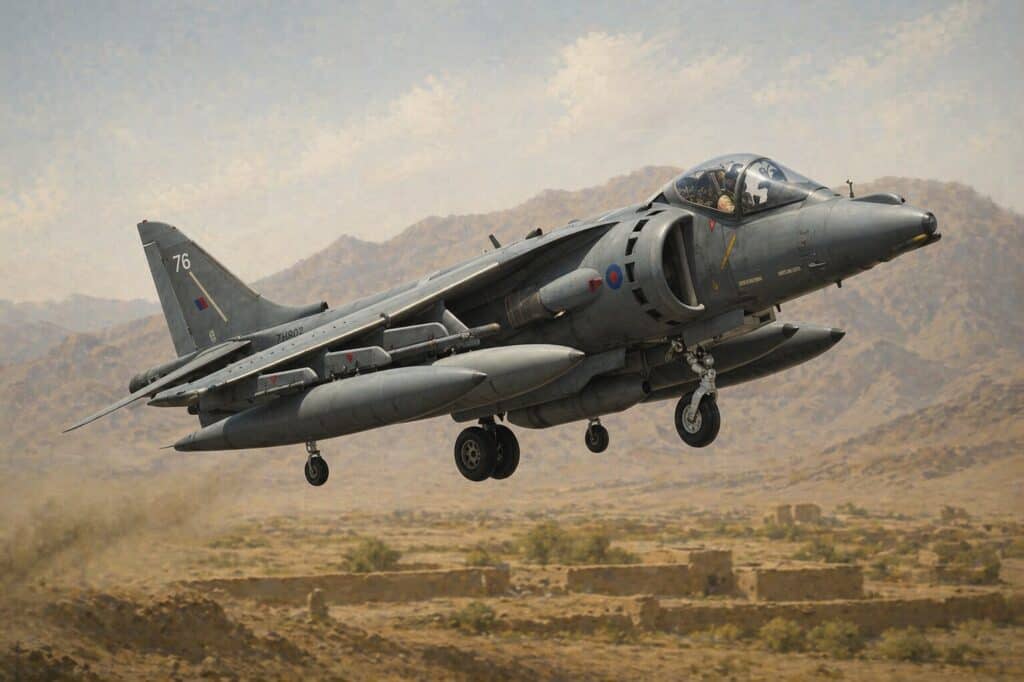
Fixed-wing strike aircraft supported Herrick from 2004, when Harrier GR7 aircraft of Joint Force Harrier, formed from the RAF’s 1(F) and IV(AC) Squadrons alongside the Royal Navy’s 800 Naval Air Squadron, began flying from Kandahar Airfield. Harrier’s contribution before 2006 was limited in scale, but it gave the RAF and the wider coalition experience of sustained fast-jet operations from the airfield that would later become the hub of British air activity in southern Afghanistan.
Once the Helmand campaign intensified, Harrier’s role expanded to armed overwatch, close air support and reconnaissance for British and coalition troops in contact, and later Harrier GR9 aircraft carried more capable sensors and precision weapons into theatre.
By 2010 the Panavia Tornado GR4 had taken over the RAF’s fast-jet commitment from the Harrier force. Equipped with the RAPTOR reconnaissance pod and the LITENING targeting pod, and carrying precision-guided weapons including Paveway IV, the Tornado combined surveillance and strike capability in a single airframe, giving crews a continuous picture of the ground situation that could inform a request for air support the moment it came in. The Tornado remained the RAF’s principal fast-jet type in Afghanistan until British fast-jet combat flying over the country ended in 2014.
Across Herrick as a whole, fast jets flew a very large number of sorties relative to the number of weapons they released. Aircraft spent much of their time providing presence and reassurance to troops on the ground, gathering information and remaining ready to act, reflecting the campaign’s emphasis on precision and on positive identification of a target before any weapon was released.
Helicopter Lift and Chinook Operations
No single aircraft type did more to shape the daily tempo of the Helmand campaign than the Boeing Chinook. RAF Chinook squadrons, based at RAF Odiham and rotated through Kandahar Airfield and Camp Bastion, moved troops between forward operating bases and patrol locations, resupplied positions that could not safely be reached by road, carried artillery ammunition and equipment forward, and evacuated casualties when circumstances demanded it.
Helmand’s road network was limited and heavily mined with improvised explosive devices, and journeys that would have taken minutes by helicopter could take hours, or prove too dangerous to attempt, by land. Chinook lift therefore determined which positions British forces could hold, resupply or reinforce, and how quickly commanders could concentrate troops in response to a developing situation. Alongside the RAF’s Chinooks, Army Air Corps Apache helicopters provided armed escort and close support for many of these movements.
Chinooks also carried the Medical Emergency Response Team, a flying trauma team of doctors, nurses and paramedics drawn from the RAF and the other services that flew directly into contact to treat and evacuate casualties, working in close coordination with the Role 3 hospital at Camp Bastion. That combination of rapid helicopter evacuation and immediate trauma care in the air became one of the most consequential developments of the campaign, and it depended entirely on Chinook crews being able to reach a casualty quickly and fly them back under pressure.
Air Transport and Sustainment
Behind the combat and lift aircraft lay a transport effort that sustained the entire campaign. Lockheed C-130 Hercules aircraft flew the tactical airlift that connected Kandahar Airfield, Camp Bastion and forward locations, moving freight, personnel and equipment around the theatre, while long-range transport aircraft maintained the strategic air bridge linking the United Kingdom, staging bases in the Gulf and Afghanistan itself.
This sustainment effort attracted far less public attention than combat flying, and it remained essential to the campaign throughout. Herrick depended on a reliable flow of fuel, spare parts, ammunition and personnel across enormous distances, and on medical evacuation chains capable of moving casualties quickly from the point of injury to definitive care. Air transport made that possible in a theatre where road movement was slow, limited and frequently dangerous.
Reaper and Surveillance
Alongside its manned aircraft, the RAF introduced remotely piloted air power to Afghanistan in October 2007, when General Atomics MQ-9 Reaper aircraft began operations from Kandahar Airfield. Reaper combined long endurance with high-resolution sensors, allowing it to remain over a route, compound or area of interest for many hours at a time, tracking patterns of activity that a fast jet, with its far shorter time on station, could not observe.
Reaper carried precision-guided weapons and could strike when authorised, though most of its flying time in Herrick was spent on sustained surveillance: watching, identifying and reporting on activity below. Crews flying Reaper missions, some based in theatre and others controlling aircraft remotely from the United Kingdom, operated under the same rules of engagement and requirements for positive identification that governed every other RAF platform in Afghanistan.
The Sentinel R1, an airborne stand-off radar aircraft procured as an urgent operational requirement, added a further layer of wide-area surveillance to the campaign. Entering service in 2008, it gave commanders a ground-surveillance picture across large areas of Helmand, tracking movement that could then be cross-referenced against Reaper or fast-jet sensors. The RAF’s Shadow R1 aircraft supplemented this with airborne surveillance and signals intelligence, feeding the wider ISTAR effort that supported British and coalition forces. Taken together, these platforms turned intelligence, surveillance, target acquisition and reconnaissance into one of the RAF’s central contributions to Herrick, on a scale that had no real precedent in earlier British campaigns. By the end of Herrick, remotely piloted and specialist surveillance aircraft had moved from the margins of British air power to an established part of the RAF’s order of battle.
Bases and Joint Operations
Kandahar Airfield and Camp Bastion formed the backbone of RAF operations in southern Afghanistan. Kandahar, a major coalition hub, hosted RAF fast jets, Reaper aircraft and transport flights alongside allied forces for much of the campaign, while Camp Bastion, built from 2006 in central Helmand, grew into the primary British base in the province, complete with its own airfield, engineering facilities, hospital and logistics infrastructure.
Air operations from both bases depended on close integration with land forces. RAF liaison officers and forward air controllers worked alongside Army units to coordinate close air support, while intelligence staff tasked surveillance aircraft against the priorities of ground commanders. Engineers, armourers, movements staff and RAF Regiment personnel providing force protection sustained that effort every day, even though their work rarely appeared in public accounts of the campaign.
Force protection was a continuous requirement rather than an occasional task. RAF Regiment squadrons defended airfield perimeters, escorted convoys moving between bases and helped secure the approaches used by aircraft on take-off and landing, at bases that remained within range of indirect fire for much of the campaign. That standing defensive effort allowed flying operations to continue at the tempo the campaign demanded, and it is as much a part of the RAF’s Herrick story as the aircraft that flew from the bases it protected.
Withdrawal and Legacy
British combat operations in Helmand ended in 2014. Camp Bastion was formally handed over to Afghan security forces that October, closing the base that had anchored British operations in the province since 2006, and Operation Herrick concluded in December, succeeded by a much smaller training and advisory commitment. Withdrawal was itself a substantial air operation: years of accumulated equipment, vehicles and stores had to be moved out of Helmand by air and by long overland convoys, placing heavy demands on the RAF’s transport fleet in the campaign’s final phase even as combat flying wound down.
For the RAF, Herrick left a lasting institutional legacy. It normalised the routine use of remotely piloted aircraft alongside manned platforms, reinforced the importance of persistent surveillance and precision strike as complements to concentrated firepower, and demonstrated how far the RAF’s effectiveness in expeditionary warfare depended on the engineers, logisticians and support personnel who kept aircraft flying from bases thousands of miles from home. It also left the RAF with a generation of aircrew and support personnel experienced in sustained expeditionary operations, joint working with land forces, and the demands of a long counter-insurgency campaign rather than a short, high-intensity one.
Those lessons continued to shape RAF thinking about air power long after the last aircraft left Kandahar and Camp Bastion behind. The emphasis on persistent ISTAR, the integration of remotely piloted systems into routine operations, and the recognition that expeditionary air power depends on the strength of the support structure around it all trace directly back to the experience of Operation Herrick.