On This Day, 1939: On 21 October 1939, 46 Squadron Hurricanes intercepted Heinkel He 115 floatplanes over the North Sea in the…
Read the entry →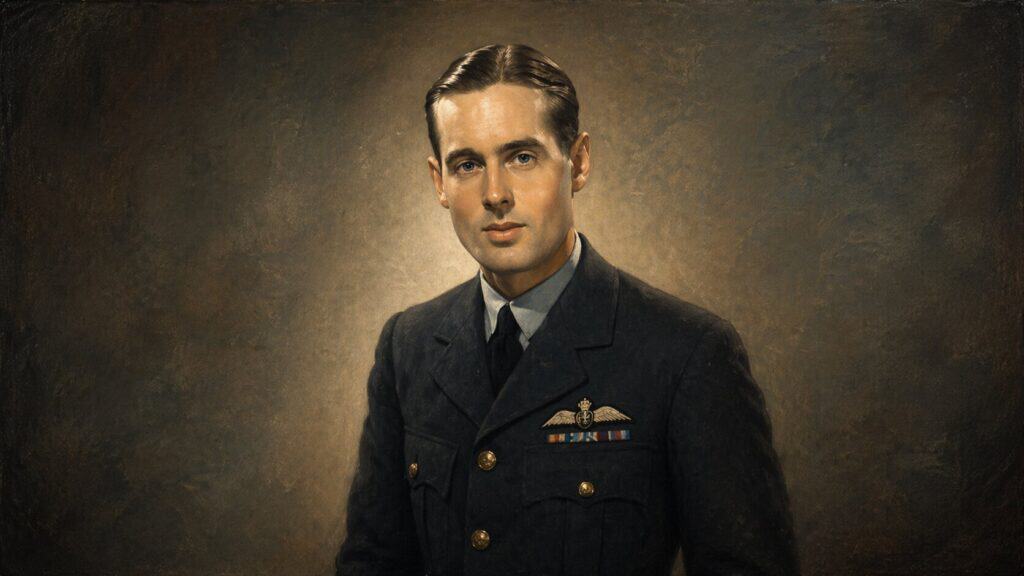
Distinguished Service Order (DSO and Two Bars)
Leonard Cheshire
Leonard Cheshire flew 100 missions, led 617 Squadron, won the Victoria Cross, and later became one of Britain’s best-known humanitarians.
Early Life
Geoffrey Leonard Cheshire was born on 7 September 1917 at Chester. He was educated in England before reading law at Oxford, an academic path that sat alongside a growing interest in flying and public service.
Entry into Service
Cheshire joined the Royal Air Force Volunteer Reserve before the Second World War and entered full-time RAF service as the conflict approached. His operational career began in June 1940, as recorded in the official citation for his Victoria Cross.
Operational Career
Early operations were flown in Bomber Command at a time when night navigation, target identification, and defensive measures were still developing rapidly. The hazards faced by bomber crews were compounded by the technical limits of early-war equipment, the expanding reach of German air defences, and the physical strain of repeated long-range sorties.
Cheshire’s first tour concluded in January 1941. The Victoria Cross citation notes that he immediately volunteered for a second tour and continued to attack heavily defended targets, including major German cities. It also records that he undertook convoy patrols in addition to bombing missions during the early phase of his career.
After a period of instructional duties in early 1942, he returned to operations and began a third tour in August 1942. The official citation states that he was given command of a squadron and led it with outstanding skill before appointment as a station commander in March 1943.
Major Actions or Commands
Cheshire’s most distinctive operational contribution came during his fourth tour, begun in October 1943. The Victoria Cross citation records that he relinquished the rank of group captain at his own request in order to return to operations, and immediately set about developing a new method of target marking requiring very low-level flying in the face of strong defences.
The citation provides a detailed example from June 1944, describing an attack in daylight at Le Havre where he dived below the effective range of lighter defences to place marker bombs, coming close to destruction under concentrated fire. It further records that he led his squadron personally on every occasion during this period and undertook the most dangerous task of marking the target alone from low level.
An additional example is given from an experimental attack on Munich in April 1944, selected for the formidable nature of its defences. Cheshire is described as diving to very low altitude to drop markers, then remaining over the target area to assess accuracy and direct other aircraft, continuing despite damage to his own aircraft. By the end of the fourth tour in July 1944, the official record stated that he had completed a total of 100 missions. The award of the Victoria Cross, gazetted on 8 September 1944, was framed not as a single act but as recognition of sustained conspicuous bravery and leadership across four years of operations.
In 1945 Cheshire was selected to observe the use of atomic weapons against Japan. A RAF Museum account describes his journey to the Pacific and his role as a British observer during the final phase of the war.
Later Life and Death
After leaving RAF service, Cheshire devoted his life to humanitarian work. In 1959 he married Sue Ryder and the couple established a home at Cavendish in Suffolk, from which they pursued charitable projects in Britain and abroad.
His later public recognition included admission to the Order of Merit in 1981 and elevation to the peerage in 1991, taking the title Baron Cheshire of Woodhall. He died on 31 July 1992 at Cavendish, from the effects of motor neurone disease.
Historical Significance
Leonard Cheshire’s historical significance lies in the combination of operational record and method. The official citation for his Victoria Cross describes a commander who repeatedly accepted extreme risk to ensure accurate marking and successful attack, and it situates his achievement in sustained leadership rather than a single episode.
His post-war life added a second legacy grounded in service to disabled people and humanitarian endeavour, recognised by national honours and his later peerage. Together, these two halves of his life secured a place in British public memory that extends beyond the operational history of Bomber Command to a wider tradition of service after war.
Group Captain
First RAF Circus Operation: Blenheims Over Guînes, 10 January 1941
On 10 January 1941, the Royal Air Force mounted what became known as the first "Circus"…
10 January 2026 · 4 minLow-Level Lancaster Strike on MAN Works at Ausburg
Augsburg Raid: J. D. Nettleton led Lancasters against Augsburg in 1942, a low-level daylight strike remembered…
17 April 2026 · 3 minNorwich Blitz: German Reprisal Raid Devastates City
Norwich Blitz: The destructive German raid on Norwich in 1942 hit large areas of the city,…
27 April 2026 · 3 min