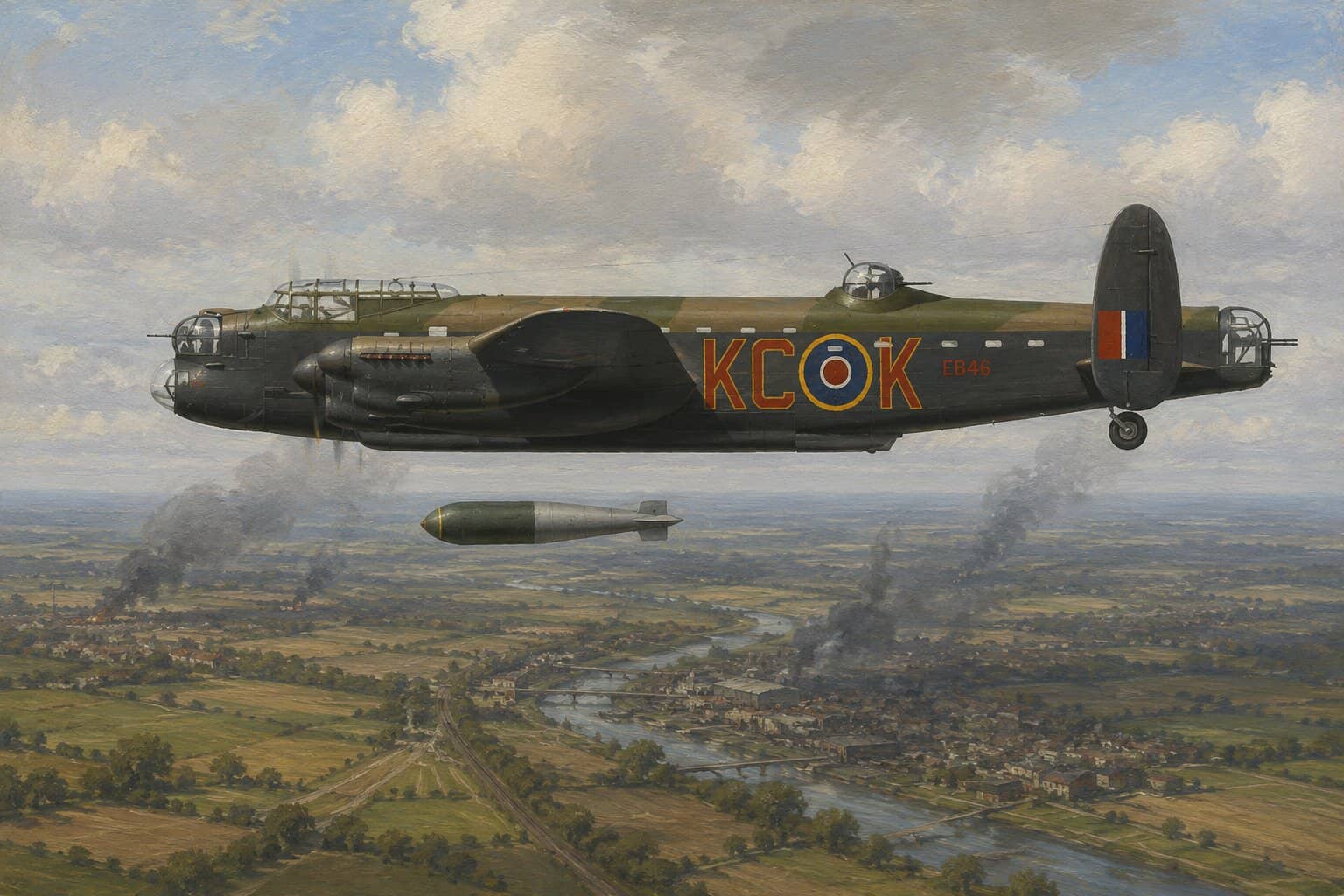
On 8 June 1944, No. 617 Squadron employed the 12,000-pound Tallboy bomb against the Saumur railway tunnel, attempting to seal an important reinforcement route only two days after the Normandy landings. The attack marked the operational debut of one of the most remarkable British weapons of the war. It showed how rapidly the RAF sought to apply specialised striking power to the battle developing in France.
A weapon designed for difficult targets
Tallboy was created by Barnes Wallis as a deep-penetration bomb intended to attack hard or protected objectives more effectively than conventional weapons. Rather than relying solely on a blast at the surface, it was designed to strike at high speed, penetrate deeply, and produce destructive shock effects. That concept made it especially valuable against targets such as tunnels, viaducts and hardened structures, where ordinary bombing could prove unreliable or inefficient.
The timing of its first combat use was significant. After D-Day, the Allied problem was not simply to hold the beaches but to prevent German reinforcements from reaching the battle area in strength. Rail links became critical targets. If key routes could be cut, the enemy’s ability to move men and material towards Normandy would be reduced at exactly the moment when the invasion remained most vulnerable.
617 Squadron at Saumur
No. 617 Squadron, already well known for precision attack, was the natural unit to introduce the new bomb operationally. Flying Avro Lancasters adapted for the task, the squadron struck the tunnel at Saumur on the Loire. The objective was not symbolic. It was a practical attempt to block a major communications artery by bringing down the tunnel, rendering the route unusable for northward movement.
The attack demonstrated both the ambition and the logic of the Tallboy concept. A heavily engineered transport target that might otherwise demand repeated raids could, in principle, be neutralised with far fewer weapons if the bomb achieved the desired penetration and structural collapse. That economy was militarily important. It reduced the number of sorties and aircraft required while offering a better chance of decisive effect.
Results and significance
At Saumur, the Tallboy proved its worth. The tunnel was effectively sealed, and a key reinforcement route was denied at a critical stage in the Normandy campaign. This did not decide the battle on its own, but it contributed to the broader Allied effort to isolate the battlefield and delay German reaction. In that sense, the debut was a tactical success with operational consequences.
The wider significance reached beyond one tunnel in France. Tallboy’s introduction showed how the RAF was learning to combine precision, specialised engineering and operational urgency. It was a reminder that air power was not only about the weight of effort, but also about choosing the right weapon for the right target. Later Tallboy attacks would become famous for their use against major warships and hardened sites, but their first combat employment had already clearly revealed the principle.
On 8 June 1944, the RAF brought innovation directly into the invasion battle. Barnes Wallis’s design, 617 Squadron’s skill and the Lancaster’s carrying capacity were fused in a mission aimed at a precise strategic problem. The result was an early and striking example of how technology and careful targeting could magnify the effect of a relatively small force.