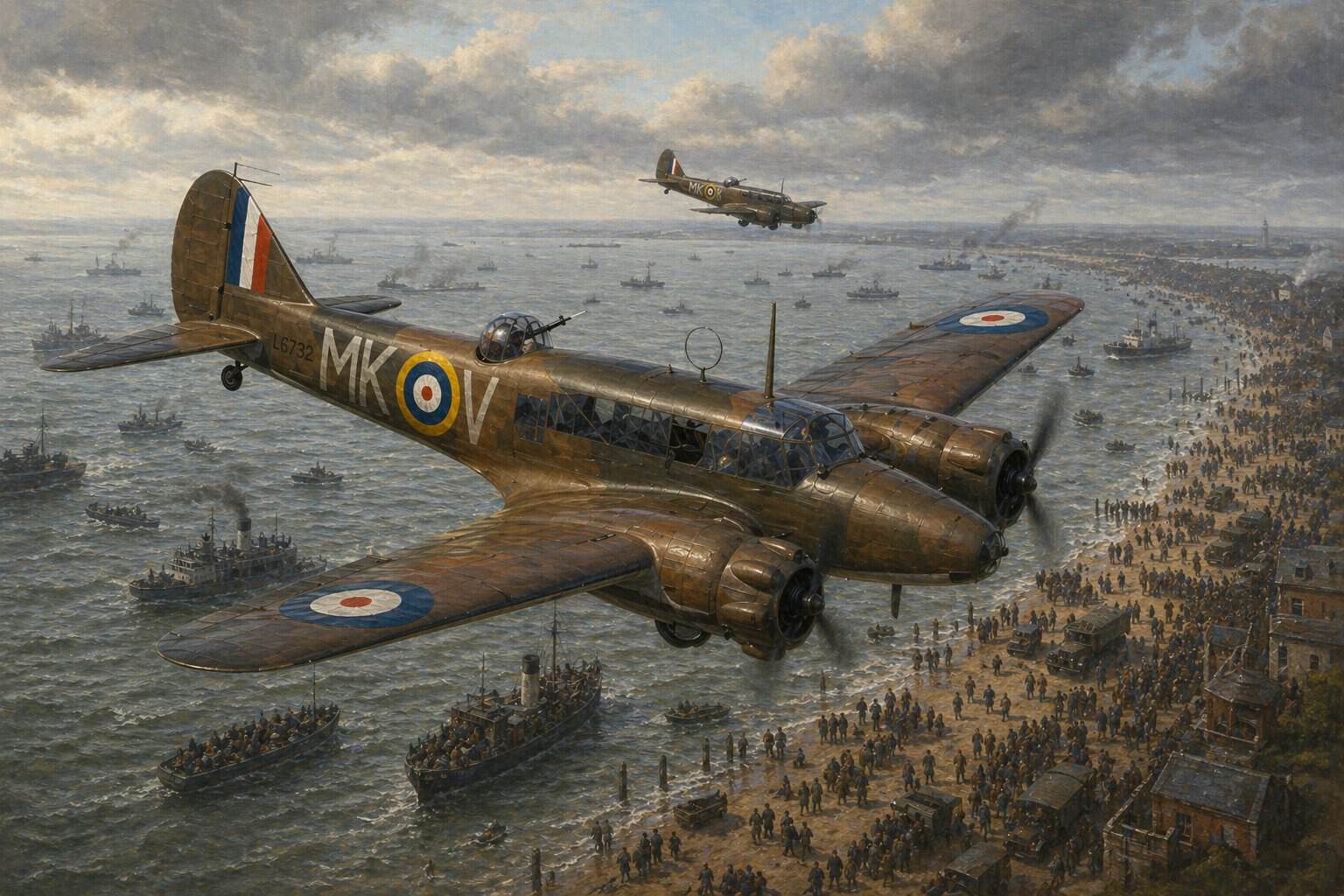
On the evening of 26 May 1940, the Admiralty ordered Vice-Admiral Bertram Ramsay to begin Operation Dynamo: the evacuation of Allied troops trapped in and around Dunkirk. RAF Fighter Command, which had already been fighting to cover the retreating armies for several days, was drawn fully into one of the hardest defensive efforts of its short history, holding the airspace over the beaches, the harbour and the Channel crossing long enough for the rescue fleet to work.
The crisis had built quickly. German armoured divisions had broken through at Sedan in mid-May and reached the Channel coast within days, cutting the British Expeditionary Force and much of the French First Army off from the rest of the Allied line and forcing them back towards a shrinking perimeter around Dunkirk. Ramsay had been preparing the evacuation from his headquarters in the tunnels beneath Dover Castle as that perimeter formed. When the Admiralty’s order came on 26 May, initial planning hoped to lift up to 45,000 men of the British Expeditionary Force within two days before enemy action stopped the evacuation.
Operation Dynamo would in fact run for nine days, ending on 4 June, and would carry 338,226 British and French troops back to England. None of that scale was known on the first evening. What was already clear was that the beaches, the approach roads and the sea lanes to Dover all lay within easy reach of Luftwaffe airfields in Belgium and northern France, and that the evacuation could not proceed without cover from the air.
Fighter Command’s Task Over the Beaches
Responsibility for that cover fell to No. 11 Group, the RAF formation covering south-east England under Air Vice-Marshal Keith Park. The nearest bases were some 50 to 60 miles from the area to be protected. A Hawker Hurricane or Supermarine Spitfire could reach Dunkirk, but fuel limited its time on patrol to about forty minutes.
Maintaining cover therefore required relays of aircraft, with difficult choices between continuity and the strength of each patrol. The area also lacked the normal radar-supported interception system that the same squadrons would rely on during the Battle of Britain, so patrols were largely flown to a fixed timetable and route rather than vectored onto incoming raids.
Patrols went out in relays, at squadron strength to begin with, and grouped into larger formations as the scale of the fighting demanded, an arrangement that would be tested and adjusted almost daily as Operation Dynamo went on.
Hurricanes and Spitfires Meet the Luftwaffe
Hawker Hurricanes and Supermarine Spitfires carried the weight of the fighter effort, with Spitfire squadrons such as Nos. 92 and 19 among those committed. Boulton Paul Defiants of No. 264 Squadron also fought over Dunkirk. No. 92 Squadron had already been in combat covering the retreat towards Dunkirk as early as 23 May, so Fighter Command’s effort was building even before Operation Dynamo formally began.
Their pilots flew repeatedly into formations of Messerschmitt fighters and Luftwaffe bombers attempting to reach the beaches, the harbour moles and the packed shipping lanes beyond. Over the nine days of Dynamo, Fighter Command flew around 2,739 fighter sorties, claiming 262 enemy aircraft destroyed while losing 106 RAF fighters. Wartime claim figures on both sides were frequently optimistic, but the scale of fighting behind them was real. This was sustained, costly air combat, constrained by limited patrol endurance, and the pressure on Fighter Command only grew as the evacuation went on.
Why the RAF Seemed Absent from the Beaches
Much of that fighting happened well away from where the waiting troops could see it. Park’s patrol lines included Gravelines–Furnes and routes farther inland towards St Omer. The aim was to intercept German formations before they reached the evacuation area; fighting on the deeper patrol lines could therefore be invisible from the beaches.
The sky above the beaches often looked empty to troops being bombed and strafed at low level, even as Fighter Command fought overhead and further inland, out of sight of the men waiting to embark. That gap between the real air battle and what could be seen from the sand fed a lasting belief among returning soldiers that the RAF had abandoned them. The impression reflected both genuine gaps in fighter cover and air combat taking place beyond the soldiers’ view. Some airmen returning from Dunkirk consequently encountered anger and suspicion from soldiers who had seen nothing of their efforts.
More Than Fighter Cover
Fighter Command’s squadrons were the most visible part of the RAF’s effort, but not the only one. Alongside the fighter patrols, the RAF mounted 651 bombing raids and 171 reconnaissance flights during the evacuation.
Bomber Command’s Blenheims attacked troops threatening the perimeter, while heavier bombers attacked road approaches and communications. The Advanced Air Striking Force also attacked communications farther back. Coastal Command contributed reconnaissance and operations against threats at sea, helping protect the improvised evacuation fleet.
None of this drew the attention that the fighter battles overhead attracted, but it was part of the same RAF role in the Dunkirk evacuation, working from the air alongside the Royal Navy and the civilian crews at sea.
The Battle Grows Through the Following Days
The pattern set on 26 May held, and hardened, as Operation Dynamo continued. On 28 May, RAF squadrons flew 321 sorties across twelve patrols, and by the next day engagements had grown heavier still. From 29 May, No. 11 Group’s controllers began trying to fly four squadrons together over the beaches at once to match the scale of Luftwaffe raids, though the changeover between formations could still leave gaps of up to ninety minutes. Later patrols were assembled at similar four-squadron strength, drawing aircraft from as many as eight squadrons at a time.
Low cloud on 30 May limited German activity and gave both sides a brief respite, but early haze on 31 May gave way to clearer skies, and the Luftwaffe returned that afternoon with fierce attacks on the shipping below.
Heavy shipping losses in daylight on 1 June forced a switch to night-only evacuation, with embarkation concentrated after dark. Fighter cover was concentrated at dusk for ships approaching Dunkirk and at dawn for those leaving, a shift that only deepened the impression among some troops that the RAF had gone quiet.
The lessons Park drew from those nine days fed directly into how he ran No. 11 Group when the Battle of Britain opened over much the same stretch of Kent and Sussex barely six weeks later, from the handling of squadron formations to the strain that sustained operations placed on pilots and ground crews alike.
That story of intensifying fighting, and of the evacuation’s final days in early June, belongs to a separate chapter in the RAF’s part in Operation Dynamo. What 26 May established was the pattern behind all of it.
The Pattern Set on 26 May
The order to begin Dynamo on 26 May gave the RAF’s existing operations a new urgency: protecting troops and shipping during a major evacuation. Over the following nine days, patrol strength and timing changed as commanders tried to meet the needs of the evacuation. The purpose remained to reduce the danger to the men and ships below, building on fighting already under way before the order came.
The evacuation preserved trained soldiers Britain and its allies needed for the fighting ahead. The RAF helped make that possible alongside the naval crews, merchant seamen, civilian boat crews and troops defending the perimeter. Its contribution was costly and often unseen, but neither continuous nor sufficient to prevent every attack.
