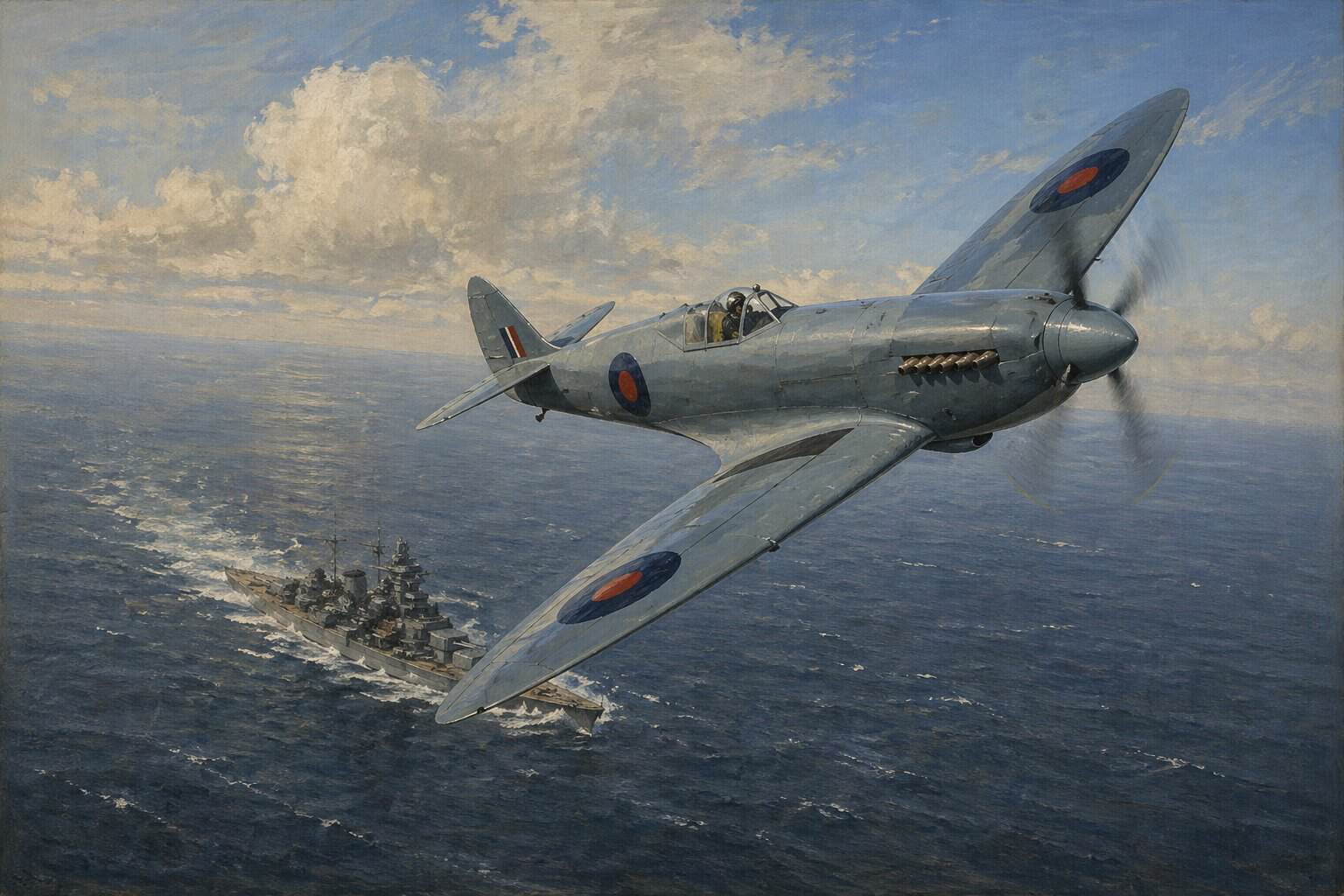
On 21 May 1941, Pilot Officer Michael Suckling flew a photographic reconnaissance Spitfire from RAF Wick to the Norwegian coast and photographed the German battleship Bismarck at anchor in the Grimstadfjord, south of Bergen. The heavy cruiser Prinz Eugen lay separately in Kalvanes Bay, some nine miles to the north-west. British intelligence already held reports that the German force had passed through the Kattegat on 20 May, but Suckling’s photographs confirmed Bismarck’s presence near Bergen and sharpened the Admiralty’s operational picture as the German breakout developed.
Suckling’s sortie was flown by No. 1 Photographic Reconnaissance Unit, which kept a forward detachment at Wick to cover the Norwegian coast and the anchorages German warships used while working up for operations against Atlantic convoys. His photographs reached Coastal Command headquarters within hours and were passed on to the Admiralty, turning a suspected German sortie into a confirmed operational picture.
The Threat Bismarck Posed
Bismarck was the most powerful warship in the German fleet, and her presence in the North Atlantic threatened the convoys that kept Britain supplied with food, fuel and war material. A single successful raid by a ship of her size and armament could inflict losses on a scale no U-boat or surface raider working alone could match, and earlier German sorties had already shown how disruptive a single heavy unit could be once loose among the shipping lanes.
Locating Bismarck before she reached open water gave the Royal Navy a chance to concentrate its forces at the right place and time. Without confirmed intelligence, British commanders would have had to guess at her likely route and spread ships thinly across the Atlantic approaches north and south of Iceland, weakening the response wherever she actually appeared. Reliable reconnaissance turned a defensive guessing game into a plan that could be acted on.
The PRU Spitfire Task
Photographic reconnaissance depended on aircraft built for observation rather than combat. The Supermarine Spitfire variants flown by No. 1 PRU had their guns and armour removed and extra fuel tanks fitted in their place, extending their range at the cost of any means of self-defence. Their protection came from altitude, speed and careful route planning rather than firepower, and their pilots flew alone, deep into hostile airspace, with no escort to call on if they were intercepted.
Wick gave these Spitfires the range they needed to cross the North Sea to Norway and return within a single sortie. Suckling took off on the morning of 21 May and flew a planned route over the fjords near Bergen where German warships were known to shelter, photographing from high altitude before turning for home.
What Suckling Saw in Norway
Flying at around 8,000 metres, Suckling photographed Bismarck at anchor in the Grimstadfjord and identified Prinz Eugen separately in Kalvanes Bay, to the north-west. He landed at Wick and had his film developed and examined before the photographs were confirmed as showing Bismarck and Prinz Eugen.
The sighting placed both ships in Norwegian waters on 21 May, prepared to continue their passage north and then west once conditions allowed. Confirmation that they had actually sailed came from a separate reconnaissance flight the following day. Suckling’s sighting recorded where the ships were on 21 May; the Maryland’s flight on 22 May recorded that they had gone.
Intelligence Into Action
Suckling’s photographs were rushed south to Coastal Command and on to the Admiralty, and Home Fleet units at Scapa Flow were brought to a state of readiness. Poor weather over Bergen delayed a further look at the anchorage, but on 22 May a Fleet Air Arm Martin Maryland flew from RNAS Hatston in Orkney and found the fjord empty. Bismarck and Prinz Eugen had sailed.
The following day, confirmation that the anchorage was empty showed that the German ships were again at sea. Together with the intelligence already accumulated on their movements, the reconnaissance reports helped British commanders refine the search as Home Fleet units moved to intercept the breakout into the Atlantic.
The Chase Begins
The pursuit that followed Suckling’s sighting led to the loss of HMS Hood in the Denmark Strait on 24 May and, six days after the Grimstadfjord photographs were taken, to the sinking of Bismarck on 27 May 1941. Suckling’s photographs provided an important piece of the intelligence picture that guided the Royal Navy’s response as the German force moved towards the Atlantic.
For the RAF, the episode stands as a demonstration of what photographic reconnaissance could achieve on its own terms. An aircraft stripped of weapons, flying alone and relying entirely on height and speed for its survival, supplied an important part of the intelligence picture behind one of the war’s defining naval operations.