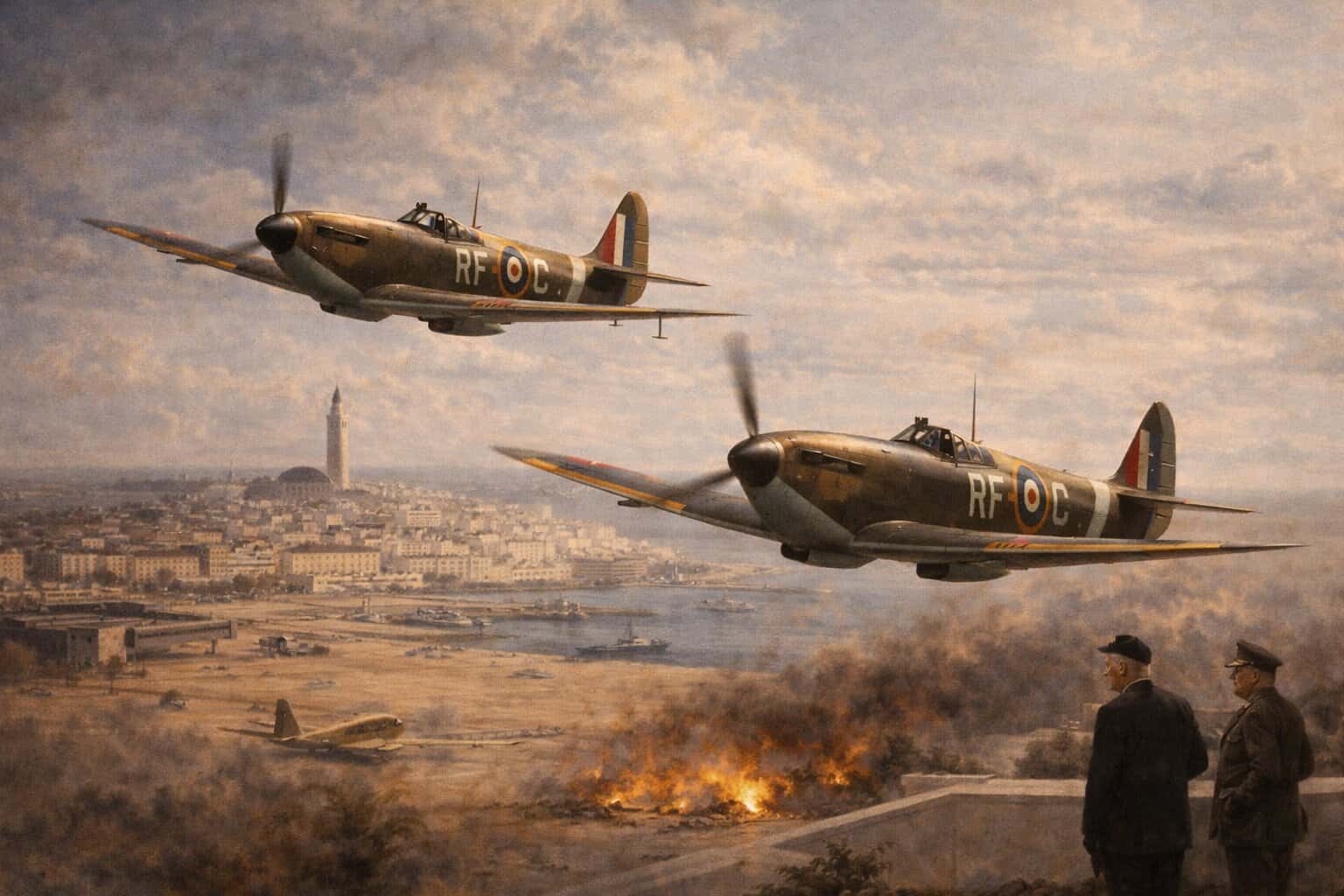
On 18 January 1943, Royal Air Force units were engaged in providing air security and transport support during the Allied conference held at Casablanca in French Morocco. The gathering, attended by Prime Minister Winston Churchill and President Franklin D. Roosevelt, brought together senior British and American leaders to determine strategic direction for the next phase of the war. Ensuring the security of the conference required coordinated military arrangements, including a significant air component.
The conference, which ran from 14 to 24 January 1943, took place only weeks after Allied forces had secured footholds in North Africa during Operation Torch. Although major Axis resistance in Morocco had ended, the wider North African campaign was still ongoing. German and Italian forces remained active in Tunisia, and the possibility of air attack or reconnaissance could not be dismissed.
Strategic Context
By January 1943, Allied air forces in North Africa were expanding rapidly. RAF formations had been redeployed from the Middle East and the United Kingdom to support the advance across the Western Desert and into Tunisia. Airfields in Morocco and Algeria were in various stages of development, providing operational reach across the theatre.
The presence of senior Allied leaders in Casablanca introduced additional security considerations. Safeguarding the conference location and associated transport movements required both defensive and logistical planning. Air cover was considered essential to deter potential Axis reconnaissance or bombing attempts.
Air Security Arrangements
RAF fighter units based in the region contributed to defensive patrols over Casablanca and surrounding areas. These patrols were designed to provide early warning and interception capability should hostile aircraft approach. While no major air attack materialised during the conference period, the presence of regular patrols served both a practical and deterrent function.
In addition to defensive measures, RAF aircraft were involved in transport and liaison duties. Senior military officers and support personnel required movement between command centres across North Africa. Transport aircraft operating within the theatre facilitated these journeys, maintaining communication links between forward headquarters and the conference venue.
Meteorological support and communications also formed part of the RAF contribution. Reliable weather forecasting was vital for both transport flights and defensive patrols, while secure communications ensured coordination between British and American forces.
Operational Environment
The broader operational situation in North Africa remained fluid. Axis air forces based in Tunisia retained the ability to conduct reconnaissance and limited strike missions. Allied air superiority was improving but not yet absolute. As a result, precautionary measures around Casablanca reflected realistic assessments of the threat environment.
The RAF’s involvement in conference security occurred alongside ongoing offensive operations elsewhere in the theatre. Aircraft were simultaneously engaged in supporting ground forces in Tunisia, attacking supply lines, and contesting airspace against German and Italian units. The ability to allocate assets to both frontline operations and strategic security tasks demonstrated the growing strength of Allied air power in early 1943.
Significance in the Wider Air War
The Casablanca Conference is remembered primarily for its political and strategic decisions, including the declaration of a policy of “unconditional surrender” towards the Axis powers. However, the successful and secure conduct of the conference depended in part on effective military protection, including air defence.
The RAF’s participation illustrates the multifaceted role of air forces during the Second World War. Beyond bombing and air combat, air units were essential in providing security, mobility, and coordination for high-level command activities. Such tasks, though less visible than frontline engagements, were integral to the functioning of coalition warfare.
The events of 18 January 1943 highlight how air power underpinned strategic decision-making. By ensuring that Allied leaders could meet securely in an active theatre of war, RAF units contributed indirectly to the formulation of plans that would shape subsequent campaigns in Europe and the Mediterranean.
In the broader narrative of the air war, the Casablanca security arrangements demonstrate the increasing maturity of Allied air organisation by early 1943. Air superiority was becoming not only a battlefield objective but also a prerequisite for strategic coordination at the highest level.