On This Day, 1944: On 27 November 1944, the RAF Fauld explosion devastated an underground bomb store and nearby workplaces, killing about…
Read the entry →Boeing E-7 Wedgetail
Boeing Defense, Space & Security
The Boeing E-7 Wedgetail AEW1 is set to restore RAF airborne early warning from RAF Lossiemouth, replacing the E-3D Sentry with modern battle management.
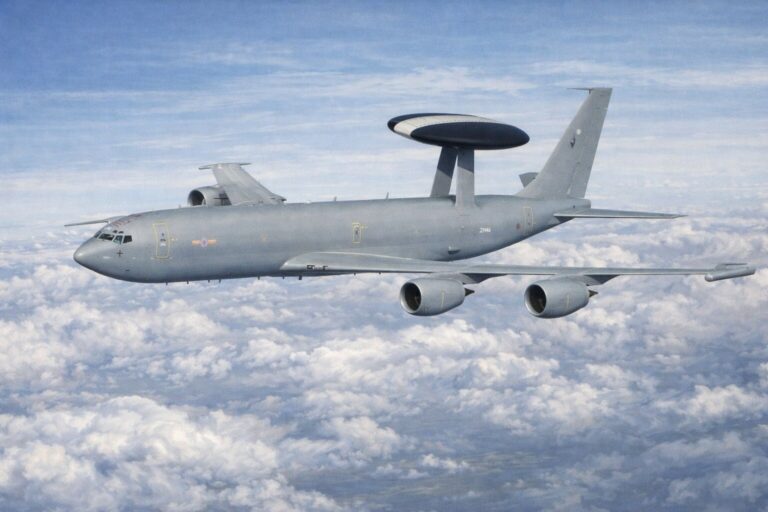
The Boeing E-7 Wedgetail AEW Mk1 is the Royal Air Force’s next-generation airborne early warning and control aircraft. Developed from the Boeing 737-700 Next Generation airliner, it combines long-range radar surveillance with an airborne battle-management system capable of directing friendly aircraft and sharing a recognised picture of activity across a wide area. The RAF selected Wedgetail to succeed the E-3D Sentry, which retired in 2021. Its planned operating base is RAF Lossiemouth, with No. VIII Squadron responsible for the airborne early warning mission.
Why does the RAF need the E-7 Wedgetail?
The RAF chose the Wedgetail in 2019 to replace its E-3D Sentry fleet, which retired in 2021 and left Britain without its own airborne early warning aircraft. Flying high above the battle, the E-7’s radar sees far beyond the horizon of ground-based sensors and lets its crew direct fighters, ships and other forces.
Wedgetail was developed initially for the Royal Australian Air Force, which introduced the E-7A as a modern alternative to older airborne warning aircraft. Its operational use by Australia, followed by adoption by other air forces, demonstrated the appeal of a commercial airframe fitted with a specialised surveillance and command system. The UK selected the type in 2019, seeking to modernise a capability previously provided by the Boeing E-3D Sentry.
Airborne early warning is important because radar aircraft can look beyond the limitations imposed by the curvature of the Earth and terrain on ground-based sensors. Operating at altitude, Wedgetail can detect and track aircraft at considerable distances, monitor maritime activity and provide commanders with an overview of a rapidly changing situation. Its crew can coordinate fighter patrols, support air defence and help integrate aircraft and ships during joint operations.
The withdrawal of the E-3D fleet in 2021 created a gap in the UK’s own fixed-wing airborne early warning capability. Allied systems could contribute to NATO operations, but they were not equivalent to a sovereign RAF fleet available for national tasking. Wedgetail’s introduction is therefore a question of both modernisation and restoration.
Airframe and Performance
The E-7 is based on the Boeing 737-700 airframe, adapted to carry a large dorsal radar array and specialist mission equipment. Two CFM56-7 turbofan engines, each rated at approximately 27,300 pounds of thrust, power the aircraft. Published RAF dimensions are a wingspan of 35.80 metres, length of 33.60 metres and height of 12.50 metres. The RAF quotes a maximum speed of approximately 460 knots and an operating ceiling of about 41,000 feet.
A typical crew comprises two pilots and ten mission specialists, although crewing can vary according to task and training requirements. The mission crew operates radar, communications and tactical systems, interprets the developing picture and helps direct friendly forces. The aircraft’s value lies in the endurance and reach of its surveillance and command functions rather than speed or offensive weapons.
What makes the Wedgetail’s MESA radar different?
The Northrop Grumman MESA radar sits in a fixed ‘top hat’ above the fuselage and steers its beams electronically instead of rotating like the E-3’s radome. That lets the crew concentrate on a chosen sector while keeping 360-degree coverage, and the picture is shared with fighters, ships and command centres over Link 16.
Wedgetail’s most distinctive feature is the Northrop Grumman Multi-role Electronically Scanned Array, or MESA, radar mounted above the fuselage in a fixed structure often called the top hat. Unlike the mechanically rotating radome of the E-3 Sentry, the E-7’s electronically steered radar can adjust its scanning patterns without rotating the entire antenna. The system provides coverage around the aircraft, allowing the crew to concentrate attention where required while maintaining broader surveillance.
Radar information is combined with electronic support measures, identification systems and data received from other platforms. Secure communications and tactical data links, including Link 16, help distribute the air picture to fighters, ships and command centres. The mission crew can monitor multiple tracks, identify threats, allocate tasks and guide aircraft towards interceptions or other objectives.
This is why the E-7 is properly described as an airborne early warning and control aircraft. Detection is only the first stage. The ability to interpret information, coordinate responses and connect different forces can be decisive during complex air operations. The system’s effectiveness also depends on trained personnel, communications security and integration with wider NATO and UK command networks.
How many E-7 Wedgetails does the RAF have?
The UK ordered five Wedgetails in 2019 but cut the order to three in 2021, converted from Boeing 737s by STS Aviation Services in Birmingham. The three aircraft, WT001 to WT003, are being delivered to No. 8 Squadron at RAF Lossiemouth.
The United Kingdom initially planned to acquire five Wedgetails under the agreement announced in 2019. In 2021 the intended fleet was reduced to three aircraft. That decision reduced the number of airframes available to sustain operations, training and maintenance simultaneously, and prompted criticism about resilience and value for money.
A small fleet can deliver a highly capable system, but aircraft availability becomes especially important when one airframe is undergoing maintenance and another is committed to training or testing. A three-aircraft force offers less flexibility for continuous coverage or simultaneous tasks than a larger fleet. The eventual effectiveness of the programme will depend on serviceability, trained crews, support arrangements and the pace at which the aircraft become operationally available.
Conversion work has been undertaken by STS Aviation Services at Birmingham, with the mission equipment and specialist modifications integrated into former commercial Boeing 737 aircraft. The programme also required new support and training facilities at RAF Lossiemouth, underlining that acquiring the aircraft is only one part of establishing the capability.
When does the E-7 Wedgetail enter RAF service?
The first RAF Wedgetail flew on 20 September 2024 and reached RAF Lossiemouth on 21 May 2026, and a second aircraft followed it there in October 2026. Both were still in test and evaluation in November 2026, with no Initial Operating Capability yet announced.
The first UK Wedgetail flew from Birmingham on 20 September 2024, a significant milestone following the conversion programme’s technical and scheduling difficulties. Testing then continued as aircraft systems, flying characteristics and mission equipment were progressively assessed.
On 21 May 2026 the first aircraft, WT001, arrived at RAF Lossiemouth for further testing and evaluation. Its arrival established an important physical presence at the intended RAF base, but did not by itself constitute operational service entry. In June 2026 WT001 was undergoing test activity, WT002 was approaching its own testing phase and WT003 remained in conversion. By August 2026 WT002 had appeared in full RAF livery, another visible sign of programme progress. In October 2026 WT002 flew into RAF Lossiemouth to join No. VIII Squadron.
These milestones must be distinguished from formal declarations of Initial Operating Capability or full operational capability. Delivery, flight testing, crew training and operational readiness are separate stages. As of the confirmed developments covered here, the programme was advancing through testing and introduction rather than operating as a fully declared RAF airborne warning fleet.
Delays and Challenges
The Wedgetail programme has experienced delays and additional complexity during the conversion and testing process. Parliamentary scrutiny identified equipment redesign, recertification requirements, supply-chain disruption and contractor performance among the contributing factors. These difficulties matter because the RAF’s previous E-3D fleet had already retired, leaving a prolonged period without its own replacement aircraft in operational service.
The programme illustrates the challenges of integrating advanced military systems into a commercial-derived aircraft. Radar, mission consoles, power supply, cooling, communications and flight certification must function together, while training and maintenance arrangements need to be established. Progress in one area does not automatically remove the remaining obstacles to service entry.
No. VIII Squadron and RAF Lossiemouth
No. VIII Squadron, which flew the Avro Shackleton AEW2 and then the E-3D Sentry in the airborne early warning role, is the RAF unit designated to operate Wedgetail. The aircraft will be based at RAF Lossiemouth in Scotland, where the RAF already operates the P-8 Poseidon maritime patrol fleet. This co-location supports surveillance and command capabilities focused on the North Atlantic and northern approaches to the United Kingdom.
New facilities, including the Aden Wing development and supporting training infrastructure, are intended to sustain the fleet and prepare its personnel. Wedgetail’s introduction requires mission specialists as well as pilots, engineers and support teams. Training must develop not only familiarity with the aircraft but the tactical judgement required to control complex air operations alongside RAF, Royal Navy and allied assets.
Historical Significance
Wedgetail represents a significant change in the RAF’s approach to airborne surveillance and battle management. Its electronically scanned radar, networked mission systems and trained controllers are intended to improve how the service detects threats, shares information and coordinates aircraft across large areas. It is a force multiplier rather than a combat aircraft intended to engage targets itself.
The aircraft also illustrates a strategic tension. A sophisticated three-aircraft fleet could restore an important sovereign capability, but its limited size makes sustained availability and operational resilience central concerns. Its long-term importance will depend not simply on the performance of the MESA radar, but on the RAF’s ability to field a trained, supported and operationally ready force.
For now, Wedgetail’s place in RAF history is defined by the transition from the retired Sentry fleet, the challenges of procurement and conversion, and the gradual establishment of a new airborne command capability. An aircraft’s arrival at its base does not by itself mean operational readiness.
| Dimensions | |
| Wingspan | 117 ft 2 in (35.8 m) |
| Length | 110 ft 4 in (33.6 m) |
| Height | 41 ft 2 in (12.5 m) |
| Wing area | 980 sq ft (91 m²) |
| Weights | |
| Empty weight | 102,750 lb (46,606 kg) |
| Max takeoff weight | 171,000 lb (77,600 kg) |
| Performance | |
| Cruise speed | 530 mph (853 km/h) |
| Service ceiling | 41,000 ft (12,500 m) |
| Range | 4,028 miles (6,500 km) |
| Powerplant | |
| Engines | 2 × CFM56-7B27A turbofan engines |
| Power | 27,300 lbf thrust each |
Concorde Undergoes Return-to-Service Tests at RAF Brize Norton
On 18 July 2001, a modified Concorde began RAF Brize Norton trials ahead of the supersonic…
18 July 2026 · 3 minRAF Tornado Sorties from Bruggen in Operation Allied Force
On 4 April 1999, RAF Tornado GR1 crews flew Allied Force missions from Bruggen, striking bridges…
4 April 2026 · 3 minOperation Telic Begins with Major RAF Commitment in Iraq
On 21 March 2003, Operation Telic began with a major RAF commitment, combining precision strike, coalition…
21 March 2026 · 3 min