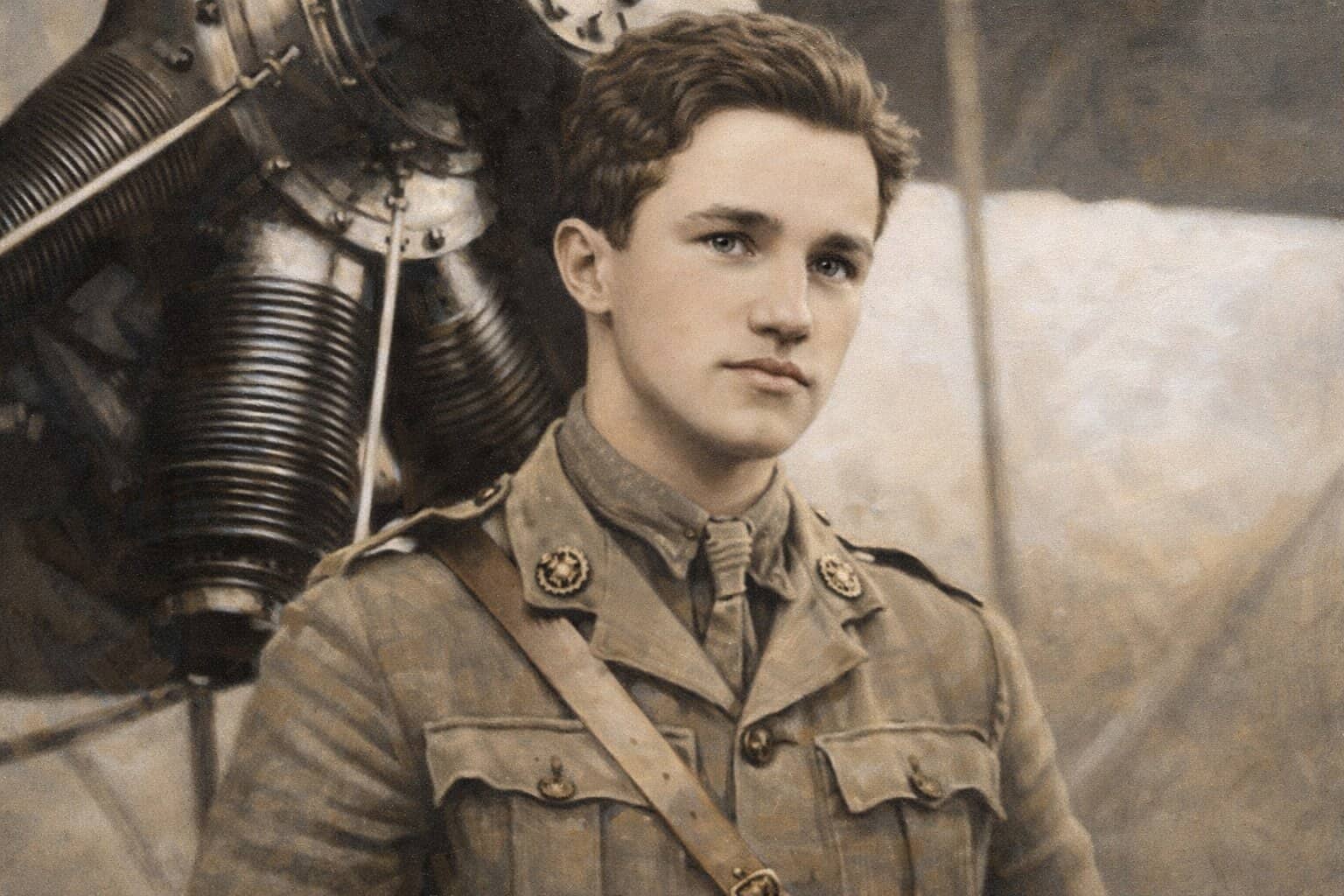
On 7 May 1917, Captain Albert Ball was posted missing after an evening patrol over the Western Front. News of his disappearance quickly spread through Britain and the Royal Flying Corps, for Ball had become one of the best-known British fighter pilots of the war. Later evidence indicated that he had been killed when his aircraft came down after combat with German fighters.
The loss was more than a personal tragedy. Ball had come to represent a particular phase of the air war, when the individual fighter pilot occupied a growing place in public imagination and when air fighting over France was becoming harsher, more organised and more demanding. His disappearance resonated both within the service and far beyond it.
A Leading Fighter Pilot of the Royal Flying Corps
Before his death, Ball had already achieved a reputation out of proportion even to the high standards of the Royal Flying Corps. He was widely celebrated in Britain as a fighting pilot of unusual aggression and determination, and his successes made him one of the most famous British airmen of the First World War.
By the spring of 1917, he had returned to operations at a time when air combat on the Western Front was growing in intensity. British flying units were under heavy strain, and the period is often remembered for severe operational pressure and heavy losses. In that setting, Ball’s presence carried military and symbolic importance alike.
He is closely associated with the Royal Aircraft Factory S.E.5, one of the key British fighters of the period. The type represented an important stage in the development of British fighter capability, combining speed, strength and firepower in a form suited to the changing character of the air war. Ball’s service in such aircraft linked his name to a broader story of technical adaptation and personal skill.
The Circumstances of His Loss
Ball failed to return from patrol on 7 May. Because he disappeared in combat conditions, the exact sequence of events was not fully clear at first, and he was initially recorded as missing. Later evidence suggested that his aircraft had crashed after engagement with German opponents.
That uncertainty was typical of the period. Air fighting over the front often took place in poor visibility, at speed and under confused conditions, while confirmation on the ground could be delayed or incomplete. In many cases, reports were shaped only gradually as information emerged from both sides.
For the Royal Flying Corps, however, the immediate fact was plain enough: one of its most prominent fighter leaders had been lost at a time when experienced pilots were exceptionally difficult to replace.
Significance Beyond One Pilot
Ball’s death mattered because it highlighted the cost of early fighter warfare at its most intense. British military aviation in 1917 still depended heavily on a relatively small number of highly trained pilots, and public attention often focused on outstanding individuals. That gave figures such as Ball enormous visibility, but it also meant that their loss was felt keenly.
His career also belonged to a broader transition in air warfare. The romantic image of the lone ace was already being tested by the realities of massed air operations, improved aircraft design and more systematic tactical methods. Ball remained a symbol of courage and offensive spirit, yet his death also reflected how unforgiving the Western Front had become, even for the most gifted pilots.
A True Loss
The posting of Albert Ball as missing on 7 May 1917 remains one of the defining moments in the history of British military aviation before the creation of the RAF. It marked the loss of a pilot whose fame reached well beyond his own unit, and it illustrated the high human cost of the air fighting that shaped the final years of the First World War.
On this day, Ball’s disappearance stands not simply as the story of a celebrated ace but as a reminder of the perilous conditions in which Britain’s early airmen fought and of the long tradition of sacrifice inherited later by the Royal Air Force.