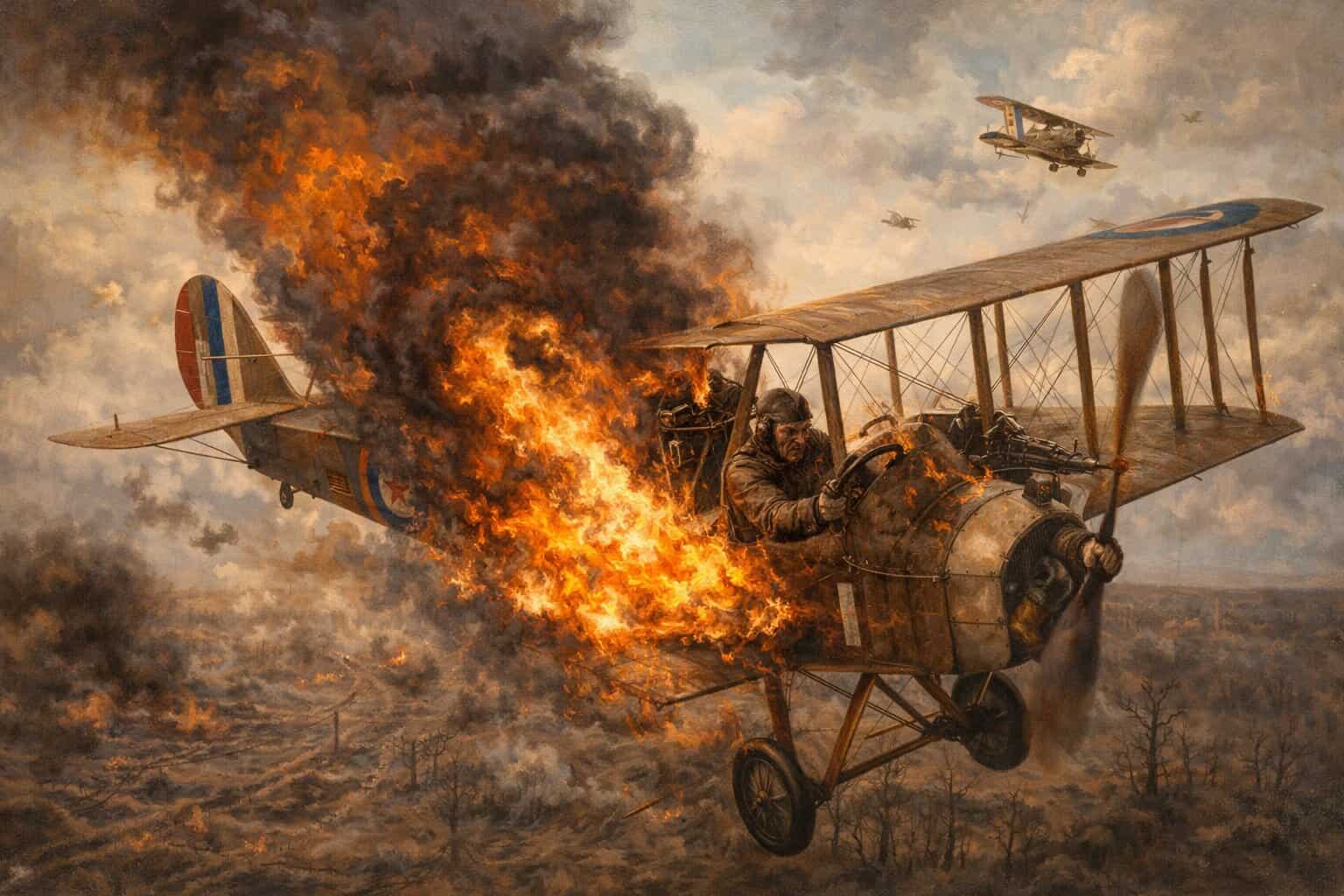
On 7 January 1917, Sergeant Thomas Mottershead of No. 20 Squadron, Royal Flying Corps, brought his burning aircraft back to British lines over the Western Front, saving the life of his observer at the cost of his own. The action, fought at 9,000 feet above the Ploegsteert Wood sector, earned him a posthumous Victoria Cross, the only one awarded to a non-commissioned officer of the Royal Flying Corps during the First World War.
Offensive Patrol over Ploegsteert Wood
No. 20 Squadron was based at Clairmarais, east of St-Omer in northern France. On 7 January, Mottershead flew with his observer, Lieutenant W. E. Gower, on an offensive patrol over the Ploegsteert Wood sector. His usual FE2b was unserviceable, so the two men took up FE2d serial A39 instead, the aircraft in which Mottershead would fly his last sortie.
During the patrol their aircraft was attacked at an altitude of 9,000 feet. The petrol tank was pierced and the FE2d caught fire, leaving Mottershead and Gower in an increasingly desperate position above the Western Front.
Bringing the Burning FE2d Home
With flames spreading around him, Mottershead kept control of the aircraft rather than allowing it to go down inside enemy-held territory. He flew on, enveloped in fire, and succeeded in bringing the machine back across the lines to British-held ground, where he made a landing.
Although Mottershead made a successful landing, the aircraft collapsed on touching the ground and pinned him beneath the wreckage. He was subsequently rescued, while Gower survived. Mottershead had suffered severe burns and was taken for treatment, but his injuries proved fatal.
Mottershead’s Death and Victoria Cross
Mottershead died of his injuries on 12 January 1917, five days after the action over Ploegsteert Wood. The Victoria Cross, the highest award for gallantry available to British and Commonwealth forces, followed afterwards: the official citation was published in the London Gazette on 12 February 1917, more than a month after his death, making the award posthumous.
The citation recorded the essential facts of the action: the aircraft struck and set alight at altitude, Mottershead’s decision to remain at the controls despite being enveloped in flames, and his success in bringing the FE2d back to British lines before it collapsed on landing. The citation recognised Mottershead’s bravery, endurance and skill in bringing the burning aircraft back to British lines, selecting a landing place despite severe burns and saving the life of his observer.
A Unique RFC Victoria Cross
Mottershead’s Victoria Cross occupies a distinctive place in Royal Flying Corps history. The RAF Museum records him as the only non-commissioned officer of the RFC to win the Victoria Cross during the First World War.
It was also his second decoration for gallantry. He had previously received the Distinguished Conduct Medal before joining No. 20 Squadron, adding another chapter to a service career that ended with the action over Ploegsteert Wood.
The official citation focused on his presence of mind, endurance and careful selection of a landing place while suffering severe burns. It stated that his actions undoubtedly saved the life of Lieutenant Gower.
Mottershead is buried in Bailleul Communal Cemetery Extension in Nord, France, where the Commonwealth War Graves Commission records his death of wounds on 12 January 1917. His Victoria Cross remains on record as the only one awarded to a non-commissioned officer of the Royal Flying Corps during the First World War.

