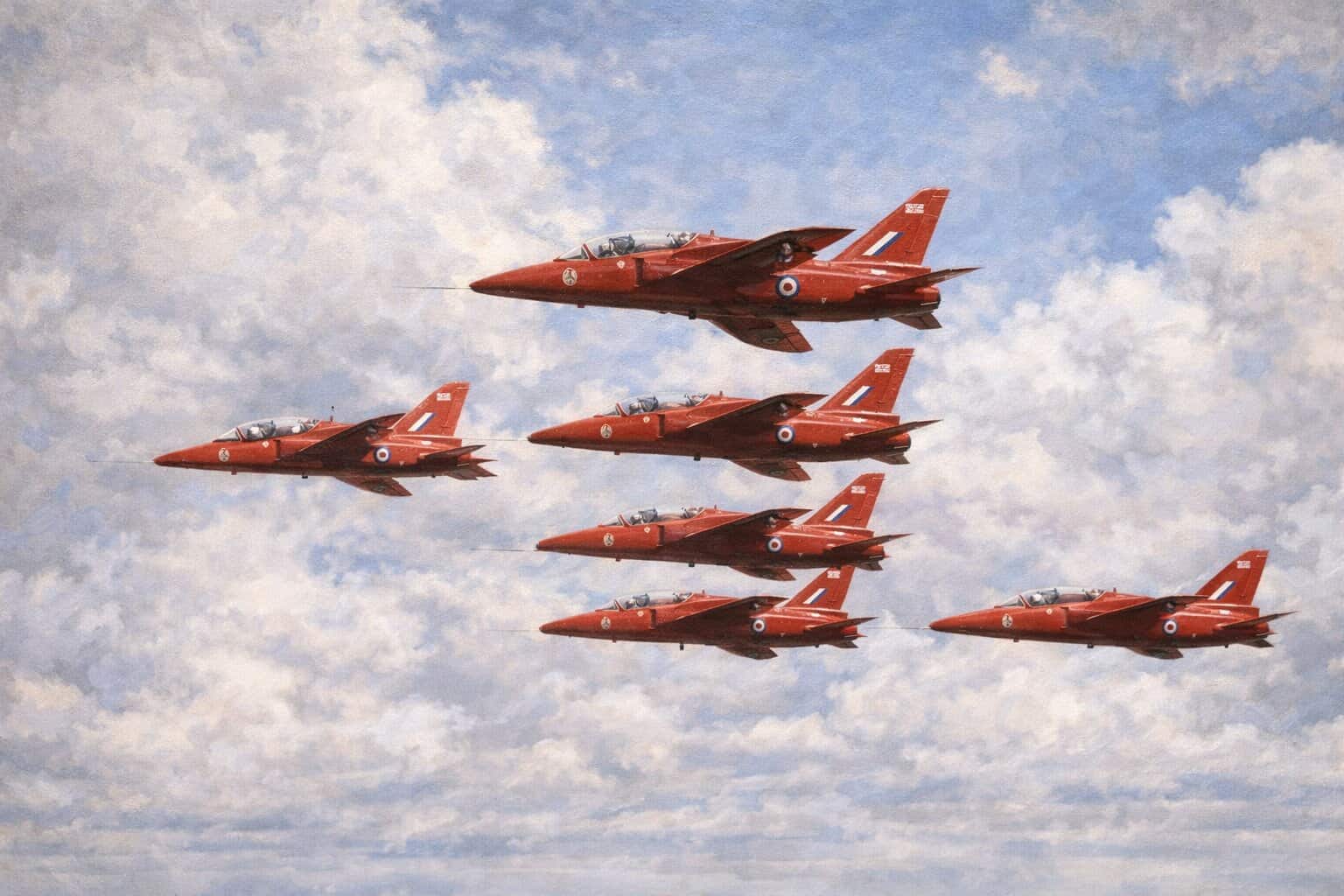
On 6 May 1965, the Red Arrows first official display took place at RAF Little Rissington, marking the public debut of what would become the Royal Air Force’s best-known aerobatic team. The display was flown using seven Folland Gnat T.1 trainers inherited from the earlier Yellowjacks team, and it represented more than a simple change of name. It signalled the formal arrival of a new RAF display unit intended to present precision, discipline, and the service’s public face in the air.
By the mid-1960s, military flying displays were already an established part of how the RAF demonstrated professionalism and modernity to the public at home and abroad. A dedicated team, properly organised and recognisable, offered a clearer identity than the smaller, short-lived formations that had come before. The creation of the Red Arrows gave the RAF a permanent and distinctive aerobatic formation at a time when image, skill, and ceremonial presence all carried real importance.
From Yellowjacks to Red Arrows
The team that appeared at Little Rissington did not emerge without precedent. Its aircraft and much of its immediate experience came from the Yellowjacks, the RAF display team that had already demonstrated the Folland Gnat’s potential as an aerobatic aircraft. The Gnat was small, agile, and visually striking in formation, making it well-suited to close-order manoeuvres and the kind of disciplined flying required of an official display team.
The Red Arrows inherited seven of these aircraft, and with them a flying style that could be developed into something more permanent and more widely recognisable. What changed on 6 May 1965 was that the RAF now presented the team under a new identity with official standing. That distinction mattered because it placed the display team on a firmer footing within the service, allowing it to become part of the RAF’s long-term public and ceremonial presence rather than a passing experiment.
The Importance of the First Official Display
The first official display was significant not because of combat or operational effect, but because it marked the beginning of an institution. RAF display flying has always depended on exact formation work, confidence in aircraft handling, and the ability to present military flying as a controlled spectacle rather than mere entertainment. The Red Arrows’ debut showed that the RAF intended to make that presentation a permanent feature of its public identity.
Little Rissington was therefore the starting point for a team that would become familiar far beyond the station circuit of the 1960s. From this first formal appearance, the Red Arrows began the path towards becoming one of the most recognisable symbols of the modern Royal Air Force. That status was still in the future on 6 May 1965, but the foundations were clearly laid in the combination of inherited experience, suitable aircraft, and official endorsement.
A Lasting RAF Symbol
In retrospect, the day’s importance lies in what followed. The Red Arrows went on to become one of the most visible expressions of RAF skill and discipline, known for precise formation aerobatics and for representing the service at home and overseas. Their later fame, flying the BAE Hawk, can make the first official display seem inevitable, yet it was this moment at RAF Little Rissington that established the team in formal RAF life.
The event stands as a useful reminder that not every important date in RAF history is tied to battle. Some mark the creation of institutions that shape how the service is seen and remembered. The first official display of the Red Arrows belongs in that category: a Cold War moment of presentation and professionalism that began one of the RAF’s most enduring public traditions.