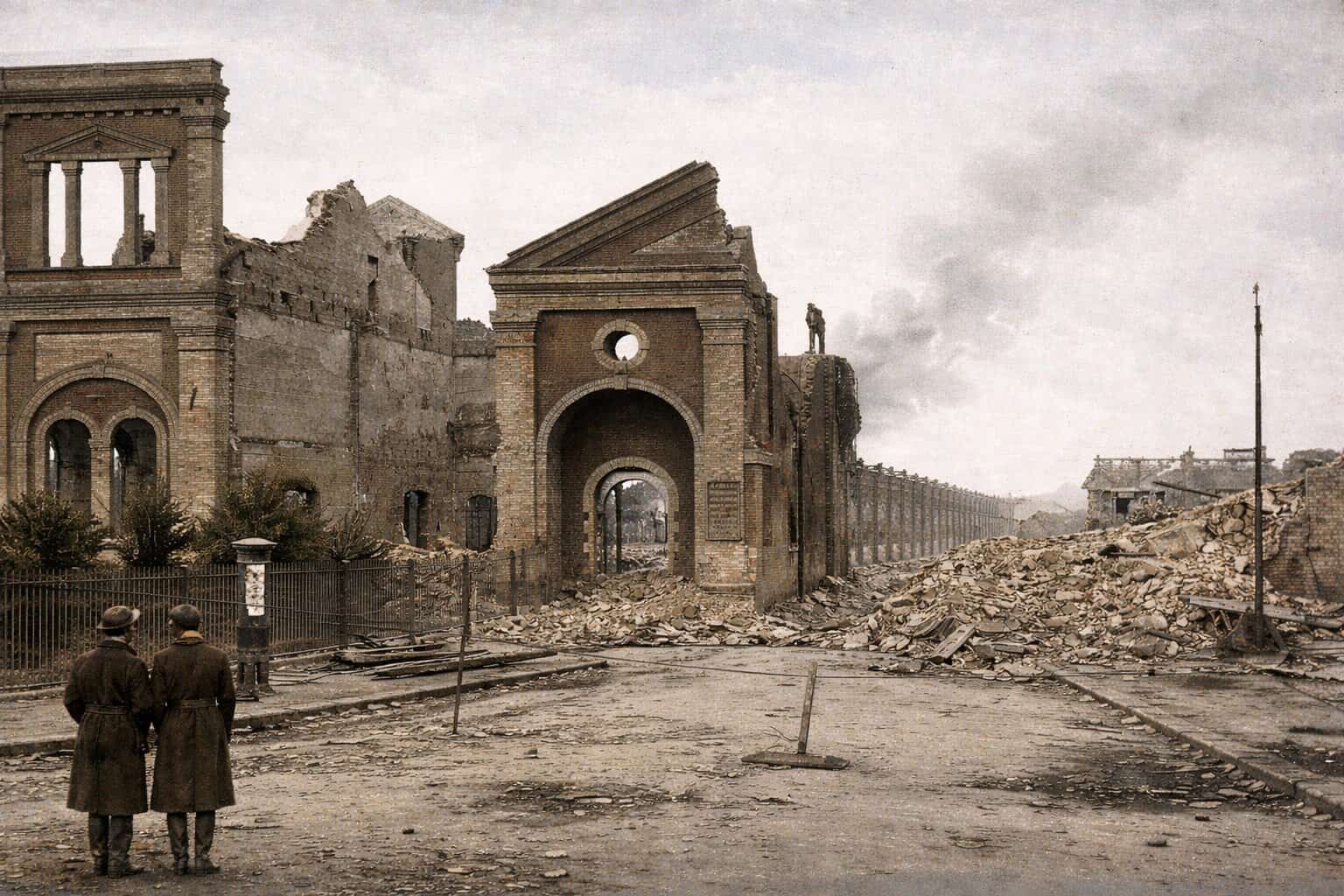
On 27 April 1942, Norwich suffered one of the heaviest attacks of the German reprisal raids against historic English cities. The raid brought widespread destruction, civilian casualties and severe disruption to the life of the city. In local memory, it is remembered not only for the scale of the damage but also for what it revealed about the vulnerability of a provincial centre far from the better-known targets of the main Blitz.
A key part of that damage fell on Norwich City station. Once an important railway terminus and still in use until the 1960s before disappearing from the cityscape, it stands as a reminder that the attack struck transport and communications as well as homes, shops and public buildings. The survival of Norwich Cathedral has often drawn attention in later recollection, but the raid was never simply a story of a famous landmark spared. It was a night in which large parts of the city were hit and ordinary urban life was torn apart.
Norwich and the German reprisal campaign
The attack on Norwich formed part of the German reprisal campaign of 1942, often associated with the so-called Baedeker raids. These operations were directed against cities valued for their history and architecture as well as their practical importance. They were intended to answer British bombing in Germany by demonstrating that English provincial cities could also be struck hard from the air.
That purpose made the raid both military and psychological. Bombing could damage transport links, utilities and local industry, but it also sought to undermine morale by showing that no community was beyond reach. For Norwich, the raid demonstrated that the air war was not confined to London, the great ports or the best-known industrial centres. Historic cities of regional importance remained exposed when German forces were willing to commit aircraft to punitive attacks.
The night of destruction
For those on the ground, the raid was experienced through blast, fire and confusion rather than through the strategic language of reprisal. Streets were shattered, buildings collapsed and rescue work continued amid darkness, smoke and the threat of further attack. The bombing of City Station was especially significant because it showed how quickly an air raid could disrupt the practical workings of a city as well as inflict symbolic damage.
Railway stations were more than landmarks. They were points of movement, supply and communication, linking a city to the wider national war effort. Damage there therefore carried consequences beyond the immediate destruction of buildings. In Norwich, the raid affected the daily functioning of the city at the same time as it imposed the human cost borne by civilians, emergency services and those left homeless or bereaved.
The cathedral’s survival has understandably remained part of the story, but it should not dominate it. What mattered most on the night was the wider pattern of damage across the city and the ordeal endured by its people. Norwich was neither an incidental target nor a decorative afterthought in the wider air war. It was a living city struck with great force.
Why the raid matters in RAF history
The Norwich raid belongs in RAF history because the story of air power is also the story of what Britain’s air defences existed to protect. Fighter interception, anti-aircraft fire, warning systems and civil defence measures could reduce the effect of attack, but they could not guarantee immunity. Some raiders would still break through, and when they did, civilians on the ground bore the burden.
Remembering Norwich also broadens the picture of the home front. The air war over Britain was not defined only by the Battle of Britain or by the long main phase of the Blitz. Later reprisal raids still exposed the continuing reach of German air attack and the continuing necessity of endurance. Norwich recovered, but the bombing left permanent marks on the city’s fabric and memory.