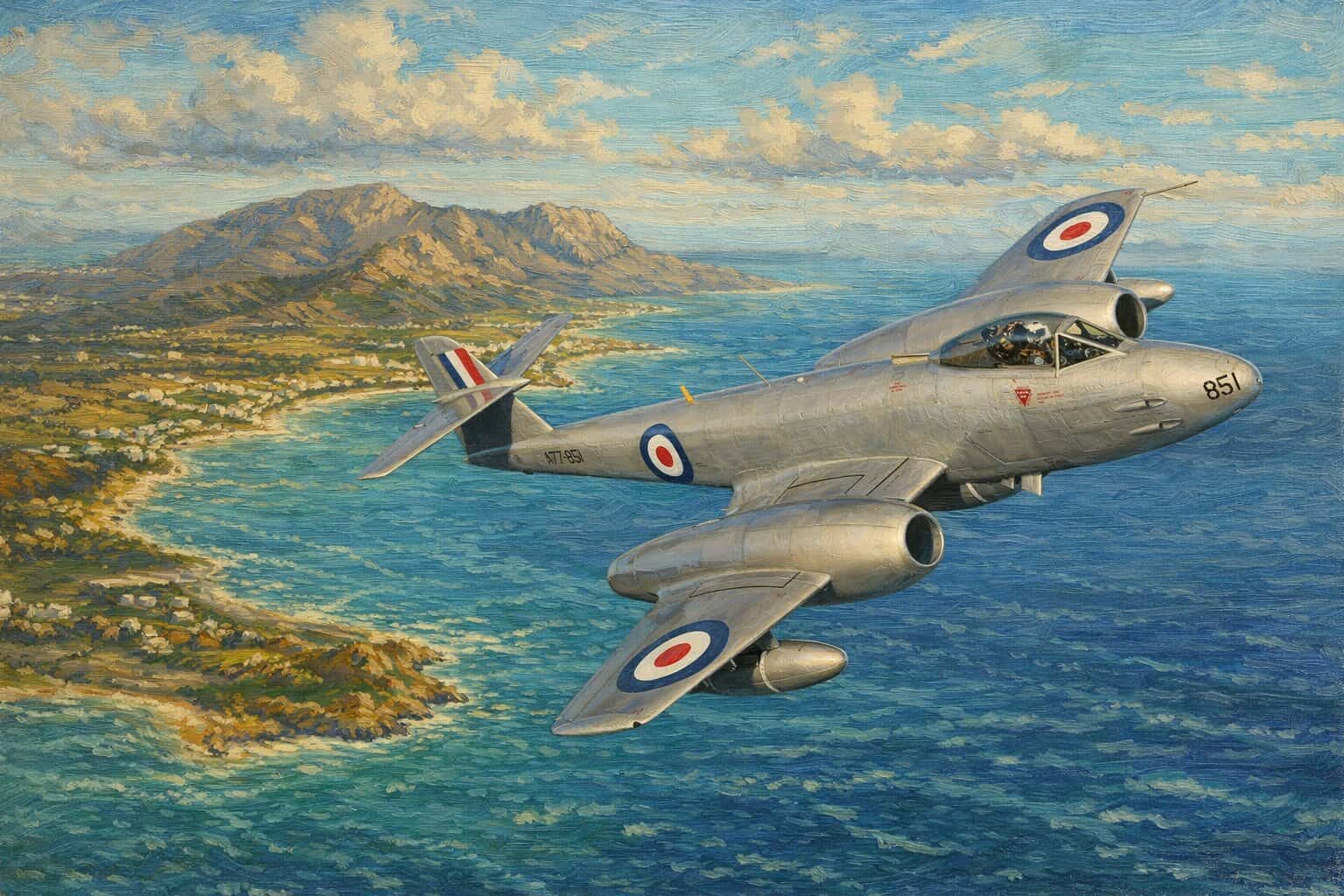
On 28 February 1955, Air Vice Marshal J. R. Whitley flew an English Electric Canberra from RAF Scampton to Nicosia in Cyprus, completing the roughly 2,000-mile journey in 4 hours and 13 minutes at an average speed of about 484 mph. For the RAF, the flight was more than a headline-making run. It was a public demonstration of the Canberra’s reach and pace at a time when Britain was presenting jet air power as a serious instrument of policy in the early Cold War.
The Setting
By the mid-1950s, the English Electric Canberra had already established itself as one of Britain’s most important post-war aircraft. It represented a decisive step beyond piston-engined bombers, combining altitude, speed, and range in a way that suited the strategic demands of the new age. Record flights and demonstration runs helped prove those qualities in practical terms. They were not merely stunts for the press. They showed what the aircraft could achieve over distance and how quickly RAF air power might be brought to bear.
The Scampton-to-Nicosia flight came at a particularly sensitive moment. Cyprus was growing in importance for Britain’s military position in the eastern Mediterranean and Middle East, and tensions on the island were rising sharply in the weeks before the outbreak of the Cyprus Emergency in April 1955. Against that background, a rapid jet flight from Lincolnshire to Cyprus carried an obvious message about mobility, readiness, and technical confidence.
The Flight to Cyprus
The figures alone explain why the run attracted attention. A journey of around 2,000 miles in just over four hours underlined the Canberra’s exceptional performance for its day. Flying from RAF Scampton to Nicosia, Whitley demonstrated that a modern RAF jet bomber could cover a strategically important route at impressive speed.
That mattered because distance remained one of the central facts of British air policy. Bases, commitments, and alliances stretched across several regions, and the value of an aircraft was measured not only by what it could carry but by how quickly it could reach the point where it might be needed. In that respect, the Canberra was an aircraft suited to the new strategic geography of the post-war RAF.
Why It Mattered
The timing of the flight also adds to its significance. Reports on the same day indicated that RAF Canberras based in Cyprus would take part in Blue Trident One, the year’s first Southern Atlantic Pact exercise, carrying out simulated attacks on Italy and Turkey. That does not make the Scampton run an operational mission in itself. Still, it does place it within a wider pattern of RAF activity in which speed, reach, and overseas deployment were increasingly important.
In that sense, the Cyprus run illustrated a broader truth about the early Cold War RAF. Air power was expected to be visible, responsive, and technically credible. Demonstration flights helped demonstrate that Britain possessed aircraft capable of quickly and effectively connecting home bases with distant theatres. They also reinforced the Canberra’s reputation as one of the RAF’s outstanding aircraft of the period.
Historical Perspective
The Canberra Cyprus run deserves to be remembered for capturing a moment of transition. The RAF was adapting from the experience of the Second World War to the demands of the jet age, and aircraft such as the Canberra stood at the centre of that change. Whitley’s flight to Nicosia was therefore significant not simply as a record but as evidence of a service redefining range, speed, and readiness in Cold War conditions.
On this day, the journey from Scampton to Cyprus offered a concise demonstration of what post-war British air power was becoming: faster, farther-reaching, and increasingly shaped by global commitments rather than purely local defence.