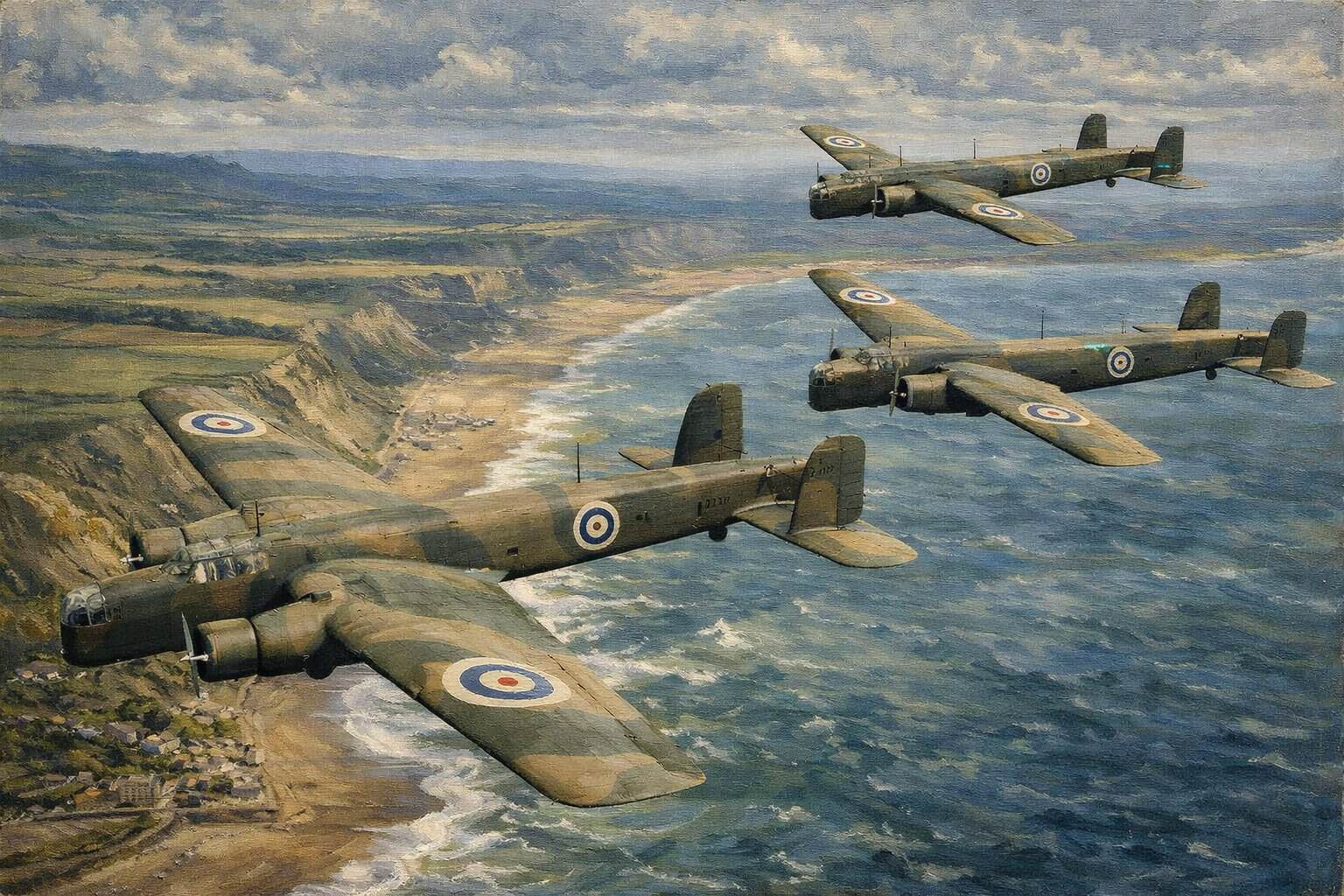
On 27 February 1942, RAF Armstrong Whitworth Whitley aircraft departed, carrying airborne troops and radar specialists for the raid later known as Operation Biting. Their objective was not the destruction of a city or the support of a major land battle, but the seizure of components from a German Würzburg radar installation at Bruneval on the French coast. It was a sharply defined operation in which aircraft, parachute troops and technical experts were brought together for a single purpose: to recover equipment and knowledge that could help Britain understand a growing German advantage in radar defence.
The significance of the operation lay in the target itself. By early 1942, the air war over occupied Europe was becoming increasingly shaped by electronics as well as by aircraft and guns. Radar stations helped direct night fighters and strengthen the German defensive system. Capturing part of such an installation, rather than merely photographing or bombing it, offered the possibility of learning exactly how the enemy’s equipment worked.
The force departs
The Whitleys carrying the raiding force represented the essential opening stage of the operation. Their task was to deliver the airborne element accurately so that the installation could be examined and key components removed before German forces could react in strength. This demanded careful navigation, timing and coordination. Success depended not on scale, but on precision. If the drop was inaccurate or delayed, the entire venture risked collapse.
That combination of air transport, specialist troops and technical intelligence made Operation Biting notable within the wider RAF war effort. It showed how air power could be used not only to strike targets directly, but also to place a small force exactly where it could achieve an outsized result. In this respect, the aircraft were not simply a means of delivery. They were central to making the raid possible at all.
Equipment, prisoners and hard-won results
According to the surviving summary, the force withdrew successfully with vital equipment and prisoners, though not without casualties. That outcome mattered greatly. The recovery of radar components offered British scientists and intelligence staff material evidence rather than conjecture, while prisoners could add further information about the site and its operation. The raid combined tactical daring with practical intelligence value.
Its cost should not be overlooked. Even a limited raid of this sort exposed the men involved to severe danger from the moment of departure to the final withdrawal. The achievement at Bruneval was therefore not simply a technical success, but a reminder of how much depended on disciplined execution under pressure.
A wider air-war importance
Operation Biting deserves notice because it reflected a broader wartime truth: victory in the air depended increasingly on information, detection and scientific understanding as much as on courage in combat. The RAF’s role in the operation formed part of that larger contest. By carrying the raiders to Bruneval and enabling the seizure of the Würzburg material, the service contributed to an operation whose importance extended well beyond the immediate raid.
For The RAF Chronicle, 27 February 1942 stands as a clear example of air power used with intelligence, restraint and purpose. It was a carefully judged operation, modest in size but significant in effect, and it showed that the struggle for control of the air was also a struggle to understand the technology that shaped it.